World Wars: 1914–20XX
Second World War (1939–1945)
Battle of Stalingrad (1942–1943): the city fight that turned the Eastern Front
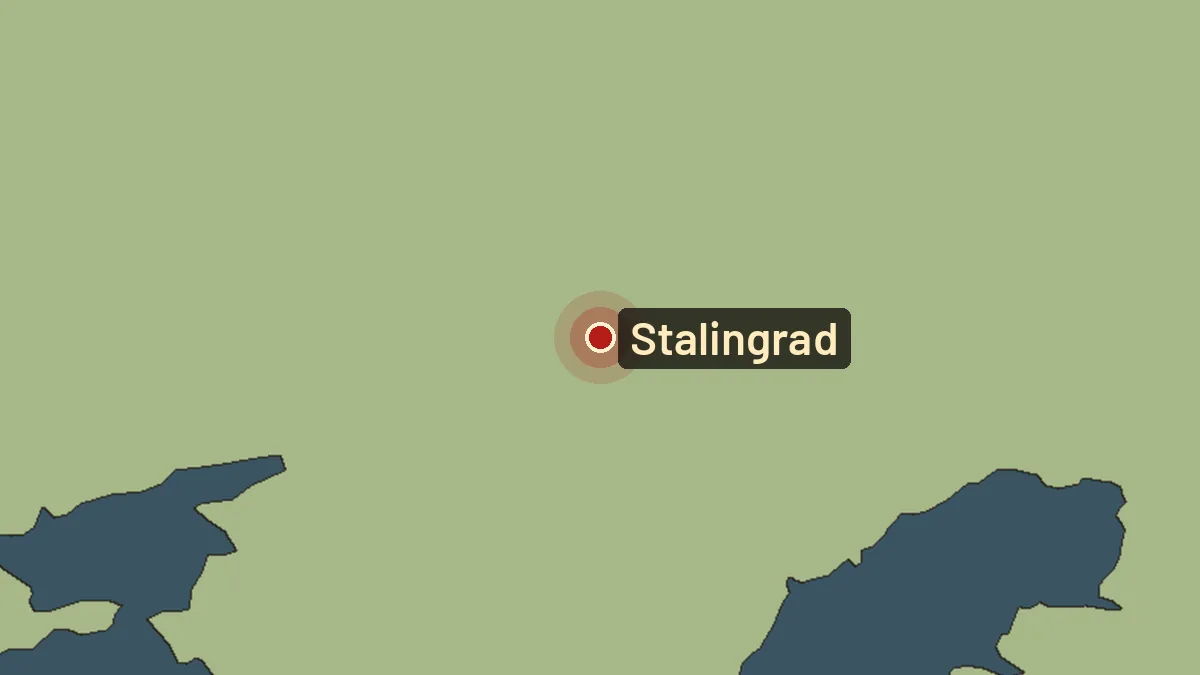
For five months in 1942 and 1943 the Soviet Union and Germany fought over a long industrial city strung along the west bank of the Volga. The struggle began as a German drive to cut a river and protect the flank of an advance on the oil of the Caucasus. It turned into a battle for every street, factory and cellar, and then into a trap: in November the Red Army encircled the German 6th Army, and in February 1943 its survivors surrendered. Stalingrad was the first time an entire German field army was destroyed, and after it the initiative in the east passed to the Soviet side.
Case Blue
The German invasion of the Soviet Union in June 1941 had failed to win the war before winter, and the Red Army had pushed the Germans back from Moscow. For 1942 Hitler aimed south. Operation Blue (Fall Blau), launched on 28 June, sent German armies and their Romanian, Italian and Hungarian allies across the steppe towards the Don and the Volga, while a second force drove for the oil fields of the Caucasus, which Germany badly needed.
Stalingrad, named after Stalin and formerly called Tsaritsyn, was a centre of arms production and river traffic. At first it was meant to be blocked and neutralised rather than taken street by street, but as the summer went on, capturing the city with Stalin's name became an aim in itself for Hitler. Stalin, for his part, had issued Order No. 227 on 28 July, known by its refrain "Not one step back", which threatened harsh punishment for unauthorised retreat.
The city battle
On 23 August General Friedrich Paulus's 6th Army reached the Volga north of the city, and the Luftwaffe launched massive air raids that set much of Stalingrad on fire and killed many thousands of civilians. Through September German troops fought their way into the centre. The Soviet 62nd Army, commanded from mid-September by General Vasily Chuikov, was pushed back into a narrow strip along the river, sometimes only a few hundred metres deep, and kept alive by boats ferrying men and ammunition across the Volga at night under fire.
Chuikov told his troops to stay as close as possible to the enemy, so German aircraft and artillery could not strike without hitting their own men. The fighting broke down into small, savage actions in ruins, sewers and factory halls: the grain elevator, the Mamayev Kurgan hill, the Tractor Factory, the Barrikady gun works and the Red October steelworks. German soldiers called it the Rattenkrieg, the "rats' war". A four-storey apartment block held by a small Soviet group under Sergeant Yakov Pavlov became famous as "Pavlov's House". By November the Germans held most of the city, but the Soviets still clung to the river bank.
Operation Uranus
While the city fight drew in German strength, the Soviet high command, with Georgy Zhukov and Aleksandr Vasilevsky leading the planning, prepared a counterstroke. The long German flanks along the Don and in the steppe south of the city were held mainly by Romanian armies, short of anti-tank guns and spread thin.
On 19 November 1942, in fog and snow, Soviet forces broke through the Romanian Third Army northwest of Stalingrad; the next day a second blow fell south of the city. On 23 November the two pincers met near Kalach on the Don. Roughly 250,000 to 300,000 German and allied soldiers were trapped in the pocket, which the Germans called the Kessel, the "cauldron".
Hitler forbade a breakout. Hermann Göring promised that the Luftwaffe could supply the army from the air, but the deliveries never came close to what was needed, and the men inside began to starve and freeze. In December Field Marshal Erich von Manstein's relief attack, Operation Winter Storm, got to within about 50 kilometres of the pocket before it was halted, while a new Soviet offensive smashed the Italian Eighth Army on the middle Don and threatened Manstein's rear.
Surrender
In January 1943 the Red Army attacked the pocket and split it in two. On 30 January Hitler promoted Paulus to field marshal, a hint that he expected him to die rather than surrender, since no German field marshal had ever surrendered. The next day Paulus surrendered in the southern pocket, and the last troops in the north laid down their arms on 2 February.
About 91,000 men went into Soviet captivity. Weakened by hunger, frost and disease, most of them died; only some 5,000 to 6,000 returned to Germany, the last in 1955. Casualty figures for the whole campaign are uncertain, but losses on both sides combined were well over a million, and some estimates go much higher.
Why it mattered
Germany announced three days of national mourning, the first public admission of a major defeat. Germany's allies had lost whole armies, and their faith in a German victory was shaken. Militarily Stalingrad did not end the war in the east; Manstein restored the front in early 1943. But Germany had lost its best chance to reach the Caucasus oil, and after the failure of its summer offensive at Kursk in July 1943 it never regained the initiative. For the Soviet people, and for much of the world, Stalingrad became the symbol of the turning of the tide.
Did you know?
- The city was renamed Volgograd in 1961 during de-Stalinisation. Above it on Mamayev Kurgan stands "The Motherland Calls", a statue about 85 metres tall.
- As Tsaritsyn, the city had already been fought over in 1918 during the Russian Civil War, when Stalin himself was sent there as a Bolshevik commissar.
Stalingrad in World Wars: 1914–20XX
World Wars: 1914–20XX currently covers the First World War; a 1939 scenario is planned, and the Battle of Stalingrad is part of its event database. In that event both Germany and the Soviet Union suffer enormous manpower losses, German morale falls and Soviet morale rises for about six months, and the initiative on the Eastern Front passes to the Soviets.
Many of the armies at Stalingrad belong to states you can already lead in the 1914 game: Germany, Russia, Romania and Italy, with Hungary then still part of Austria-Hungary. In 1914 the same Russian steppe was far behind the front, and in the Parallel Fronts scenario armoured divisions can carry the war across it decades early. Choose your side and see whether your offensive ends on the Volga.
▶ Play now Free in your browser, no download needed.
Further reading: Wikipedia (English)