World Wars: 1914–20XX
Second World War (1939–1945)
Second Battle of El Alamein (1942): Montgomery defeats Rommel in Egypt
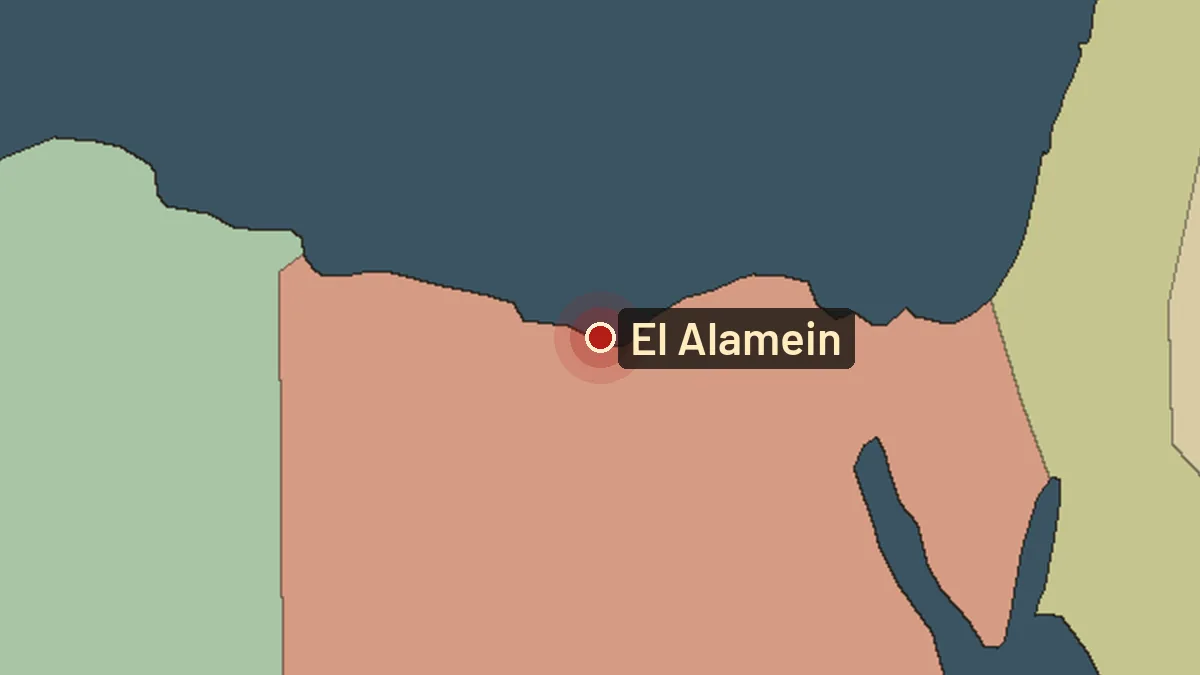
On the night of 23 October 1942 nearly a thousand British guns opened fire at once along a narrow front in the Egyptian desert, some 100 kilometres west of Alexandria. Behind the barrage, infantry and engineers moved into the vast minefields protecting the German-Italian army of Field Marshal Erwin Rommel. Twelve days of grinding battle later, Rommel's army was in full retreat. The Second Battle of El Alamein ended the Axis threat to Egypt and the Suez Canal, and it was the last great victory Britain won largely on its own.
The war in the desert
Since 1940 British and Commonwealth forces had fought Italy, and from early 1941 Rommel's Afrika Korps, back and forth along the coast of Libya and Egypt. The prize was Egypt, with the Suez Canal, the route to India and access to Middle Eastern oil. In mid-1942 Rommel won his greatest victory at Gazala, took the port of Tobruk with more than 30,000 prisoners, and drove deep into Egypt.
He was stopped at El Alamein, a railway halt where the desert front was only about 60 kilometres wide, between the Mediterranean and the impassable Qattara Depression. Neither flank could be turned, so any attacker had to break through head-on. In July 1942, in what became the First Battle of El Alamein, General Claude Auchinleck halted Rommel's advance there.
Montgomery takes command
In August Winston Churchill reorganised the command. General Harold Alexander became commander-in-chief Middle East and Lieutenant General Bernard Montgomery took over the Eighth Army after the officer first chosen, General William Gott, was killed when his aircraft was shot down. Montgomery restored confidence, made it clear there would be no further retreat, and at Alam Halfa at the turn of August and September defeated what proved to be Rommel's last attempt to break through to the Nile.
Then he refused to attack until he was ready, despite pressure from London. By late October the Eighth Army had about 195,000 men and more than 1,000 tanks, including several hundred new American Sherman and Grant tanks, against roughly 116,000 Axis troops with about 550 tanks, around half of them weaker Italian models. The Allies controlled the air, and British codebreakers were reading much of the Axis supply traffic, which helped aircraft and submarines from Malta sink tankers bound for Libya. Rommel's army was short of fuel above all.
Lightfoot and Supercharge
The Axis had laid around half a million mines in deep belts the Germans called the "Devil's Gardens". Montgomery's plan, Operation Lightfoot, was to clear corridors through them in the north with infantry and engineers, then pass the armour through and destroy the enemy in a "crumbling" battle of attrition. To mislead the enemy, an elaborate deception with dummy tanks, guns and even a fake water pipeline suggested the main blow would come in the south.
Rommel was in Germany on sick leave when the battle began. His stand-in, General Georg Stumme, died of a heart attack on the first day under fire, and Rommel flew back on 25 October. The fighting was slow and costly. The corridors were not cleared on schedule, armour jammed in the minefields, and German and Italian units, among them the Italian Folgore parachute division, fought hard. Australian troops in the north pulled Rommel's reserves towards the coast in heavy fighting.
On 2 November Montgomery launched a new thrust, Operation Supercharge, led by New Zealand and British troops. Rommel's tank strength fell to a few dozen German machines. On 3 November Hitler ordered him to stand fast and choose between "victory or death", but on 4 November the line broke and Rommel withdrew, leaving most of the Italian infantry, who lacked transport, to be captured.
After Alamein
The pursuit was slower than critics later thought it should have been, slowed by rain, fuel and caution, and Rommel escaped with the remnants of his army. Yet the strategic result was decisive. On 8 November American and British troops landed in Morocco and Algeria in Operation Torch, and the Axis forces in Africa were caught between two Allied armies. They surrendered in Tunisia in May 1943, with roughly a quarter of a million men taken prisoner.
In Britain church bells rang in celebration. In a speech in London on 10 November Churchill said: "Now this is not the end. It is not even the beginning of the end. But it is, perhaps, the end of the beginning." Later, in his memoirs, he wrote that before Alamein Britain never had a victory and after it never had a defeat, an exaggeration, but one that captured how the battle was felt at the time. El Alamein came only weeks before the Soviet encirclement at Stalingrad, and together they marked the turn of the war.
Did you know?
- Large parts of the battlefield are still contaminated by mines laid in 1942, and they continue to cause casualties among people living in the area.
- In the First World War Egypt was also a British stronghold: in early 1915 an Ottoman army crossed the Sinai and attacked the Suez Canal before being driven back.
El Alamein in World Wars: 1914–20XX
World Wars: 1914–20XX currently covers the First World War; a 1939 scenario is planned, and the Second Battle of El Alamein is part of its event database. In that event Britain takes the initiative on the North African front and its morale rises for several months, while Germany and Italy both suffer heavy manpower losses.
The 1914 map already reaches across North Africa, and you can lead Britain, Germany or Italy, three of the powers that fought in the desert. In the Parallel Fronts scenario, with armoured divisions and bomber wings available from 1914, a war of fuel and tanks in the Western Desert can break out a generation early. Take command and see whether you can hold the canal.
▶ Play now Free in your browser, no download needed.
Further reading: Wikipedia (English)