World Wars: 1914–20XX
Second World War (1939–1945)
Operation Barbarossa (1941): the German invasion of the Soviet Union
Before dawn on 22 June 1941, about three million German soldiers, joined by Romanian and Finnish forces and soon by Hungarian, Italian and Slovak contingents, attacked the Soviet Union along a front of some 1,500 kilometres from the Baltic to the Black Sea. It was the largest land invasion in history. Within weeks the Germans had destroyed whole Soviet armies and taken millions of prisoners. Yet by December their exhausted troops stood frozen before Moscow, and the war in the east had become the long struggle that would decide the Second World War in Europe.
A war of conquest and annihilation
Hitler had written in the 1920s that Germany's future "living space" lay in the east, at the expense of Russia. The Nazi-Soviet pact of 1939 was a temporary convenience. After France fell and Britain refused to make peace, Hitler concluded that defeating the Soviet Union would deprive Britain of its last hope on the continent and give Germany the grain, oil and land it wanted. On 18 December 1940 he signed Directive No. 21, Operation Barbarossa, named after the medieval emperor Frederick Barbarossa. The goal was to destroy the Red Army in western Russia and reach a line from Archangel to the Volga, all before winter.
From the start it was planned as a war of annihilation. The "Commissar Order" instructed troops to shoot captured Soviet political officers, and SS mobile killing units, the Einsatzgruppen, followed the army to murder Jews, communists and others. Planners accepted that millions of Soviet civilians would starve when food was diverted to Germany.
Stalin received many warnings, from his own spies, from Britain and from German deserters, but he dismissed most of them as provocations and hoped to avoid war until at least 1942. The Red Army was large, with more tanks and aircraft than the Germans, but it was in the middle of reorganisation, much of its equipment was outdated, and its officer corps had been devastated by Stalin's purges of 1937–1938.
The summer of encirclements
The Germans attacked in three army groups. Army Group North under Wilhelm von Leeb drove through the Baltic states towards Leningrad. Army Group Centre under Fedor von Bock, with two of the four panzer groups, struck towards Minsk, Smolensk and Moscow. Army Group South under Gerd von Rundstedt advanced into Ukraine towards Kiev.
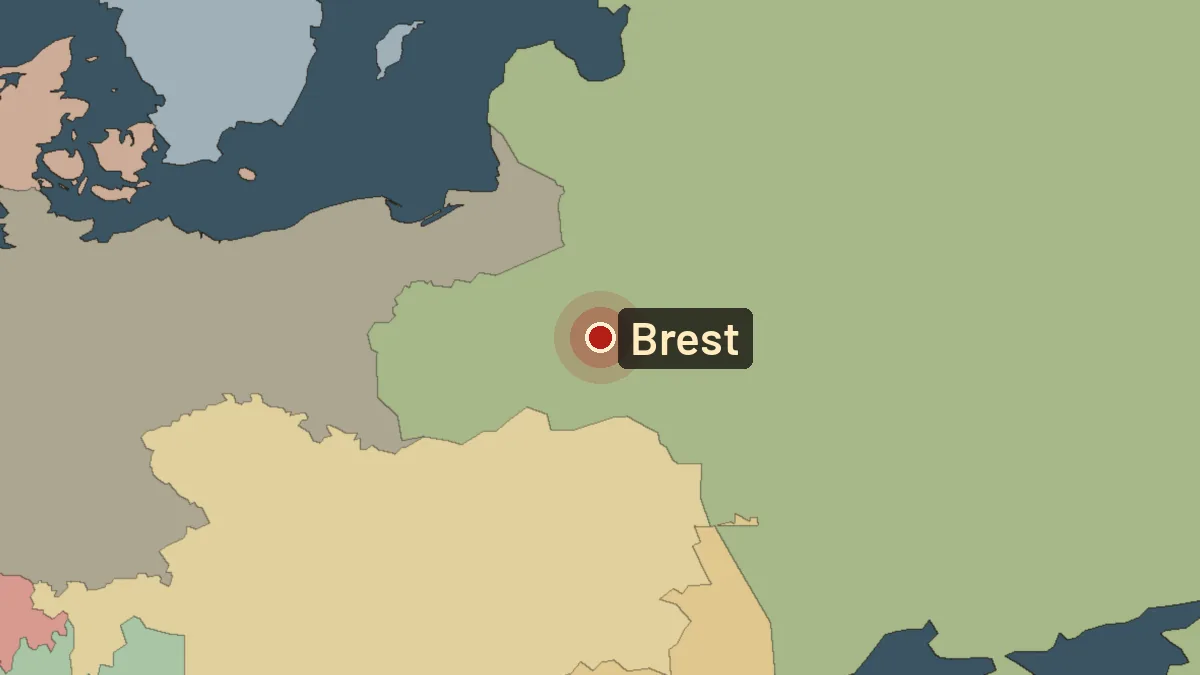
The first days were a catastrophe for the Soviet Union. More than a thousand Soviet aircraft were destroyed on the first day, most of them on the ground. The fortress of Brest on the border held out for weeks in isolated pockets, but around Białystok and Minsk the panzers closed a vast pocket by the end of June, capturing some 300,000 men. Stalin did not speak to the nation until 3 July, when he called for a "patriotic war" and a scorched-earth policy.
The battle of Smolensk in July and August cost the Germans time and heavy losses. Hitler then turned Guderian's panzer group south instead of towards Moscow, and in September the Germans encircled the Soviet armies defending Kiev. More than 600,000 Soviet soldiers were captured, the largest encirclement in history. In the north, German and Finnish forces cut off Leningrad by early September, beginning a siege of almost 900 days in which hundreds of thousands of civilians died, most of them of starvation.
Typhoon and the battle for Moscow
At the end of September the Germans launched Operation Typhoon, the drive on Moscow. Two more giant pockets at Vyazma and Bryansk in October yielded hundreds of thousands more prisoners, and panic briefly gripped the capital. But then the autumn rains turned roads into rivers of mud, and supply lines stretched over hundreds of kilometres of poor roads and railways of a different gauge. When the ground froze in November the advance resumed, and some German units came within about 30 kilometres of the Kremlin.
Meanwhile the Soviet Union mobilised on a scale the Germans had not imagined. More than 1,500 factories were dismantled and moved east to the Urals, Siberia and Central Asia, and new armies were raised. Learning from his spy Richard Sorge that Japan intended to strike south rather than attack the Soviet Union, Stalin could bring more reinforcements from the Far East. On 5 December, in temperatures far below zero, General Georgy Zhukov launched a counter-offensive that drove the Germans back from Moscow.
Barbarossa had failed. The Soviet Union had lost enormous territory, population and industry, and some three million soldiers had been captured, most of whom would die in German captivity. But the Red Army survived, and Germany now faced a long war on two fronts, the outcome its leaders had always feared. Within days, the attack on Pearl Harbor and Germany's declaration of war on the United States turned the conflict into a true world war.
Did you know?
- Behind the front, the killing of Jews began on a massive scale. At Babi Yar near Kiev, German units and their auxiliaries shot more than 33,000 Jews in two days at the end of September 1941.
- Napoleon had crossed into Russia on 24 June 1812, almost exactly 129 years earlier. The comparison was not lost on contemporaries.
Operation Barbarossa in World Wars: 1914–20XX
World Wars: 1914–20XX currently covers the First World War; a 1939 scenario is planned, and Operation Barbarossa is already part of the game's event database for it. There it is designed so that Germany declares war on the Soviet Union, which joins the Allies, an Eastern Front opens, German forces get a large breakthrough bonus for about 90 days, and Soviet industry is relocated to the Urals.
The Eastern Front is already one of the great theatres of the game you can play today. In 1914 the German and Austro-Hungarian armies face Russia from East Prussia to Galicia, and in 1918 the Treaty of Brest-Litovsk briefly gave Germany control of much of the ground it would invade again in 1941. In the Parallel Fronts scenario, armoured divisions and bomber wings can race across those plains in 1914. Lead Germany or Russia and decide the war in the east your own way.
▶ Play now Free in your browser, no download needed.
Further reading: Wikipedia (English)