World Wars: 1914–20XX
First World War (1914–1918)
Treaty of Versailles (1919): the peace that ended the First World War
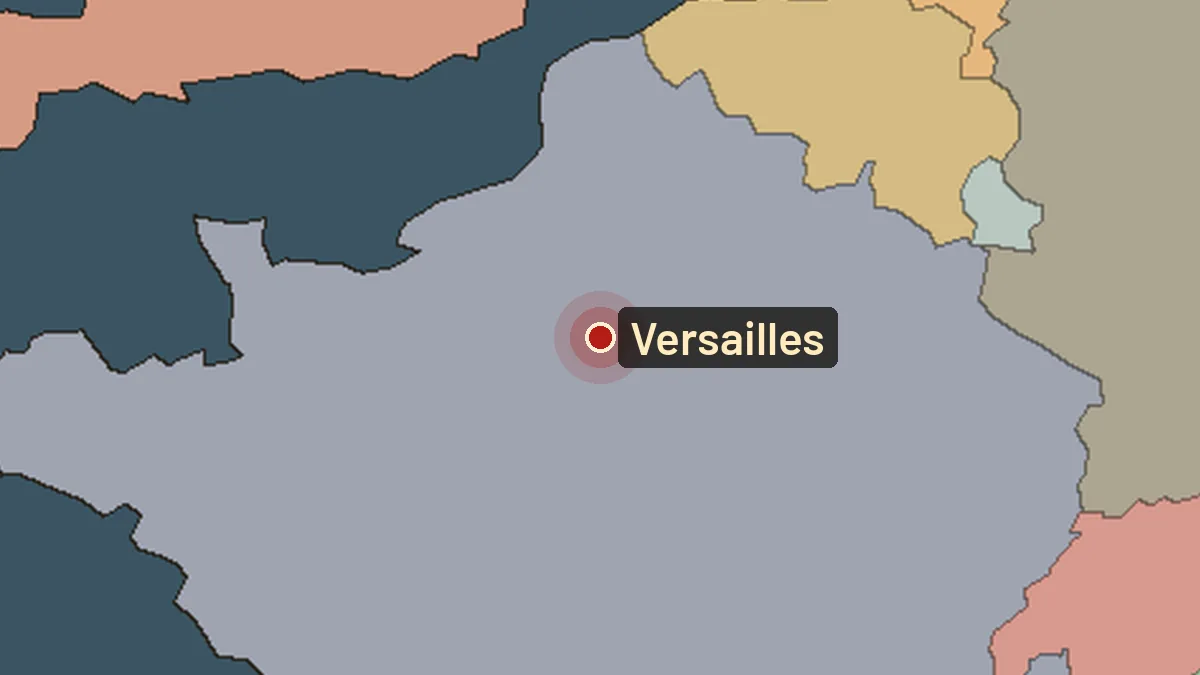
On 28 June 1919, exactly five years after the shots at Sarajevo, two German ministers walked into the Hall of Mirrors at Versailles and signed a peace treaty they had not been allowed to negotiate. The Treaty of Versailles formally ended the First World War between Germany and the Allies. It redrew the map of Europe, disarmed the German army and made Germany liable for war damages. Almost from the day it was signed, people argued about whether it was too harsh, too weak, or both at once.
From armistice to peace conference
The fighting on the Western Front stopped with the armistice of 11 November 1918, but an armistice is only a ceasefire. The war itself still had to be ended by treaty. The Paris Peace Conference opened on 18 January 1919. The real decisions, however, were made by a small group soon called the "Big Four": the French prime minister Georges Clemenceau, the British prime minister David Lloyd George, the American president Woodrow Wilson and the Italian prime minister Vittorio Emanuele Orlando.
The three men wanted different things. France had lost well over a million soldiers and had seen its industrial north-east devastated; Clemenceau wanted security against a future German attack and payment for the damage. Lloyd George had just won an election in which many voters demanded that Germany pay, yet he also feared that a crushed Germany would turn to revolution and hurt British trade. Wilson came with his Fourteen Points and his plan for a League of Nations, and hoped for a peace based on national self-determination rather than revenge.
Germany and its allies were not invited to the talks. The German delegation received the finished draft on 7 May 1919 and was given only a short time to reply in writing. Its objections brought a few changes, such as a plebiscite in Upper Silesia, but the core of the treaty stayed. Faced with the threat of renewed war and the continuing naval blockade, the National Assembly in Weimar voted to accept, and Foreign Minister Hermann Müller and Transport Minister Johannes Bell signed on 28 June.
What the treaty said
The territorial clauses were the most visible. Alsace-Lorraine, taken by Germany in 1871, returned to France. Most of the provinces of Posen and West Prussia went to the new Polish state, creating the "Polish Corridor" to the Baltic that separated East Prussia from the rest of Germany. Danzig became a Free City under the League of Nations. Small areas went to Belgium (Eupen-Malmedy), and after a plebiscite northern Schleswig went to Denmark. The coal-rich Saar was placed under League administration for fifteen years, with its mines given to France. All German colonies in Africa and the Pacific were handed to the victors as League mandates. In total Germany lost around 13 percent of its European territory and about a tenth of its population.
The military clauses were designed to make another German offensive impossible. The army was limited to 100,000 volunteers, conscription was banned and the General Staff abolished. Germany could have no tanks, no military aircraft and no submarines, and its navy was reduced to a handful of old ships. The Rhineland was to be occupied by Allied troops for up to fifteen years and permanently demilitarised, together with a strip on the east bank of the Rhine.
Then came the money. Article 231 stated that Germany and its allies were responsible for causing all the loss and damage suffered by the Allies in the war imposed on them by German aggression. It was written mainly as a legal basis for reparations, but in Germany it was read as a moral verdict and became known as the "war guilt clause". The treaty did not fix a final sum; in 1921 a commission set it at 132 billion gold marks, although much of that amount was never expected to be paid in full.
A peace that pleased no one
Germans of almost every political camp called the treaty a "Diktat", a dictated peace, and the politicians who signed it were later denounced by nationalists as traitors. In Britain the economist John Maynard Keynes, who had resigned from the British delegation, argued in 1919 that the reparations would wreck the European economy. In France, many thought the treaty too lenient because it left Germany united and potentially the strongest power on the continent. Marshal Ferdinand Foch is said to have remarked that it was "not peace, but an armistice for twenty years".
The United States never ratified the treaty. The Senate, led by Wilson's opponent Henry Cabot Lodge, rejected it in November 1919 and again in March 1920, largely because of the League of Nations, and the USA later made a separate peace with Germany.
Historians today are more cautious than the first critics. Many point out that the treaty was not as crushing as the one Germany itself imposed on Russia at Brest-Litovsk in 1918, and that its weakness lay as much in poor enforcement as in its terms. What is clear is that in the 1930s Adolf Hitler made overturning Versailles a central promise, and that he broke its terms one by one: rearmament, conscription and, in March 1936, the remilitarisation of the Rhineland.
Did you know?
- The ceremony was held in the same Hall of Mirrors where the German Empire had been proclaimed on 18 January 1871, after France's defeat in the Franco-Prussian War. Clemenceau chose the room deliberately.
- A week before the signing, on 21 June 1919, the interned German fleet scuttled itself at Scapa Flow in Scotland so that its ships could not be handed over to the Allies.
- Versailles dealt only with Germany. The other defeated powers received separate treaties: Saint-Germain (Austria), Trianon (Hungary), Neuilly (Bulgaria) and Sèvres (the Ottoman Empire).
Versailles in World Wars: 1914–20XX
In the Historical (1914) scenario the Treaty of Versailles arrives on 28 June 1919 as the final act of the First World War. Germany hands Alsace-Lorraine back to France and West Prussia to Poland, its army is capped at 100,000 men, the Rhineland is demilitarised and Germany pays reparations to the Entente for years to come. The treaty also leaves behind a lasting resentment in Germany, a desire for revenge that the game tracks as a seed of the next war.
Versailles is the peace of the war as it was really fought. Lead Germany, change the course of 1914–1918, and try to make sure your delegates never have to make that journey to the Hall of Mirrors.
▶ Play now Free in your browser, no download needed.
Further reading: Wikipedia (English)