World Wars: 1914–20XX
Second World War (1939–1945)
The Battle of Berlin (April–May 1945): Seelow, the Reichstag and Hitler's End
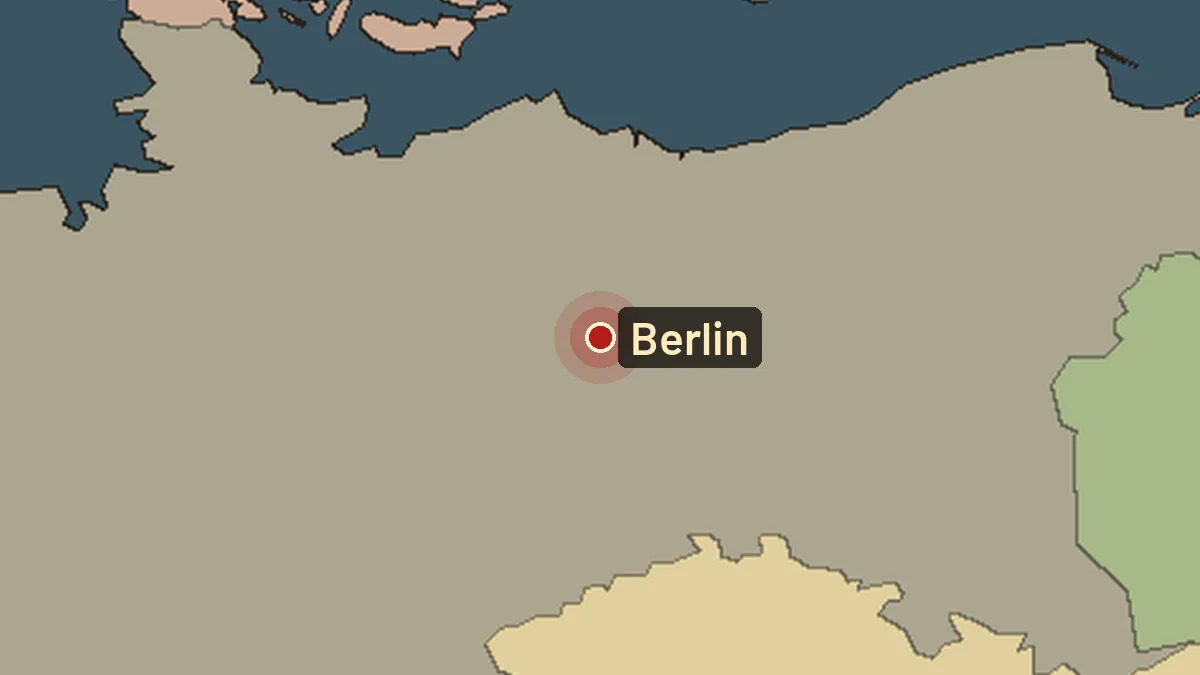
In the spring of 1945 the war in Europe came home to the city where it had been planned. On 16 April more than two million Soviet soldiers opened the final offensive across the Oder River, about 70 kilometres east of Berlin. Two weeks later Red Army troops were fighting room by room through the Reichstag, Adolf Hitler was dead in his bunker under the Reich Chancellery, and the capital of the Third Reich lay in ruins. The Battle of Berlin was the last great battle of the war in Europe and one of the bloodiest.
The race to Berlin
By February 1945 Marshal Georgy Zhukov's 1st Belorussian Front had reached the Oder, and Soviet bridgeheads lay within striking distance of the capital. In the west, the Americans and British crossed the Rhine in March and advanced fast into Germany. The Western Allied supreme commander, Dwight D. Eisenhower, decided not to make Berlin his objective. The city lay deep inside the zone already promised to the Soviet Union, and he expected the cost of taking it to be very high.
Stalin did not want to take chances. He set his two leading marshals, Zhukov and Ivan Konev of the 1st Ukrainian Front, against each other in a race to the city, with Konstantin Rokossovsky's 2nd Belorussian Front attacking further north. Together they had roughly 2.5 million men, more than 6,000 tanks and tens of thousands of guns and mortars.
Against them stood Army Group Vistula under General Gotthard Heinrici, a defensive specialist, and the remnants of other formations. Many units were understrength. Alongside regular soldiers fought the Volkssturm, a militia of older men and teenagers, Hitler Youth boys, police, and foreign volunteers of the Waffen-SS.
The Seelow Heights
Zhukov's main blow fell on the Seelow Heights, a ridge rising above the marshy Oder valley. The attack opened before dawn on 16 April with a huge artillery barrage and the glare of searchlights meant to blind the defenders. Heinrici had anticipated the bombardment and pulled his men back to a second line, so much of the shelling hit empty positions, while the searchlights silhouetted the attackers in smoke and dust.
The battle for the heights cost the Soviets dearly and took three days instead of one. Further south, Konev broke through faster across the Neisse River, and Stalin allowed him to turn his tank armies north towards Berlin. By 20 April, Hitler's 56th birthday, Soviet long-range artillery was shelling the city centre.
The encirclement
On 25 April Zhukov's and Konev's spearheads met west of Berlin, closing the ring around the city. The same day Soviet and American troops met on the Elbe River at Torgau, cutting Germany in two. South-east of the capital, the German Ninth Army under General Theodor Busse was trapped in a forest pocket near Halbe, where tens of thousands of soldiers and civilians died trying to break out westwards.
Inside the ring, Hitler still issued orders to armies that no longer existed. He placed his hopes on General Walther Wenck's Twelfth Army, which turned east from the Elbe but could only open a corridor for survivors of the Ninth Army and refugees to escape towards the Americans.
Street fighting and the Reichstag
The fight for the city itself was brutal. Soviet assault groups of infantry, tanks, flamethrowers and heavy guns fired at point-blank range advanced through rubble, cellars and the U-Bahn tunnels. Defenders armed with Panzerfaust anti-tank weapons knocked out many tanks in the narrow streets. Civilians sheltered in cellars and flak towers with little food or water.
On 29 April Hitler married Eva Braun in the bunker and dictated his political testament, naming Grand Admiral Karl Dönitz as head of state. On 30 April, with Soviet troops a few hundred metres away, the two killed themselves. That evening Soviet soldiers raised a red banner on the Reichstag, though fighting inside the building continued. Joseph Goebbels and his wife killed their six children and themselves on 1 May. On 2 May General Helmuth Weidling, the last commander of the Berlin defence area, surrendered the city.
Aftermath
The cost was enormous. Soviet sources give over 80,000 dead and missing for the whole operation and more than 350,000 casualties in all. German military losses are much less certain; Soviet figures claimed some 480,000 prisoners. Estimates of civilian deaths in Berlin vary widely, from tens of thousands upwards. In the weeks that followed, Soviet soldiers committed mass rapes of German women in Berlin, a crime long silenced on both sides and now widely documented.
Germany surrendered unconditionally a week later. Berlin itself was divided into four sectors under American, British, French and Soviet control, and the city became a focus of the Cold War, from the Berlin Blockade of 1948–49 to the Wall of 1961–89.
Did you know?
- The famous photograph of a Soviet soldier raising the flag over the Reichstag was taken by Yevgeny Khaldei on 2 May and partly restaged; it was also retouched before publication.
- At Halbe, south-east of Berlin, a large war cemetery holds tens of thousands of soldiers and civilians killed in the last days of the war.
- Polish troops fought alongside the Red Army in the battle, and a Polish flag was raised on the Victory Column in central Berlin.
The Battle of Berlin in World Wars: 1914–20XX
World Wars: 1914–20XX currently covers the First World War, and this battle is part of the game's event database for the planned 1939 scenario. In it Berlin passes to the Soviet Union, Germany's government changes to the short-lived Dönitz government, and both sides suffer heavy manpower losses.
In 1918 Germany lost a war without a single battle on its own soil, a fact that later fed the "stab-in-the-back" myth. In the Historical (1914) scenario you can play Germany, France or Russia and see whether you can bring the war to Berlin a generation early, and in the Parallel Fronts scenario armoured divisions and bomber wings already fight in 1914. Pick a side and decide where the last battle is fought.
▶ Play now Free in your browser, no download needed.
Further reading: Wikipedia (English)