 World Wars: 1914–20XX
First World War (1914–1918)
First Battle of the Marne (1914): how Paris was saved and the trenches began
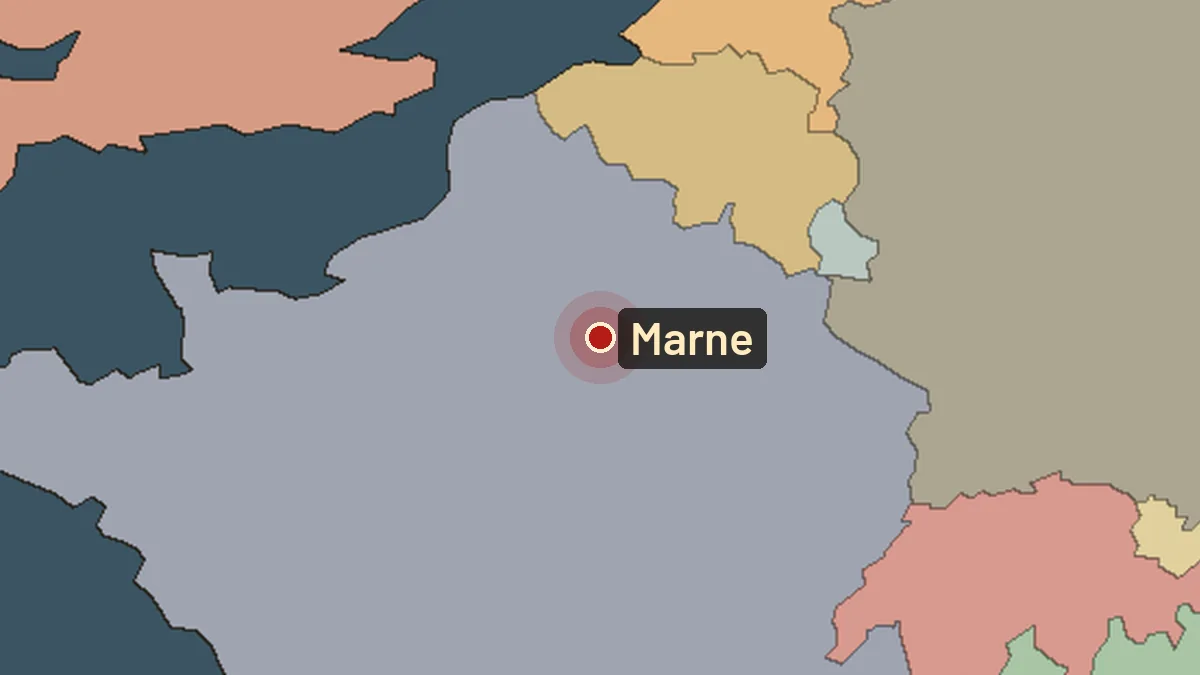
In the first days of September 1914, German troops were within some 50 kilometres of Paris. The French government had already left for Bordeaux. Then, along the river Marne, the French and British armies turned and struck back. The German armies retreated, dug in on the heights above the Aisne, and the war of movement that everyone had expected to end by Christmas became four years of trench warfare.
A plan built on speed
Germany went to war in August 1914 facing enemies on two sides: France in the west and Russia in the east. The German General Staff's answer, known as the Schlieffen Plan after its original author, was to knock France out quickly while Russia was still mobilising. Most of the German army would swing through neutral Belgium in a huge wheel, come down on Paris from the north and trap the French armies against their own eastern frontier. After that, the trains would carry the victorious troops east.
The invasion of Belgium brought Britain into the war on 4 August, but at first the plan seemed to work. In the Battle of the Frontiers in August, the French attacks in Lorraine and the Ardennes were thrown back with terrible losses; on 22 August alone some 27,000 French soldiers were killed. The French and the small British Expeditionary Force (BEF) fell back for two weeks in what became known as the Great Retreat, marching up to 30 kilometres a day in summer heat.
The fatal turn
The German right wing was exhausted, too. Its men had marched hundreds of kilometres, its supply columns lagged behind the railheads, and two army corps had been taken from the western armies and sent east to face an unexpectedly fast Russian advance into East Prussia. At the end of August, General Alexander von Kluck, commanding the German First Army on the extreme right, turned south-east to keep contact with General Karl von Bülow's Second Army and to chase the retreating French. That meant passing east of Paris instead of enveloping it from the west, and it exposed his flank to the city.
French air and cavalry reconnaissance spotted the change. General Joseph Gallieni, the military governor of Paris, urged an immediate attack, and the French commander-in-chief, General Joseph Joffre, agreed to halt the retreat and turn the whole Allied line around.
Six days on the Marne
On 5 September the new French Sixth Army under General Michel-Joseph Maunoury moved out of the Paris area against Kluck's flank on the river Ourcq. Kluck reacted quickly and swung his corps west to meet it. In doing so he opened a gap of roughly 50 kilometres between his army and Bülow's, screened only by cavalry.
Into that gap advanced the BEF under Field Marshal Sir John French and the French Fifth Army, now led by General Louis Franchet d'Espèrey. Further east, General Ferdinand Foch's new Ninth Army held on in the marshes of Saint-Gond under heavy attack. The fighting stretched across more than 200 kilometres of front.
To reinforce the Ourcq, the Paris garrison commandeered vehicles of every kind. On the nights of 6 and 7 September, around 600 Paris taxis carried several thousand soldiers towards the front. Militarily their contribution was small, but the "taxis of the Marne" became one of the best-known images of the war.
At German headquarters in Luxembourg, the chief of staff, Helmuth von Moltke the Younger, had poor communication with his armies. He sent a staff officer, Lieutenant Colonel Richard Hentsch, to assess the situation. On 8 and 9 September Hentsch found Bülow ready to withdraw and approved a general retreat of the right wing. From 9 September the German armies fell back about 60 kilometres to the river Aisne.
Why it mattered
The Marne ended German hopes of a short war. Moltke was replaced by Erich von Falkenhayn within days. On the Aisne the Germans dug the first trench lines of the Western Front, and Allied attacks against them failed. Both sides then tried to outflank each other further and further north in the "Race to the Sea", until by November an unbroken line of trenches ran from the North Sea coast of Belgium to the Swiss border.
The French called the battle the "Miracle of the Marne". For Germany it meant exactly what its planners had feared: a long war on two fronts against enemies with greater combined resources. The front lines drawn in the autumn of 1914 would barely move until the spring of 1918.
Did you know?
- Joffre was famous for his calm. Throughout the Great Retreat he kept his regular meals and long nights of sleep, which earned him the nickname "Papa Joffre".
- The Germans returned to the Marne in the summer of 1918. The Second Battle of the Marne, from July 1918, was the last major German offensive of the war and the turning point of that year.
The Marne in World Wars: 1914–20XX
In the Historical (1914) scenario the Battle of the Marne arrives on 5 September 1914. French morale rises, German morale falls, both sides suffer heavy manpower losses, and the Western Front switches to trench warfare: infantry that stays in place digs in and becomes much harder to dislodge. The Trench and Joffre entries unlock in the in-game encyclopedia.
In the Parallel Fronts scenario, where engines, radio and flight matured 25 years early, nothing forces the Germans to stop at the Marne. Armoured divisions and fighter wings can reach Paris in days, and if the city falls the game tells you how far the real German army got. Can you hold the line as Joffre did, or win the race as Kluck could not?
▶ Play now Free in your browser, no download needed.
Further reading: Wikipedia (English)
 The first tanks (Flers–Courcelette)