 World Wars: 1914–20XX
First World War (1914–1918)
The Gallipoli Campaign (1915–16): the Dardanelles, 18 March and Anzac Cove
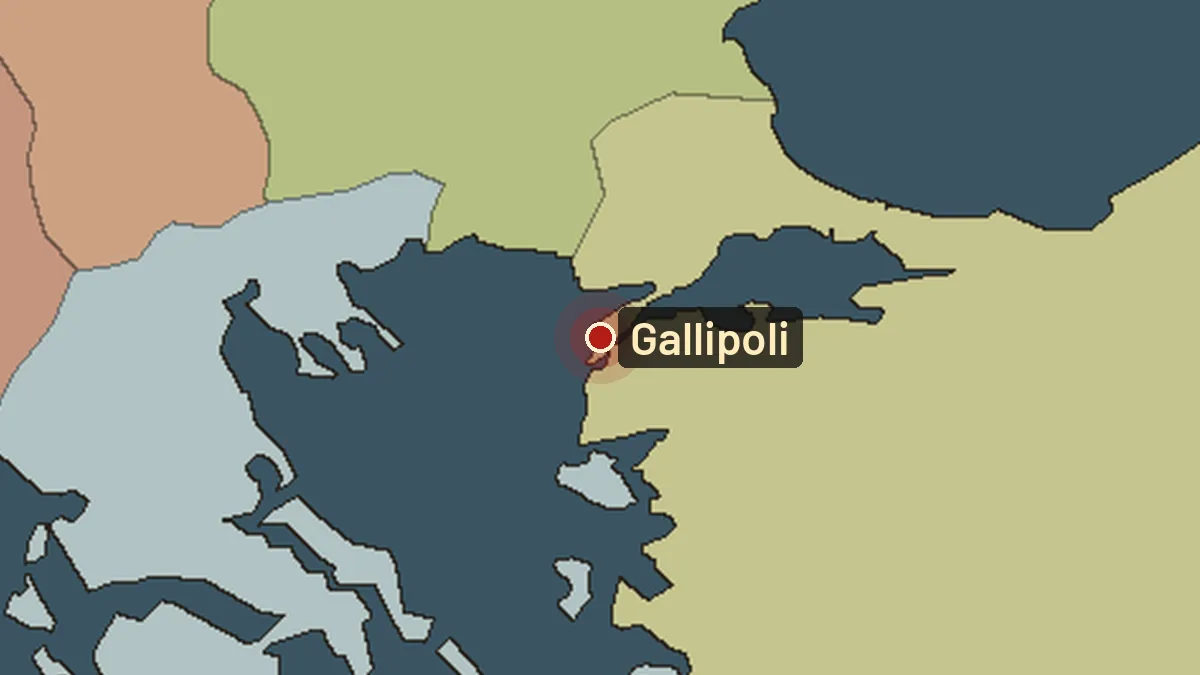
In 1915 the Allies tried to win the war with one bold stroke in the east. If their fleets could force the Dardanelles, the narrow strait guarding Constantinople, the Ottoman capital might fall, a sea route to Russia would open, and the neutral Balkan states might join the Allies. Instead, the Gallipoli campaign became a costly eight-month stalemate. For Turks it is the victory of Çanakkale; for Australians and New Zealanders it is where the Anzac legend was born.
Why the Dardanelles?
By the end of 1914 the Western Front was locked in trenches, and the Ottoman Empire had entered the war on Germany's side at the end of October. Russia's warm-water route through the Black Sea and the Turkish Straits was closed, and in early 1915 Russia asked its allies for help against an Ottoman offensive in the Caucasus. In London, the First Lord of the Admiralty, Winston Churchill, championed a plan to force the straits with older battleships that were too slow for the main fleet.
The Dardanelles are about 60 kilometres long and, at the Narrows near Çanakkale, little more than a kilometre wide. Forts on both shores, mobile howitzers hidden in the hills and lines of sea mines defended them. The Allied bombardment of the outer forts began on 19 February 1915.
18 March: the naval attack
On 18 March eighteen British and French battleships, supported by cruisers and destroyers, attacked the Narrows. The forts were damaged but the mines were not cleared: the minesweepers were converted trawlers with civilian crews who could not work under fire.
Ten days earlier, on the night of 7–8 March, the small Ottoman minelayer Nusret had laid a line of 26 mines parallel to the shore in Erenköy Bay, where the Allied ships manoeuvred during bombardments. The line had not been detected. On 18 March the French battleship Bouvet struck a mine and sank within minutes with most of her crew. The British battleships Irresistible and Ocean were also lost, and the battlecruiser Inflexible and two French battleships were badly damaged. The Allied admiral, John de Robeck, broke off the attack. In Turkey, 18 March is still commemorated as the day of the Çanakkale naval victory.
25 April: the landings
The Allies now decided that the army must take the peninsula. The five weeks they needed to assemble a force gave the Ottoman Fifth Army, commanded by the German general Otto Liman von Sanders, time to prepare. At dawn on 25 April British and French troops landed at Cape Helles (Seddülbahir) at the tip of the peninsula, French troops made a diversionary landing at Kum Kale on the Asian shore, and the Australian and New Zealand Army Corps (ANZAC) landed further north at what became known as Anzac Cove (Arıburnu).
The Anzacs pushed inland towards the high ground of the Sarı Bair ridge. There they met the Ottoman 19th Division under Lieutenant Colonel Mustafa Kemal, who led his troops forward on his own initiative. His order to the 57th Infantry Regiment became famous: "I don't order you to attack, I order you to die. In the time it takes us to die, other troops and commanders can take our place." The Anzacs were held to a narrow beachhead.
Stalemate and evacuation
Through the summer both sides fought from trenches often only metres apart, in heat, flies and disease. In August the Allies tried again: a night offensive from Anzac towards the Sarı Bair heights and a new landing at Suvla Bay (Anafartalar). New Zealand troops briefly held the summit of Chunuk Bair (Conkbayırı), but Ottoman counter-attacks, many directed by Mustafa Kemal as commander of the Anafartalar Group, retook the heights.
In October General Ian Hamilton was replaced by General Charles Monro, who recommended withdrawal. Bulgaria had joined the Central Powers that month, opening a direct rail link from Germany to Constantinople. Anzac and Suvla were evacuated on the nights of 19–20 December 1915 and Cape Helles on 8–9 January 1916. Unlike the landings, the evacuation went almost perfectly: very few men were lost.
What it meant
For the Allies, Gallipoli was a strategic failure. The straits stayed closed, Russia remained cut off from its allies' supplies, and Churchill lost his post at the Admiralty. For the Ottoman Empire it was the greatest victory of the war and lifted morale across the empire. Mustafa Kemal emerged as a national hero and later led the Turkish War of Independence and founded the Republic of Turkey.
In Australia and New Zealand, 25 April is commemorated as Anzac Day. In Turkey, the battlefields on the peninsula are now a historical national park, and the words attributed to Atatürk about the Anzacs who lie there, "there is no difference between the Johnnies and the Mehmets", are carved at Anzac Cove.
Did you know?
- The Ottoman defenders are remembered for many acts of endurance, including the story of Corporal Seyit, said to have carried a heavy shell to a damaged gun by hand on 18 March.
- Some of the Allied soldiers who served at Gallipoli came from as far away as India, Newfoundland and French West Africa.
Gallipoli in World Wars: 1914–20XX
In the Historical (1914) scenario the campaign opens on 18 March 1915 and creates a new Gallipoli front for about 300 days. Both sides lose heavy manpower, and Ottoman morale rises for months afterwards. The Çanakkale and Mustafa Kemal entries unlock in the in-game encyclopedia, and the evacuation arrives in January 1916.
If you play the Entente, you can try what Churchill could not: if Istanbul falls, the straits open and the game shows you how history really went. In the Parallel Fronts scenario aircraft carriers can give the landings the air support they never had in 1915. Playing the Ottoman Empire, your task is to hold the peninsula once again.
▶ Play now Free in your browser, no download needed.
Further reading: Wikipedia (English)
 The first tanks (Flers–Courcelette)