World Wars: 1914–20XX
First World War (1914–1918)
The Arab Revolt (1916–1918): Sharif Hussein, Lawrence and the Hejaz
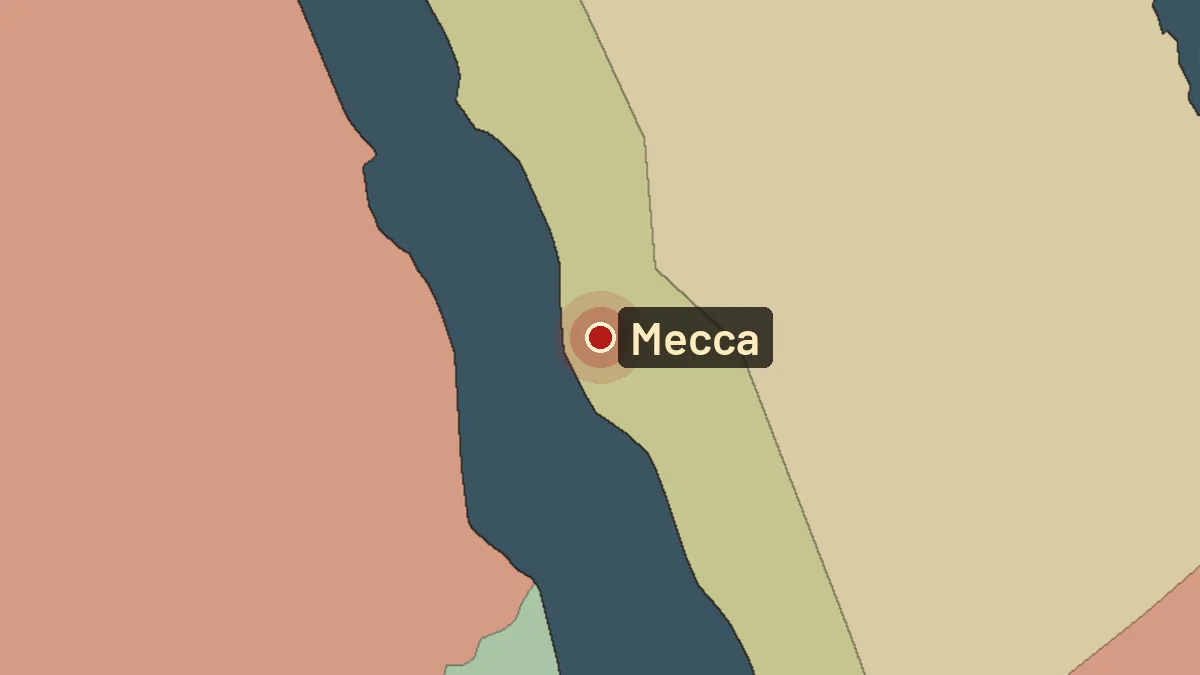
In June 1916 Sharif Hussein ibn Ali, the guardian of Islam's holiest cities, declared revolt against the Ottoman sultan. His forces quickly took Mecca and the Red Sea ports, and over the next two years Arab fighters raided the Hejaz Railway, captured Aqaba and advanced into Syria alongside the British. The Arab Revolt tied down Ottoman troops far from the main fronts and gave rise to one of the war's most famous legends, that of "Lawrence of Arabia". It also left behind a bitter dispute over promises that were never kept.
An emir between two empires
Hussein was the Sharif and Emir of Mecca, a member of the Hashemite family that traced its descent to the Prophet Muhammad. The Ottoman government had appointed him in 1908, but relations with the Committee of Union and Progress in Constantinople grew tense. The new Hejaz Railway, completed to Medina in 1908, allowed the central government to project power deep into Arabia, and Hussein feared he would be deposed.
When the Ottoman Empire entered the war in late 1914, the sultan called for a holy war against the Allies. Hussein did not openly support it. Instead, through 1915 and early 1916, he exchanged a series of letters with Sir Henry McMahon, the British High Commissioner in Egypt. In this Hussein–McMahon correspondence, Britain agreed in principle to support Arab independence after the war in return for a revolt, although the letters left the borders, especially in Syria, Palestine and Iraq, deliberately vague. Meanwhile, in May 1916, Britain and France secretly agreed in the Sykes–Picot Agreement to divide much of the same region into zones of their own influence.
Tension in Syria also played a part. Cemal Pasha, the Ottoman governor and commander there, had Arab activists accused of treason tried by military courts, and on 6 May 1916 a group of them were hanged in Beirut and Damascus.
The rising in the Hejaz
The revolt began in Mecca on 10 June 1916. Hussein's tribal forces took the city within days, and with the support of Royal Navy ships the port of Jeddah surrendered in June. Other Red Sea towns followed, and Taif fell in September. But an attack on Medina failed. The city's garrison, commanded by Fahreddin Pasha, was connected to Syria by the Hejaz Railway and was too strong for the lightly armed Bedouin.
Hussein's sons became the revolt's field commanders: Ali and Abdullah around Medina, and Faisal, who proved the most capable leader, further north. Britain supplied money, rifles, artillery and advisers. One of these was a young intelligence officer, Captain T. E. Lawrence, who arrived in late 1916 and became Faisal's liaison officer and friend.
Railway raids and Aqaba
The revolt's leaders and their British advisers soon concluded that Medina did not need to be captured. It was better to keep its garrison isolated and dependent on a single, vulnerable railway line. From early 1917 Arab raiding parties, often with British explosives experts, blew up tracks, bridges and trains along hundreds of kilometres of the Hejaz Railway. The Ottomans repaired the line again and again, but had to commit thousands of men to guard it.
In January 1917 Faisal's army moved north to the coastal town of Wejh. Then, in the summer, a small force led by the Howeitat chief Auda abu Tayi and accompanied by Lawrence made a long march through the desert and attacked the port of Aqaba from the landward side, where its defences were weakest. Aqaba fell on 6 July 1917. It became the base from which Faisal's Northern Arab Army operated on the right flank of General Edmund Allenby's British forces in Palestine.
Into Syria
In 1918 Arab forces fought around Ma'an and the Dead Sea and cut the railway around Deraa during Allenby's great offensive at Megiddo in September. As the Ottoman armies in Palestine and Syria collapsed, Arab and British Empire troops entered Damascus on 1 October 1918, and Faisal set up an Arab administration there. Aleppo was taken later in October, shortly before the Armistice of Mudros ended the fighting with the Ottoman Empire.
Medina was the last to go. Cut off and starving, Fahreddin Pasha refused to surrender even after the armistice, and only handed over the city in January 1919. In Turkey he is remembered as the "Defender of Medina".
Broken promises and new states
The revolt did not produce the large independent Arab kingdom Hussein had expected. At the peace conferences the Arab lands were divided into League of Nations mandates: Syria and Lebanon went to France, Palestine, Transjordan and Iraq to Britain. The Balfour Declaration of November 1917 had also promised British support for a Jewish national home in Palestine. Faisal was proclaimed King of Syria in 1920, but French troops drove him out within months. The British then made him King of Iraq in 1921, while his brother Abdullah became ruler of Transjordan. Hussein himself lost the Hejaz to Ibn Saud of Nejd in 1924–25.
Views of the revolt differ sharply. In Arab national memory it is the start of a modern independence movement. In Turkey it is often remembered as a betrayal at a moment of mortal danger. Militarily it tied down a considerable number of Ottoman troops at modest cost, though historians debate how much it contributed to the outcome compared with Allenby's army.
Did you know?
- The Arab Revolt adopted a flag of black, green, white and red. Its colours still appear in the flags of Jordan, Palestine and several other Arab states.
- Lawrence wrote a famous account of the campaign, Seven Pillars of Wisdom. Historians agree it is vivid literature but question some of its details.
The Arab Revolt in World Wars: 1914–20XX
In the Historical (1914) scenario the Arab Revolt breaks out on 10 June 1916. Ottoman stability and war support fall, and a new Arab Revolt front opens in the Hejaz, forcing the Ottoman player to defend the long desert flank as well as Palestine, Mesopotamia and the Caucasus.
As the Ottoman Empire, you must decide how many troops the south deserves while the British press on from Egypt and Basra; as Britain, the revolt is a cheap way to stretch your enemy. In the Parallel Fronts scenario, aircraft and motorised columns make the desert both easier to cross and harder to hide in. Can you hold Arabia, or set it ablaze?
▶ Play now Free in your browser, no download needed.
Further reading: Wikipedia (English)