World Wars: 1914–20XX
First World War (1914–1918)
The Battle of the Somme (1916): the bloodiest day in British military history
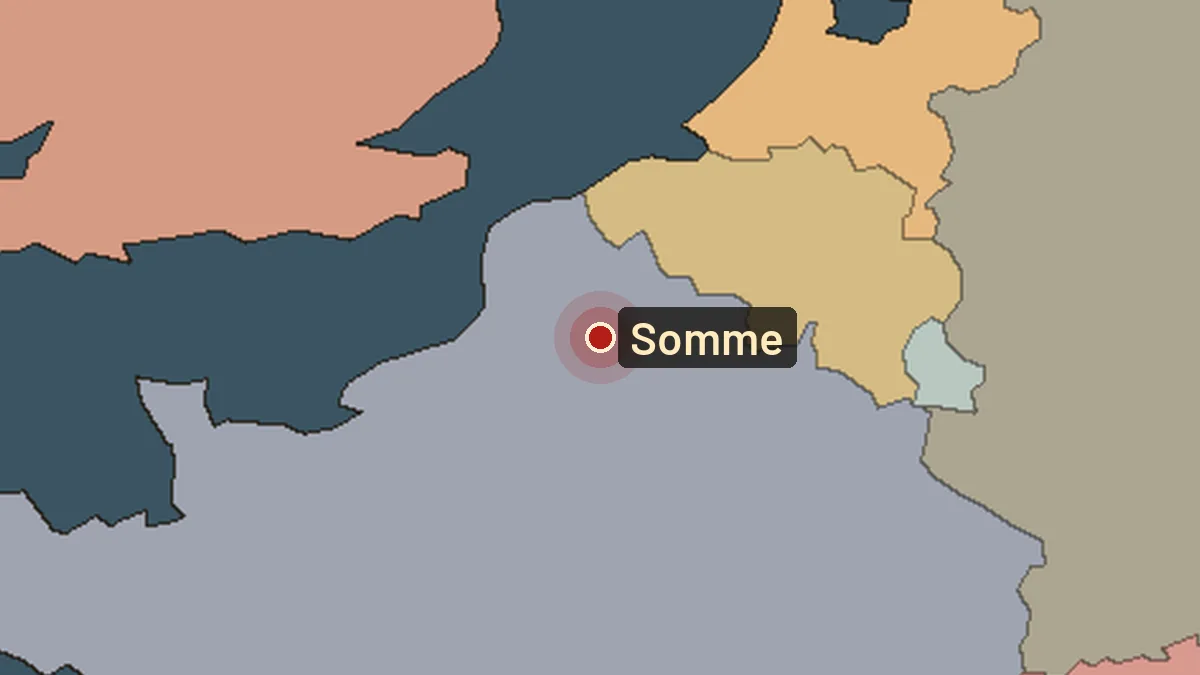
At 7:30 on the morning of 1 July 1916, whistles blew along the British trenches north of the river Somme and more than a hundred thousand men climbed out into no man's land. By nightfall about 57,000 of them had been killed, wounded or captured, the heaviest losses the British army has ever suffered in a single day. The battle that began that morning went on for four and a half months and became, for Britain, the symbol of the First World War: enormous sacrifice for a few kilometres of shattered ground.
A battle planned for the wrong reasons
The Somme was chosen at the end of 1915 as the place where the British and French armies would launch a joint offensive in the summer of 1916, mainly because it was where their sectors met. The area had no great strategic objective behind it. Then, in February 1916, the Germans attacked Verdun. As the French poured division after division into that battle, their share of the Somme offensive shrank, and its purpose changed: it now had to relieve the pressure on Verdun.
The main attack fell to the British Fourth Army under General Sir Henry Rawlinson, under the overall command of General Sir Douglas Haig. Many of its soldiers were volunteers of Lord Kitchener's "New Army", raised in 1914 and 1915. Some units were "Pals battalions", recruited from the same towns, workplaces or football clubs, so that friends and neighbours served side by side. They were enthusiastic but had never been in a major battle.
The bombardment
The British plan relied on artillery. For a week before the attack, more than 1,500 guns fired about 1.5 million shells at the German lines. The idea was that the barbed wire would be cut, the trenches destroyed and the defenders killed or stunned, so that infantry could walk across and occupy the ruins.
It did not work. Too many guns were light field pieces firing shrapnel, which did little to wire or earthworks. Many shells were duds. And the German defenders on the chalk ridges of the Somme had dug deep dugouts, some ten metres or more underground, where most survived the shelling. When the bombardment lifted on 1 July, they ran up the steps with their machine guns in the minutes it took the British to cross no man's land.
1 July 1916
The day opened with the explosion of mines dug under the German lines, among them the huge Lochnagar mine at La Boisselle. Then the infantry advanced. On much of the front, especially in the north around Serre, Beaumont-Hamel and Thiepval, the attack was cut down within minutes. At Beaumont-Hamel the Newfoundland Regiment, advancing in the open, lost most of its men in about half an hour.
There were successes in the south. Near Montauban British divisions took their objectives, and south of the river the French Sixth Army, more experienced and with far heavier artillery, advanced quickly at low cost. But the official total of the British losses that day, 57,470 casualties including more than 19,000 dead, shocked the nation when it became known.
Four and a half months of attrition
Haig did not call off the offensive. On 14 July a dawn attack on Bazentin Ridge broke into the German second line. South African troops fought for days in Delville Wood, and Australian divisions suffered heavy losses taking and holding Pozières in July and August. German commanders insisted that every lost trench be retaken by counter-attack, which cost them almost as heavily as the attackers.
On 15 September, at Flers-Courcelette, the British used tanks for the first time. They helped capture several villages but could not achieve a breakthrough. Thiepval finally fell at the end of September, and in the final phase in November, fought in rain and deep mud, Beaumont-Hamel, one of the first-day objectives, was taken. The offensive was halted on 18 November. At its deepest the Allied advance was about 10 kilometres.
What did it achieve?
The cost was immense. Estimates vary, but British Empire casualties were about 420,000, French about 200,000, and German probably between 450,000 and 600,000. The Somme helped force the Germans to stop attacking at Verdun, and it badly wore down the experienced German army of 1914 and 1915. In early 1917 the Germans pulled back to a shorter, heavily fortified position, the Hindenburg Line, partly to avoid another battle like it.
The British army also learned hard lessons there. The creeping barrage, better infantry tactics, the use of aircraft for artillery observation and the tank all developed on the Somme, and they contributed to the victories of 1918. Whether that justified the price is one of the longest-running arguments of the war's history. For many in Britain, the image of brave soldiers sent to die by distant generals, "lions led by donkeys", was formed above all by the first day on the Somme.
Did you know?
- An official British film, The Battle of the Somme, was shown in cinemas from August 1916 while the battle was still going on. Millions of people saw it, many hoping to glimpse a relative.
- The writer J. R. R. Tolkien served on the Somme in 1916 as a signals officer, until trench fever sent him home.
- On 1 July the Newfoundland Regiment lost so many men at Beaumont-Hamel that 1 July is still a day of remembrance in Newfoundland.
The Somme in World Wars: 1914–20XX
In the Historical (1914) scenario the Battle of the Somme begins on 1 July 1916. Britain, France and Germany all suffer heavy manpower losses, and British war support falls. The battle also brings the British Mark I tank into Britain's technology. The Battle of the Somme and Douglas Haig entries unlock in the in-game encyclopedia.
Playing Britain or France, you decide whether to repeat Haig's grinding offensive or look for a better place to attack; as Germany, you must hold the line without bleeding your army dry. In the Parallel Fronts scenario, armour and air power have existed since 1914, so the trenches of the Somme may never form at all. Can you break a front that history could not?
▶ Play now Free in your browser, no download needed.
Further reading: Wikipedia (English)
 Douglas Haig