World Wars: 1914–20XX
Second World War (1939–1945)
The Armistice of 22 June 1940: France surrenders in Foch's railway carriage
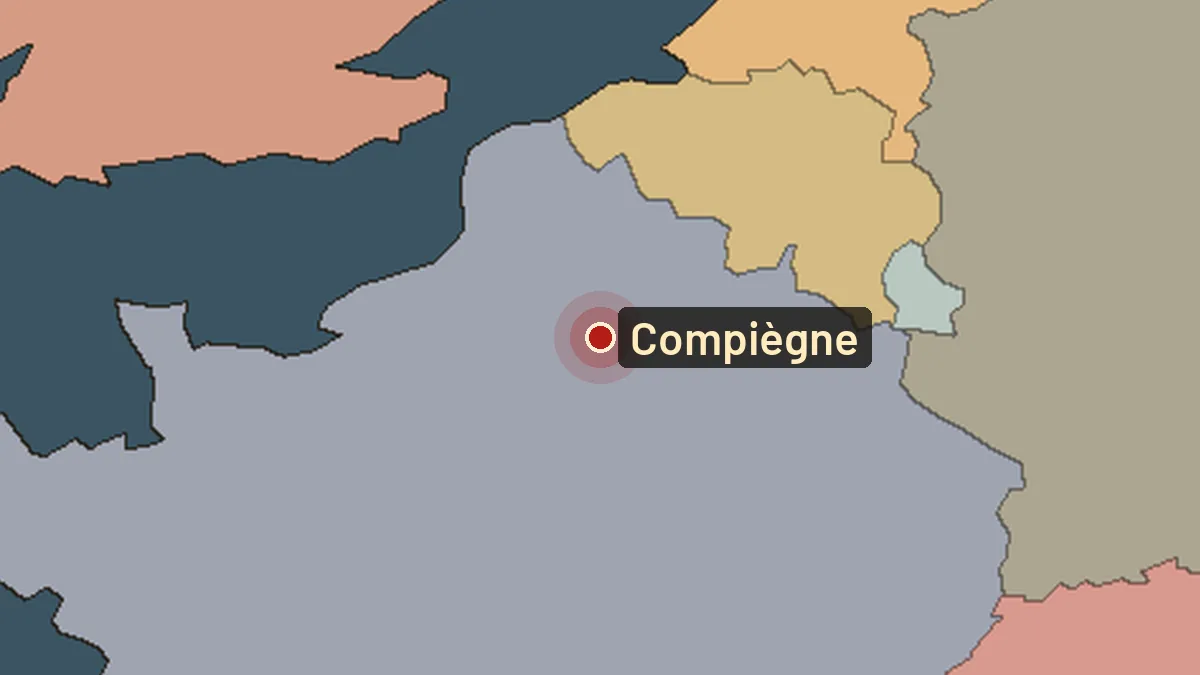
On the afternoon of 21 June 1940, Adolf Hitler arrived in a clearing in the forest of Compiègne, north of Paris. In front of him stood a railway carriage that the Germans had pulled out of a museum and placed exactly where it had stood on 11 November 1918, when German delegates signed the armistice that ended the First World War. Now it was the French who had to come and hear the terms. The armistice signed there the next day took France out of the war, split the country in two and opened the four dark years of occupation and Vichy.
From defeat to armistice
By mid-June 1940 the French army was broken. The Germans had entered Paris on 14 June and were advancing deep into the country, millions of refugees clogged the roads, and the government had fled to Bordeaux. Prime Minister Paul Reynaud wanted to continue the war from French North Africa with the fleet and the empire. Marshal Philippe Pétain, the 84-year-old hero of Verdun, and the army chief General Maxime Weygand argued that the war was lost and that the army must not be made to bear the shame of a capitulation in the field.
Reynaud resigned on 16 June. Pétain became prime minister and on 17 June asked Germany for terms. In a radio broadcast that day he told the French that "it is necessary to stop the fighting", which many units took as an order to lay down their arms.
The carriage at Rethondes
The French delegation was led by General Charles Huntziger. Hitler stayed only for the reading of the preamble, which recalled the "humiliation" of 1918, and then left. General Wilhelm Keitel, head of the German armed forces high command, conducted the talks. The terms were presented as essentially non-negotiable, and the French were allowed little more than a phone line to Bordeaux and a few clarifications. The armistice was signed at about 6.50 p.m. on 22 June. It came into force early on 25 June, after France had also signed an armistice with Italy.
The main terms were:
- France was divided by a demarcation line. Germany occupied the north, including Paris, and the whole Atlantic coast down to the Spanish border, about three-fifths of the country. The south remained unoccupied, under French administration.
- France would pay the costs of the German occupation, which in practice became a huge drain on its economy.
- The French army was reduced to a small force, about 100,000 men in mainland France, and most weapons were to be handed over.
- The French fleet was to be gathered in its ports and disarmed under German or Italian control. Germany declared that it had no intention of using it.
- French prisoners of war, some 1.5–1.8 million men, would remain in captivity until a peace treaty was signed.
There was no peace treaty, and the prisoners mostly stayed in Germany for five years. Alsace and Moselle, not mentioned in the text, were in practice annexed by Germany soon afterwards.
Vichy and Free France
The government settled in the spa town of Vichy. On 10 July 1940 the National Assembly voted, by a large majority, to give Pétain full powers to draw up a new constitution. The Third Republic was replaced by the "French State", an authoritarian regime under Pétain that collaborated with Germany, introduced anti-Jewish laws of its own and later helped deport Jews from France to the death camps. The Germans occupied the southern zone as well in November 1942.
Not everyone accepted the defeat. On 18 June, the day after Pétain's broadcast, General Charles de Gaulle, a junior member of Reynaud's government who had flown to London, spoke on the BBC and called on the French to continue the fight. Few heard the appeal at the time, but it became the founding act of the Free French movement, which gradually rallied parts of the French empire and fought alongside the Allies.
Britain feared that the French fleet might still fall into German hands. On 3 July 1940 the Royal Navy attacked French warships at Mers-el-Kébir in Algeria after their commander refused British demands, killing about 1,300 French sailors. The attack embittered Franco-British relations, but it convinced many, including in the United States, that Britain meant to fight on.
Did you know?
- Hitler had the carriage taken to Berlin and the French memorial at the clearing destroyed. The carriage was lost near the end of the war, most likely burned by German troops in 1945, and a replica now stands in a museum at the site.
- The armistice did not make France a German ally. The Vichy regime kept a fleet, colonies and formal sovereignty, which is why forces loyal to it fought the British and Free French in Syria, Madagascar and North Africa, until most of its army in Africa changed sides in November 1942.
The armistice in World Wars: 1914–20XX
World Wars: 1914–20XX currently covers the First World War; a 1939 scenario is planned, and the Armistice of 22 June 1940 is already part of the game's event database for it. There it is designed so that France leaves the war, Germany occupies northern France and the Atlantic coast, and two new countries appear: Vichy France and Free France.
The carriage at Compiègne links the two wars directly. In the game you can play today, France is a great power fighting to survive the German invasion of 1914, and the war's end in November 1918 is the moment the Rethondes clearing became famous. Lead France in the Historical (1914) or Parallel Fronts scenario and see whether you can write your own ending in that railway carriage.
▶ Play now Free in your browser, no download needed.
Further reading: Wikipedia (English)