World Wars: 1914–20XX
First World War (1914–1918)
Armistice of Salonica (1918): Bulgaria is the first Central Power to quit
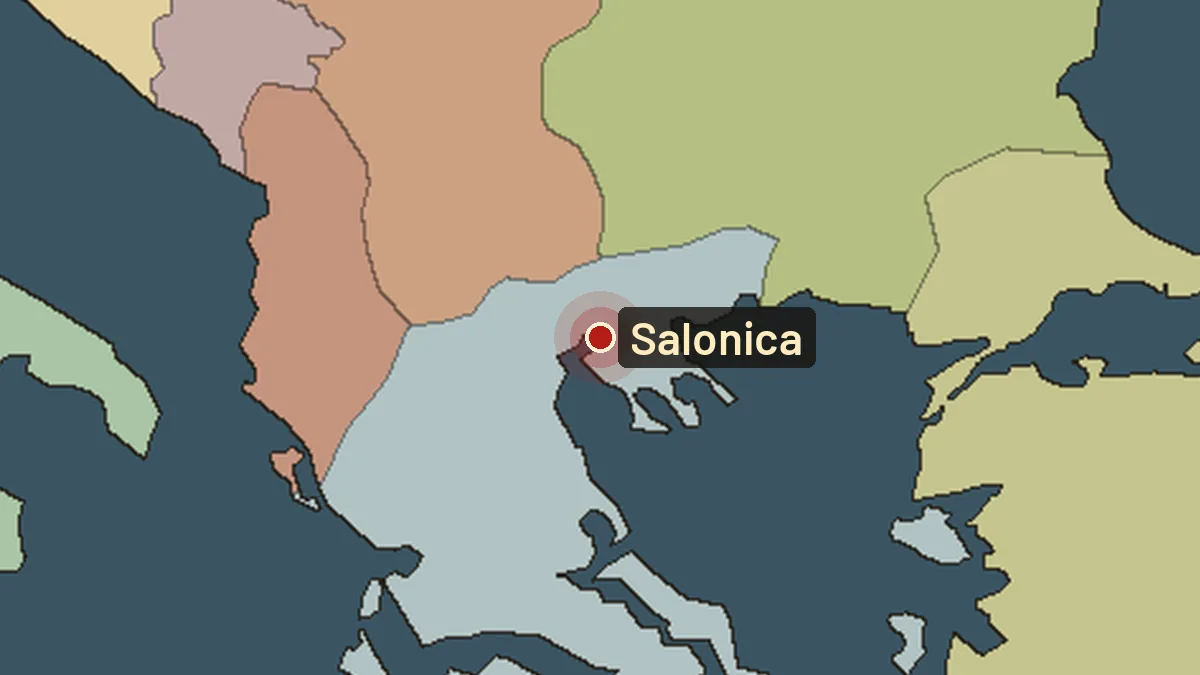
On the evening of 29 September 1918, in the headquarters of the Allied armies at Salonica, three Bulgarian delegates signed an armistice with the French general Louis Franchet d'Espèrey. At noon the next day the guns fell silent on the Macedonian front. Bulgaria, which had entered the First World War three years earlier hoping to win Macedonia, became the first of the Central Powers to leave the war. Its surrender opened the Balkans to the Allied armies, cut the railway that linked Germany to the Ottoman Empire, and helped convince the German high command that the war was lost.
Bulgaria's war
Bulgaria joined Germany and Austria-Hungary in October 1915. Its main aim was Macedonia, the region it had claimed since the 1870s and lost to Serbia and Greece after the Second Balkan War of 1913. The Bulgarian army helped to overrun Serbia in late 1915, fought the Allied army at Salonica, and in 1916 took part in the conquest of Romania, regaining southern Dobruja.
By 1918, however, the country was exhausted. Bulgaria had been at war, with short breaks, since 1912. Food was scarce in the cities, the army was hungry and poorly supplied, and many soldiers felt that the war had brought more sacrifice than reward. The peace with Romania in May 1918 disappointed Bulgarian hopes over northern Dobruja, and relations with Germany grew strained.
The collapse
On 15 September 1918 Serbian and French troops broke through the Bulgarian lines at Dobro Pole. Within days the front was falling apart. Units retreated, then dissolved, as soldiers headed home. Some of them turned against their own government: in the town of Radomir, near Sofia, mutinous troops proclaimed a republic and marched on the capital. The government of Prime Minister Aleksandar Malinov decided that only an armistice could save the state, and on 26 September it asked the Allies for a ceasefire and sent a delegation to Salonica.
The Bulgarian delegates were the finance minister Andrey Lyapchev, General Ivan Lukov and the diplomat Simeon Radev. Franchet d'Espèrey, whose troops were advancing fast, was in no mood to bargain. After brief talks they accepted his conditions and signed on 29 September.
The terms
The armistice was a short military document, but its terms were severe. Bulgaria had to evacuate all the Greek and Serbian territory it occupied and demobilise its army at once, apart from a small force for internal order and the protection of its frontiers. Its weapons, ammunition and military vehicles were to be stored under Allied control. The Allies gained the right to use Bulgarian territory, railways and ports for their military operations, and German and Austro-Hungarian troops and diplomats had to leave the country within four weeks. Bulgarian soldiers west of the meridian of Skopje, cut off by the Allied advance, were to remain in Allied hands as prisoners; estimates of their number run into the tens of thousands.
Consequences
For Bulgaria the defeat brought political upheaval. The Radomir mutiny was suppressed within days, but Tsar Ferdinand, who had led the country into two lost wars in five years, abdicated on 3 October 1918 in favour of his son, Boris III, and left for exile. The peasant leader Aleksandar Stamboliyski, imprisoned during the war for opposing it, became prime minister in 1919. Under the Treaty of Neuilly of November 1919, Bulgaria lost western Thrace, and with it its coast on the Aegean, as well as border districts to the new Kingdom of the Serbs, Croats and Slovenes, and its army was limited to 20,000 men.
For the Central Powers the armistice was a catastrophe. The direct rail route from Berlin through Sofia to Constantinople was cut, leaving the Ottoman Empire isolated, and the road to Constantinople and the Danube lay open to Allied armies. In Germany, the news arrived just as Ludendorff and Hindenburg were facing the Allied assault on the Hindenburg Line; on 29 September they told the Kaiser that Germany needed an armistice. Within six weeks the Ottoman Empire, Austria-Hungary and Germany had followed Bulgaria out of the war.
Did you know?
- Bulgaria was the last country to join the Central Powers, in October 1915, and the first to leave them.
- The abdicating Tsar Ferdinand lived on in exile in Coburg, Germany, until 1948, outliving the son, Boris III, who succeeded him.
Salonica in World Wars: 1914–20XX
In the Historical (1914) scenario the Armistice of Salonica arrives on 29 September 1918. If you lead Bulgaria the game pauses and the choice is yours: sign the armistice and leave the war, or keep resisting, at the cost of falling stability and war support. If Bulgaria signs, its stability drops sharply, and war support falls in Austria-Hungary and the Ottoman Empire as their ally drops out.
Choose differently from 1918 and the war takes a new path: a Bulgaria that holds on keeps the road from Berlin to Constantinople open a little longer. Can you lead a nation exhausted by six years of war through to a better peace than Neuilly?
▶ Play now Free in your browser, no download needed.
Further reading: Wikipedia (English)