World Wars: 1914–20XX
First World War (1914–1918)
Battle of Megiddo (1918): Allenby's breakthrough in Palestine
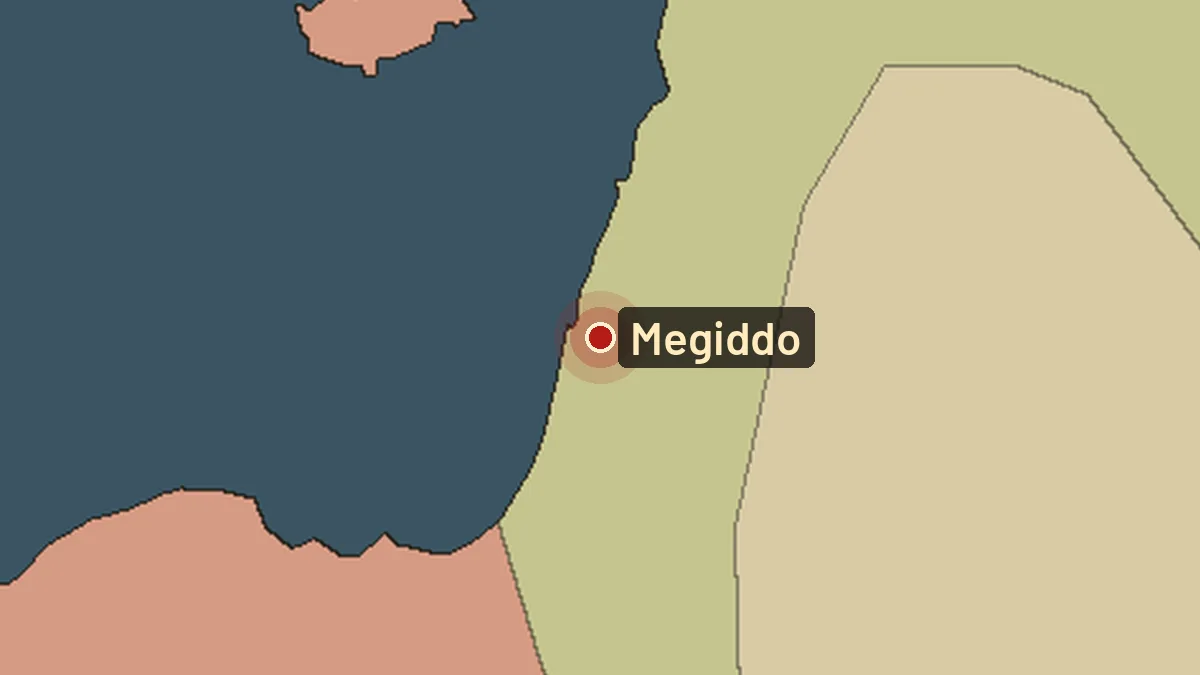
In the early hours of 19 September 1918, British and Indian infantry attacked the Ottoman lines on the coastal plain north of Jaffa after a short, violent bombardment. By mid-morning they had torn a hole in the front, and thousands of cavalrymen were riding through it. Within two days they had crossed the hills into the Jezreel valley, near the ancient mound of Megiddo, and closed the escape routes of two Ottoman armies. The Battle of Megiddo was one of the most complete victories of the First World War and one of the last great successes of cavalry in war. Within six weeks the Ottoman Empire's Arab provinces were lost, and the empire asked for an armistice.
The Palestine front
After the failure of their attacks on the Suez Canal in 1915 and 1916, Ottoman forces in Sinai and Palestine were pushed back by the British Egyptian Expeditionary Force. In late 1917 General Edmund Allenby broke the Gaza–Beersheba line and captured Jerusalem in December. The front then settled for most of 1918 along a line from the Mediterranean north of Jaffa across the Judean hills to the Jordan valley.
The Ottoman forces in Palestine formed the Yıldırım Army Group under the German general Otto Liman von Sanders, the defender of Gallipoli. The Eighth Army under Cevat Pasha held the coast, the Seventh Army under Mustafa Kemal Pasha held the hills in the centre, and the Fourth Army stood east of the Jordan. All three were seriously under strength, short of food, transport and ammunition, and weakened by disease and desertion. Allenby's army had itself been reorganised after the German Spring Offensive drew many British battalions to France, and many of the replacements were Indian units.
Deception and the plan
Allenby's plan relied on surprise. He concentrated most of his infantry and almost all of his mounted troops in secret on the coastal sector, where the flat plain offered room for cavalry, while doing everything possible to make the enemy expect an attack in the Jordan valley. Empty camps were left standing there, dummy horses made of canvas filled the horse lines, mule-drawn sledges raised dust on the roads, and a hotel in Jerusalem was requisitioned as if for a new headquarters. The Royal Air Force had won control of the air and kept German reconnaissance aircraft away. On the eve of the battle the Arab forces of Emir Faisal, with T. E. Lawrence among their British advisers, raided the railway around Deraa, cutting the main supply line of the Ottoman armies.
The battle
On 19 September the infantry of the XXI Corps broke through the Ottoman Eighth Army on the coast in a few hours. The Desert Mounted Corps under the Australian general Harry Chauvel then rode north through the gap, crossed the Carmel ridge by night through narrow passes, and on 20 September descended into the Jezreel valley, taking Afula and Beisan. A cavalry brigade raided Nazareth, where Liman von Sanders had his headquarters; he escaped only at the last moment.
The Ottoman Seventh and Eighth Armies, their retreat to the north cut off, tried to escape eastwards towards the Jordan. On 21 September British aircraft caught a long column of troops and vehicles in the narrow Wadi Fara gorge east of Nablus and attacked it repeatedly; the road was left blocked with wrecked transport. Haifa fell on 23 September after a charge by Indian cavalry from the princely states of Jodhpur and Mysore, and Amman on 25 September. Mustafa Kemal managed to lead part of his forces across the Jordan, but both armies had effectively ceased to exist.
The pursuit and its meaning
The pursuit continued north at extraordinary speed. Australian Light Horse and Arab forces entered Damascus on 1 October, and Faisal established an Arab government there. Beirut, Homs and Hama followed, and Aleppo fell on 26 October. North of Aleppo, Mustafa Kemal gathered the remnants of the Ottoman forces and held a new line, which ran close to the frontier later claimed by the Turkish national movement.
Megiddo, together with the collapse of Bulgaria, made the Ottoman position hopeless. The government of Talat Pasha resigned in October, and on 30 October 1918 the Ottoman Empire signed the Armistice of Mudros. The battle also prepared the ground for the post-war division of the Arab lands between British and French mandates.
Did you know?
- Megiddo is the ancient city known in the Bible as Armageddon. Allenby later took the title Viscount Allenby of Megiddo.
- The Indian cavalry charge at Haifa on 23 September is still commemorated in India, and a road junction in New Delhi, Teen Murti, has a memorial to the regiments involved.
Megiddo in World Wars: 1914–20XX
In the Historical (1914) scenario the Battle of Megiddo begins on 19 September 1918. The Ottoman Empire suffers heavy manpower losses, its war support falls and its army's morale drops sharply for about two months. The Battle of Megiddo entry unlocks in the in-game encyclopedia.
Playing the Ottoman Empire, the challenge is to keep your southern armies supplied and strong enough that 1918 never ends this way. Playing Britain, you can try to repeat Allenby's breakthrough sooner. In the Parallel Fronts scenario, motorised columns and air wings make the open terrain of Palestine an even faster battlefield. Will you hold the line north of Aleppo as Mustafa Kemal did, or never need to?
▶ Play now Free in your browser, no download needed.
Further reading: Wikipedia (English)