World Wars: 1914–20XX
First World War (1914–1918)
The Battle of Caporetto (1917): Italy's great defeat and the Piave
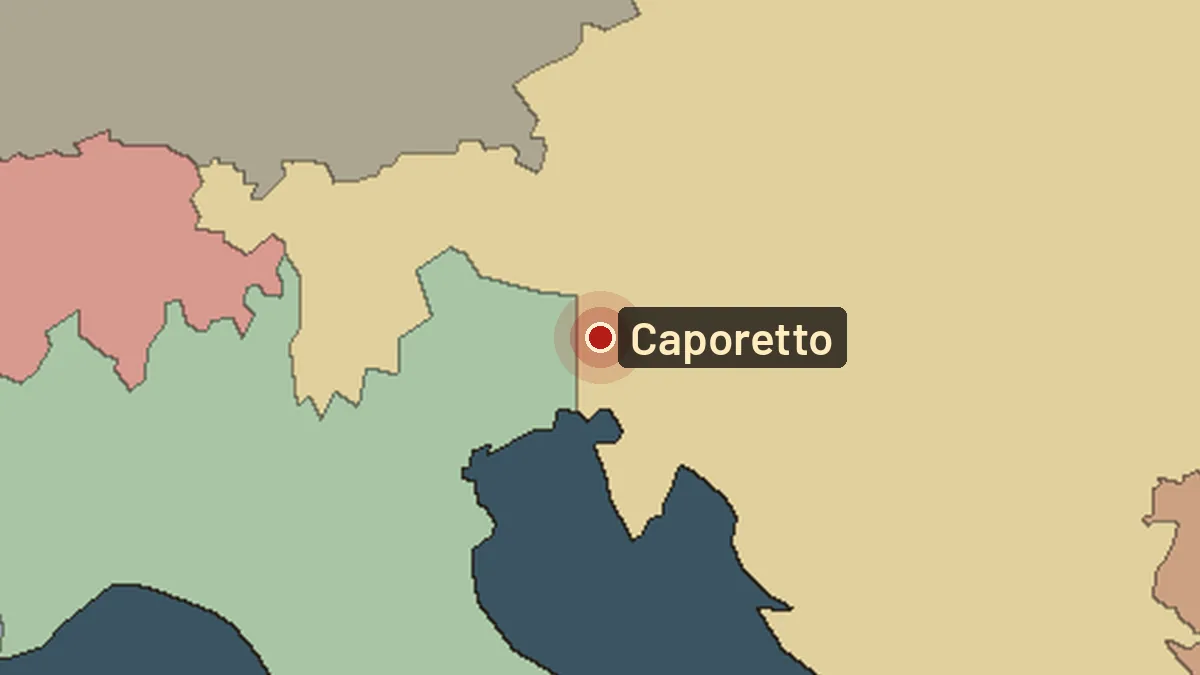
Before dawn on 24 October 1917, German and Austro-Hungarian guns opened fire on the Italian positions in the mountains of the upper Isonzo valley. Within hours the attackers had broken through near the small town of Caporetto. Within days the Italian army was in full retreat across the plain of Friuli, leaving behind hundreds of thousands of prisoners and thousands of guns. It stopped only on the Piave river, little more than 30 kilometres from Venice. In Italian, the word "Caporetto" is still used to describe a crushing defeat. Yet it was also on the Piave that Italy recovered and held.
Eleven battles on the Isonzo
Italy entered the war on the side of the Allies in May 1915, hoping to win the Habsburg lands of Trentino, Trieste and the Adriatic coast. Its main front ran along the river Isonzo, among steep hills, limestone plateaus and mountains. Under its stern chief of staff, General Luigi Cadorna, the Italian army attacked there again and again: there were eleven Battles of the Isonzo between June 1915 and September 1917. They cost hundreds of thousands of lives and gained only a few kilometres, including the town of Gorizia in 1916.
The eleventh battle, in August and September 1917, finally pushed the Austro-Hungarians off much of the Bainsizza plateau. Their army was close to exhaustion, and Emperor Karl asked Germany for help. With Russia collapsing in the east, the German high command could spare troops, and it agreed to a limited offensive to throw the Italians back across the Isonzo.
New tactics in the mountains
A new Fourteenth Army was formed under the German general Otto von Below, with seven German divisions among its Austro-Hungarian ones. Many of its units had experience of the latest German methods: short, intense bombardments instead of days of shelling, and small groups of storm troops who would infiltrate along valleys and weak points, bypassing strongpoints and pushing deep into the enemy rear.
The attack sector, between Flitsch (Bovec) and Tolmein (Tolmin), was held by the Italian Second Army under General Luigi Capello. Italian intelligence had warned that an attack was coming, but the defences were arranged badly, with too many troops packed into the front line and reserves too far back.
24 October: the breakthrough
The bombardment began at 2 a.m. on 24 October, in rain and fog. Near Flitsch the attackers used gas projectors that fired large canisters of poison gas into the Italian positions in the valley, killing many of the defenders, whose gas masks gave little protection. Then the infantry moved forward. Instead of climbing the heights, the German and Austro-Hungarian columns advanced along the valley floors, and by the evening one column had reached Caporetto itself, far behind the Italian front line.
The Italian positions on the mountains were now cut off. Over the next days small German units climbed behind them and took peak after peak. A young German lieutenant, Erwin Rommel, led detachments of the Württemberg Mountain Battalion in a series of daring moves that ended with the capture of Monte Matajur on 26 October and thousands of Italian prisoners. He received Germany's highest military decoration for it.
The great retreat
On the night of 26–27 October Cadorna ordered a retreat to the Tagliamento river. The roads filled with soldiers, guns, carts and civilian refugees. Many units held together and fought rearguard actions, but others dissolved, and huge numbers of soldiers were captured or simply threw away their weapons and headed for home. The Tagliamento line could not be held, and in early November the army fell back again, to the Piave.
Cadorna's official communiqué blamed the disaster on units of the Second Army that, he claimed, had surrendered without fighting. The accusation caused outrage. On 9 November he was replaced by General Armando Diaz. At a conference at Rapallo the Allies agreed to form a Supreme War Council to coordinate their strategy, and British and French divisions were sent to Italy.
The stand on the Piave
On the Piave and the mountain massif of Monte Grappa to the north, the Italian army, reinforced by young conscripts born in 1899, held the line against attacks in November and December. The Central Powers had outrun their supplies and could not cross. Diaz treated his soldiers better than Cadorna had, improving leave, food and rest, and the army slowly rebuilt its strength.
In June 1918 an Austro-Hungarian offensive on the Piave failed, and at the end of October 1918 the Italians and their allies attacked at Vittorio Veneto. The Austro-Hungarian army collapsed, and an armistice was signed at Villa Giusti on 3 November 1918, almost exactly a year after Caporetto.
Did you know?
- Ernest Hemingway's novel A Farewell to Arms describes the retreat from Caporetto. Hemingway himself only arrived in Italy as an ambulance volunteer in 1918.
- The young soldiers born in 1899 who were sent to the Piave are still known in Italy as "i ragazzi del '99", the boys of '99.
Caporetto in World Wars: 1914–20XX
In the Historical (1914) scenario the Battle of Caporetto begins on 24 October 1917. Italy suffers very heavy manpower losses, its morale falls for about three months and its war support drops, while Austro-Hungarian morale rises for the same period. The Battle of Caporetto entry unlocks in the in-game encyclopedia.
Playing Italy, you can try to avoid Cadorna's mistakes: keep reserves ready, do not cram the front line, and be prepared to fall back to a river you can hold. Playing Austria-Hungary or Germany, you can try to go further than von Below did, all the way to Venice. In the Parallel Fronts scenario, armoured columns racing down the Isonzo valleys make Caporetto even more dangerous. Will your line hold on the Piave?
▶ Play now Free in your browser, no download needed.
Further reading: Wikipedia (English)