World Wars: 1914–20XX
First World War (1914–1918)
The Capture of Jerusalem (1917): Allenby ends 400 years of Ottoman rule
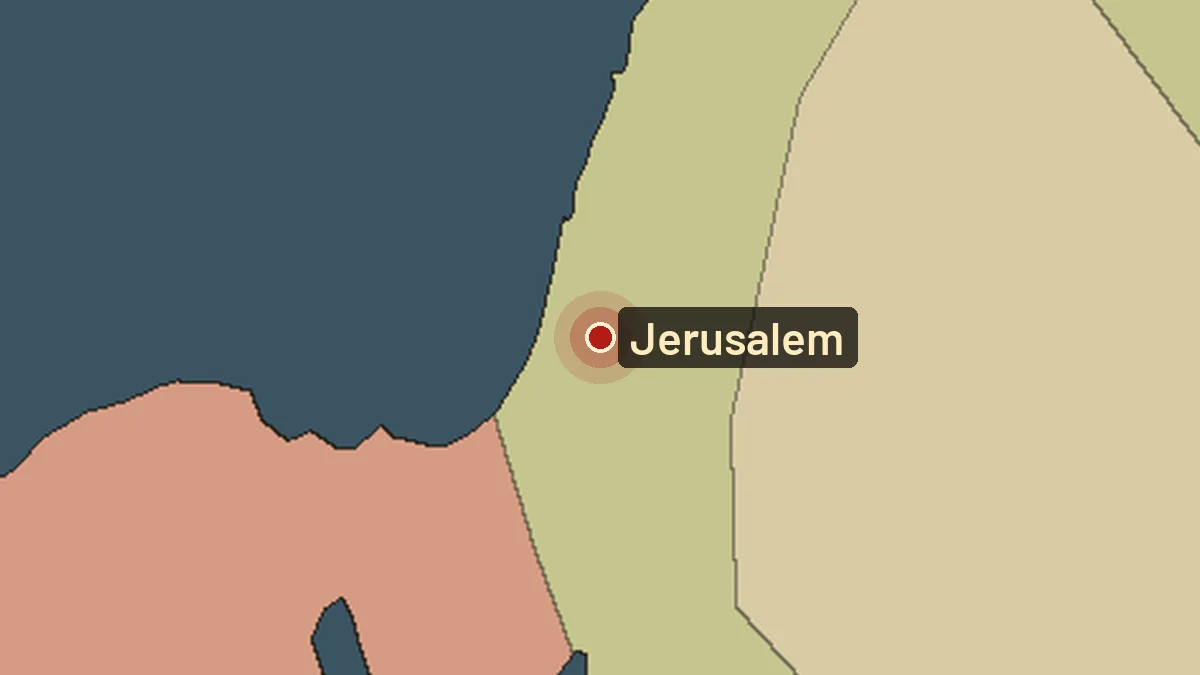
On the morning of 9 December 1917, the mayor of Jerusalem walked out of the city with a white flag to look for someone to surrender to. The Ottoman troops had withdrawn during the night, and the Holy City, sacred to Jews, Christians and Muslims, passed into British hands without a battle in its streets. Two days later General Sir Edmund Allenby entered on foot through the Jaffa Gate. After four centuries, Ottoman rule over Jerusalem was over, and Britain had the morale-raising victory its government had wanted.
From the Suez Canal to Gaza
At the start of the war the Ottoman Empire threatened British-held Egypt and the Suez Canal, the vital route to India. Ottoman forces under Cemal Pasha attacked the canal in February 1915 and again approached it in 1916, but were driven back at Romani in August 1916. The British then advanced slowly across the Sinai desert, building a railway and a water pipeline behind them.
By early 1917 they faced the Ottoman defences of southern Palestine, a line running from Gaza on the coast to Beersheba inland. Two British attacks on Gaza, in March and April 1917, failed with heavy losses. The commander, General Archibald Murray, was replaced in June by Allenby, a cavalryman who had commanded an army on the Western Front. The British prime minister, David Lloyd George, wanted a success in the east to balance the bloodshed in France, and is said to have asked for Jerusalem "as a Christmas present" for the British nation.
Beersheba and the third battle of Gaza
Allenby spent the summer reorganising and reinforcing his army. On the Ottoman side a new army group, called Yıldırım (Thunderbolt), had been formed under the German general Erich von Falkenhayn, originally to retake Baghdad, and was now sent to Palestine.
Allenby's plan was to make the Ottomans believe the main attack would again come at Gaza, while striking at the inland end of the line. On 31 October 1917 his infantry and mounted troops attacked Beersheba. Late in the afternoon, with the town's precious wells at stake, two regiments of the Australian Light Horse charged the Ottoman trenches at the gallop and broke into the town. It was one of the last successful mounted charges in history. With their flank turned, the Ottoman forces at Gaza were in danger, and Gaza fell on 7 November.
Into the Judean Hills
The Ottoman Seventh and Eighth Armies fell back, fighting hard rearguard actions. British, Australian, New Zealand and Indian troops pursued them up the coastal plain, took Jaffa in mid-November and turned east into the Judean Hills towards Jerusalem. The fighting there, in cold rain, on rocky slopes and with poor roads, was difficult and costly, and Ottoman counter-attacks around Nebi Samwil held up the advance for weeks.
Allenby was determined not to fight in Jerusalem itself, where damage to the holy places would have caused outrage around the world. Instead his troops worked round the city to the west and south. By 8 December the Ottoman positions had become untenable, and that night the garrison withdrew eastwards.
The surrender
On 9 December the mayor, Hussein Salim al-Husseini, carried a letter of surrender from the departing Ottoman governor out of the city. According to the well-known story, the first British soldiers he met were two army cooks looking for water, who did not feel able to accept the city. The letter passed up the chain of command, and later that day senior officers formally received the surrender.
On 11 December Allenby made his official entry. Rather than riding in like a conqueror, he dismounted and walked through the Jaffa Gate, a gesture of respect for the city's sanctity that was widely noted. A proclamation read in several languages promised that the holy places and the customs of all faiths would be protected.
Aftermath
An Ottoman attempt to retake the city at the end of December failed. In September 1918 Allenby's great offensive at Megiddo destroyed the Ottoman armies in Palestine, and within weeks Damascus and Aleppo had fallen. The Armistice of Mudros on 30 October 1918 ended the war with the Ottoman Empire.
Jerusalem remained under British military rule and then became the capital of the British Mandate for Palestine. A month before its capture, the Balfour Declaration had promised British support for a Jewish national home in Palestine, while British officials had also encouraged Arab hopes of independence. Those conflicting promises shaped the history of the region for the rest of the century. In Turkey, the loss of Jerusalem, held since the reign of Selim I in the early sixteenth century, is remembered as one of the most painful moments of the empire's last war.
Did you know?
- A photograph survives of the mayor and his party with the two sergeants, Sedgewick and Hurcomb, who were the first British soldiers offered the surrender of Jerusalem.
- Allenby's walk through the Jaffa Gate was often contrasted with the German Kaiser Wilhelm II's visit in 1898, for which part of the old city wall next to the gate had been opened so his carriage could enter.
The capture of Jerusalem in World Wars: 1914–20XX
In the Historical (1914) scenario Jerusalem falls to the British on 9 December 1917. Ottoman war support and stability fall, while British war support rises.
As the Ottoman Empire, you can try to hold the Gaza–Beersheba line, perhaps by keeping reserves where Allenby will strike rather than where you expect him; as Britain, Palestine is the road to Damascus and beyond. In the Parallel Fronts scenario, aircraft and motorised columns change desert warfare entirely, and the race for the Holy City could look very different. Will Jerusalem still fall by Christmas?
▶ Play now Free in your browser, no download needed.
Further reading: Wikipedia (English)