World Wars: 1914–20XX
First World War (1914–1918)
Treaty of Brest-Litovsk (1918): how Bolshevik Russia left the war
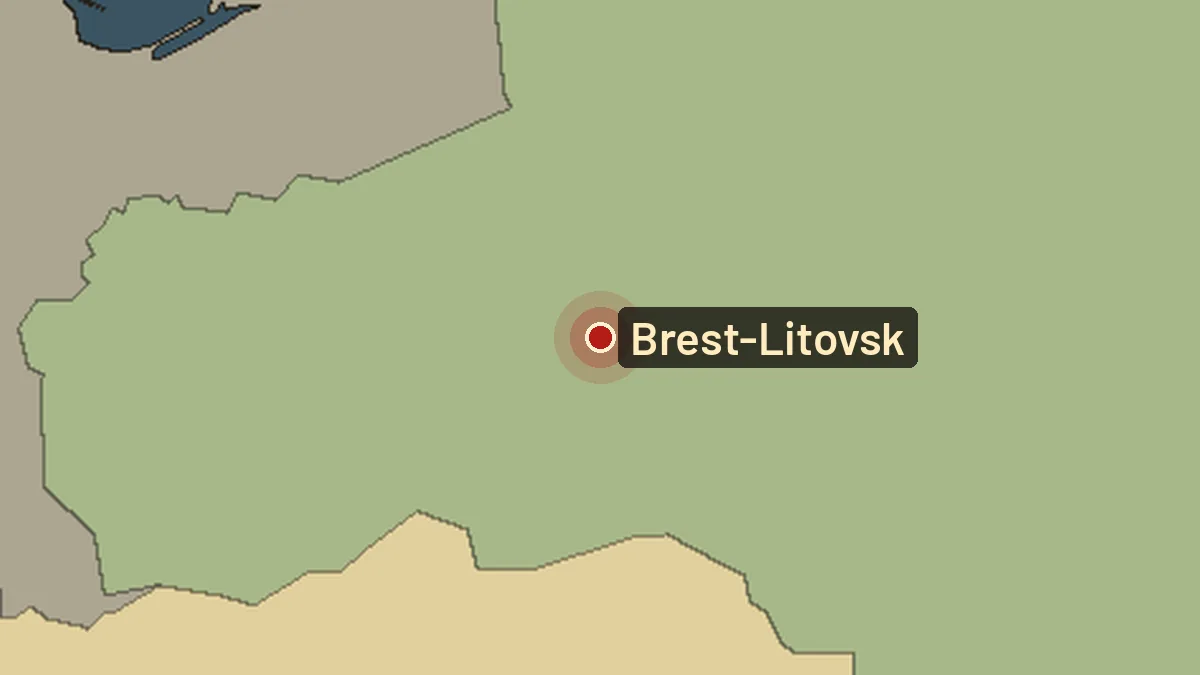
On 3 March 1918, in a fortress town on the river Bug, the Bolshevik government of Russia signed a peace treaty with Germany, Austria-Hungary, the Ottoman Empire and Bulgaria. The Eastern Front, where millions had fought since 1914, fell silent. Russia gave up territory holding roughly a third of its population, and Germany seemed to have won the war in the east. For eight months the treaty redrew the map of Eastern Europe and the Caucasus; then Germany's own defeat swept it away.
Revolution and the road to peace
By 1917 the Russian army was exhausted. The February Revolution overthrew Tsar Nicholas II, but the Provisional Government kept fighting, and its last offensive in July collapsed. When Lenin's Bolsheviks seized power in Petrograd in November 1917 (October in the old Russian calendar), their first act was a Decree on Peace calling for an end to the war without annexations or indemnities.
The Allies ignored the appeal, so the Bolsheviks turned to the Central Powers. An armistice was signed at Brest-Litovsk, the German headquarters for the Eastern Front, in December 1917, and peace talks began just before Christmas. The Germans were represented by the foreign secretary Richard von Kühlmann and by General Max Hoffmann, the real strategist of the Eastern Front; Austria-Hungary by its foreign minister Count Ottokar Czernin; and the Ottoman Empire by the Grand Vizier Talat Pasha.
"Neither war nor peace"
The talks quickly turned bitter. The Germans insisted that Poland, Lithuania and Courland (western Latvia), already under their occupation, had the right to "self-determination", which in practice meant separation from Russia under German influence. From January 1918 the Soviet delegation was led by Leon Trotsky, the commissar for foreign affairs, who used the conference as a stage for revolutionary speeches and played for time, hoping that workers in Germany and Austria would rise up.
On 9 February the Central Powers signed a separate treaty with the Ukrainian People's Republic, which promised them grain, the so-called "bread peace". The next day Trotsky announced a formula that baffled everyone: Russia would neither sign an annexationist peace nor continue the war. It would simply demobilise.
Germany answered with force. On 18 February its armies resumed the advance in Operation Faustschlag ("Fist Punch"). Meeting almost no resistance, they moved hundreds of kilometres in less than two weeks, taking Dvinsk, Minsk, Kiev and most of Estonia. In Petrograd, Lenin argued that the revolution could not survive without peace, against the "Left Communists" who wanted a revolutionary war. He won by a narrow vote, and the Soviets accepted even harsher terms than before. Grigori Sokolnikov signed for Russia on 3 March 1918.
The terms
Russia renounced Poland, Lithuania and Courland, left Livonia and Estonia under German control, recognised the independence of Finland and Ukraine, and promised to stop revolutionary propaganda in the territories of the Central Powers. The lost lands held roughly a third of the old empire's population and much of its coal, iron and industry. A supplementary agreement in August 1918 added a large financial payment to Germany.
In the Caucasus, Russia agreed to withdraw from the districts of Kars, Ardahan and Batum, which it had taken from the Ottomans in 1878, and to let their future be decided by their population. Ottoman troops entered Batum and Kars in April 1918, and a vote held under Ottoman control in the summer endorsed their return to the empire. Ottoman forces then pushed on into the Caucasus, as far as Baku in September 1918.
Victory that did not last
Brest-Litovsk freed Germany from the two-front war it had feared since 1914. Dozens of divisions moved west over the winter, making possible the great Spring Offensive of March 1918. Yet the German army still had to leave large forces, estimated at around a million men, to occupy and exploit its new empire in the east, and the grain of Ukraine never arrived in the quantities hoped for.
The treaty also hardened opinion against Germany. To the Allies it showed what a German victory would look like, and it undercut German claims, after the war, that the Treaty of Versailles was uniquely harsh.
When Germany signed the armistice on 11 November 1918, it had to renounce Brest-Litovsk, and the Soviet government annulled the treaty a few days later. The lands Russia had given up did not simply return: Poland, Finland and the Baltic states became independent, and Ukraine and the Caucasus were plunged into years of civil war. Kars and Ardahan returned to Turkey permanently under the Treaty of Kars in 1921, while Batum went to Soviet Georgia.
Did you know?
- Because of the treaty and the German advance, the Soviet government moved the Russian capital from Petrograd to Moscow in March 1918. It has remained there ever since.
- Kars, Ardahan and Batum were known in the Ottoman Empire as the "three provinces" (Elviye-i Selâse), and their recovery in 1918 was celebrated as one of the few bright moments of the war's final year.
Brest-Litovsk in World Wars: 1914–20XX
In the Historical (1914) scenario the treaty arrives on 3 March 1918, and if you lead Russia the game pauses and lets you decide. You can sign, leaving the war and giving up territory, or refuse and fight on, at the cost of falling stability and war support and the risk of civil war. If peace is signed, Russia leaves the war, Kars and Batum pass to the Ottoman Empire, the Baltic region goes to Germany, Ukraine appears as a new state, and German units freed in the east become available for the Western Front.
Playing Germany or the Ottoman Empire, Brest-Litovsk is the reward for wearing Russia down. Playing Russia, it is the hardest choice in the game: can you hold the empire together long enough to avoid it altogether?
▶ Play now Free in your browser, no download needed.
Further reading: Wikipedia (English)