World Wars: 1914–20XX
First World War (1914–1918)
Hundred Days Offensive (1918): from Amiens to the Armistice
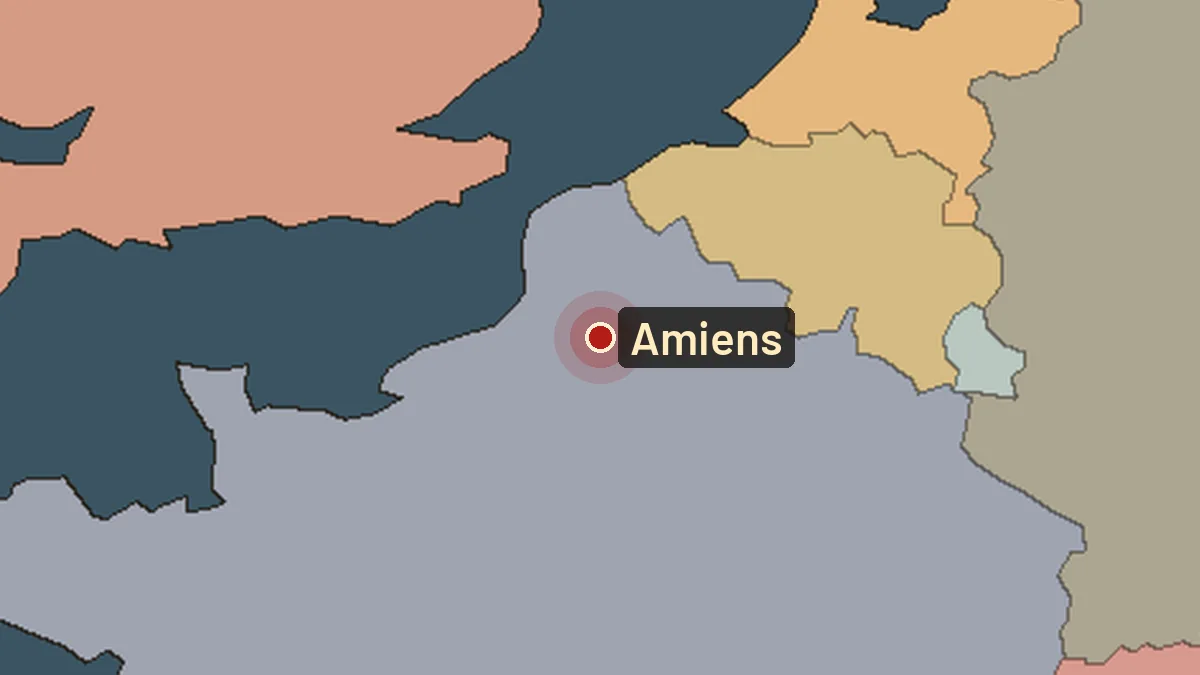
For almost four years the Western Front had barely moved. Then, between August and November 1918, it moved almost every day. Starting with the Battle of Amiens on 8 August, the Allies launched one coordinated attack after another along the whole front, broke through Germany's strongest defences, the Hindenburg Line, and pushed the German army back across northern France and into Belgium. The period became known as the Hundred Days. It was the campaign that actually won the First World War on land, and it ended with the armistice of 11 November.
After the German gamble
The German Spring Offensive of March to July 1918 had taken a great deal of ground but had cost Germany its best assault troops. When the French and Americans counter-attacked on the Marne on 18 July, the initiative passed to the Allies. They now had a single commander, General Ferdinand Foch, appointed after the crisis of March and made a Marshal of France on 6 August. American divisions were arriving in large numbers, and British and Dominion armies had learned, at great cost, how to combine infantry, artillery, tanks and aircraft.
Foch's method was simple to describe and hard to resist. Instead of one huge offensive aimed at a breakthrough, he called for a rapid series of attacks at different points, each stopped when it lost momentum, so that the Germans could never concentrate their reserves. The phrase attributed to him, "Everyone to the battle!", sums up the idea.
Amiens: the black day
The first blow fell east of Amiens. The British Fourth Army under General Henry Rawlinson, with the Canadian and Australian Corps as its spearhead and supported by the French First Army, attacked on 8 August with no preliminary bombardment to warn the enemy. Hundreds of tanks, including the faster Whippets, rolled forward behind a creeping barrage, while aircraft attacked German positions and roads. German counter-battery positions had been located in advance and were silenced in the first minutes.
By evening the Allies had advanced around 11 kilometres, one of the largest gains in a single day on the Western Front, and taken many thousands of prisoners. What struck the German command most was that whole units had surrendered with little resistance. Ludendorff later called 8 August "the black day of the German army", and he told the Kaiser that the war could no longer be won.
Breaking the Hindenburg Line
Foch kept the pressure on. In late August and early September the British attacked near Albert and Bapaume, the Australians took Mont Saint-Quentin and Péronne, and the Canadians stormed the Drocourt–Quéant Line near Arras. The Germans fell back to the Hindenburg Line, the deep defensive system built in 1916–1917 that they hoped would hold through the winter.
On 12 September the American First Army under General John Pershing fought its first major battle as an independent army, eliminating the Saint-Mihiel salient in a few days. At the end of September Foch launched a "grand offensive" on four fronts: the Americans and French in the Meuse-Argonne from 26 September, the Belgians and British in Flanders from 28 September, and the British, Australians, Americans and Canadians against the Hindenburg Line itself. On 29 September the British 46th Division crossed the steep-sided Saint-Quentin Canal, some of its men using lifebelts taken from Channel ferries, and the line was breached.
The same day, Ludendorff and Hindenburg told the Kaiser that Germany must seek an armistice at once. News that Bulgaria had signed an armistice on 29 September added to the shock.
The road to the armistice
The fighting did not stop while the diplomats exchanged notes. In October the British took Cambrai and crossed the Selle, the Belgians and British liberated much of the Flanders coast, and the Americans fought a costly battle through the forests of the Argonne. Ludendorff, who had briefly changed his mind and called for a last stand, was dismissed on 26 October. On 4 November the British crossed the Sambre and Oise Canal; among those killed was the poet Wilfred Owen. On the morning of 11 November, Canadian troops entered Mons, the Belgian town where the British army had first fought the Germans in August 1914.
The Hundred Days cost all sides heavily: the British Empire alone suffered some of its highest casualties of the war in these months, and German losses, including hundreds of thousands of prisoners, were even greater. But they ended the stalemate. The German army was not destroyed, and it marched home in good order after the armistice, a fact later used by the nationalist myth that it had been "stabbed in the back". In reality its commanders had admitted defeat at the end of September.
Did you know?
- The Canadian Corps led so many of the key attacks of these months that the period is sometimes called "Canada's Hundred Days".
- The last British soldier killed in action, Private George Ellison, died near Mons on the morning of 11 November, not far from where the first British soldier had been killed in August 1914.
The Hundred Days in World Wars: 1914–20XX
In the Historical (1914) scenario the Hundred Days Offensive begins on 8 August 1918 at Amiens and lasts until 11 November. German morale and war support fall sharply, and the Entente gains ground on the Western Front. The Hundred Days Offensive entry unlocks in the in-game encyclopedia.
Playing Britain or France, this is the moment to turn years of endurance into victory; playing Germany, the question is whether you can hold the line long enough to negotiate a better peace than the one Germany got. In the Parallel Fronts scenario, where armoured divisions and air wings have existed since 1914, the war of movement the Allies finally achieved in 1918 is the normal state of war. Can you break through sooner?
▶ Play now Free in your browser, no download needed.
Further reading: Wikipedia (English)
 Ferdinand Foch