World Wars: 1914–20XX
First World War (1914–1918)
Battle of Tannenberg (1914): a Russian army destroyed in East Prussia
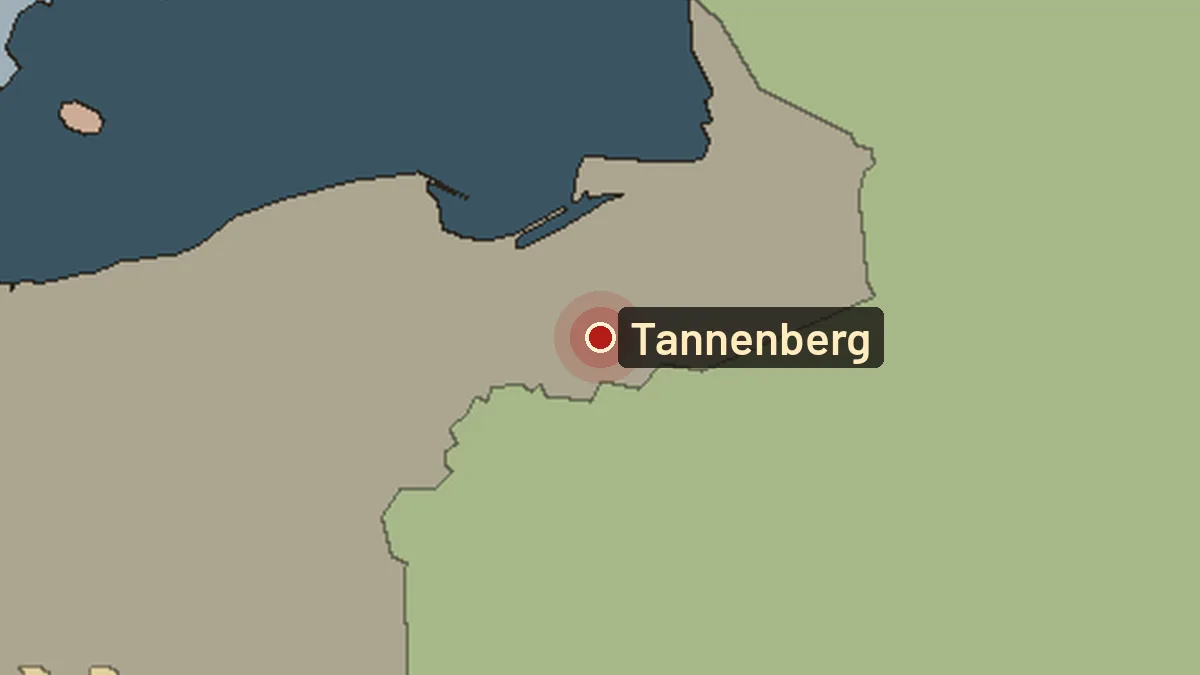
At the end of August 1914 an entire Russian army disappeared from the map of East Prussia. In five days of fighting among the lakes and forests south of Allenstein, the German Eighth Army surrounded the Russian Second Army, took some 90,000 prisoners and drove its commander to suicide. Tannenberg was one of the most complete victories of the First World War. It saved East Prussia, made Paul von Hindenburg and Erich Ludendorff the most famous soldiers in Germany, and showed how badly the Russian army was prepared for modern war.
Russia keeps its promise
Germany's war plan sent most of its army west to defeat France quickly, leaving only one army, the Eighth, to hold East Prussia. The Germans expected Russia to need about six weeks to mobilise. But Russia had promised France to attack Germany quickly, and in mid-August 1914 two Russian armies crossed the border well before the Germans had hoped: General Paul von Rennenkampf's First Army from the east and General Alexander Samsonov's Second Army from the south.
The two armies were meant to close on the Germans like pincers. In practice they were separated by the Masurian Lakes and by poor roads, their supply was chaotic, and their commanders did not coordinate. After the First Army won a clash at Gumbinnen on 20 August, the German commander, General Maximilian von Prittwitz, talked of retreating behind the Vistula and giving up East Prussia. Helmuth von Moltke, the chief of the General Staff, replaced him. The retired Paul von Hindenburg was given the command, with Erich Ludendorff as his chief of staff.
The plan
When Hindenburg and Ludendorff arrived on 23 August, the Eighth Army's staff, led by Lieutenant Colonel Max Hoffmann, had already started moving troops south against Samsonov. The idea was bold: leave only a thin cavalry screen facing Rennenkampf, who seemed in no hurry to advance, and throw almost everything against the Second Army.
Two things made the gamble possible. German railways could move whole corps quickly across East Prussia, while the Russians marched on foot through sand and forest. And Russian commanders often sent radio orders without encoding them, partly because their units lacked the codebooks. German operators picked up messages showing where the Russian corps were going and that Rennenkampf was not marching to help.
Five days in the forests
Samsonov's army was exhausted and short of food after days of marching. It pushed north-west into the centre, unaware that strong German forces were gathering on both its flanks. From 26 August the Germans struck. On the left, General Hermann von François's I Corps, brought by rail, attacked at Usdau and broke the Russian flank. On the right, the corps of August von Mackensen and Otto von Below, which had come down from the north, smashed the Russian corps on that side.
François then pushed his troops east along the Russian rear, partly against orders, until they reached Neidenburg and Willenberg. The ring closed. The Russian centre corps, still advancing, found themselves surrounded in the forests with no supplies and no escape. By 29 and 30 August, thousands of men were surrendering. Samsonov, having lost contact with his army, walked into the woods and shot himself.
Why it mattered
For Germany, Tannenberg was a triumph of nerve, railways and good intelligence. Hindenburg named it after a nearby village to answer the defeat of the Teutonic Knights by Poles and Lithuanians in the same area in 1410, and it became a German national legend. In September the Eighth Army turned on Rennenkampf and pushed his army out of East Prussia at the First Battle of the Masurian Lakes.
Yet the victory did not decide the war. Russia was huge and rebuilt its armies, and in the same weeks it was winning great victories over Austria-Hungary in Galicia. The Russian invasion also had an effect in the west: alarmed by it, Moltke took two army corps from the forces marching on Paris and sent them east. They arrived after Tannenberg had been won, and they were missing when the Germans were stopped at the Marne in September.
For Russia, Tannenberg exposed serious weaknesses: poor staff work, rivalry between generals, weak communications and supply. These problems would return again and again over the next three years.
Did you know?
- The battle was not fought at Tannenberg itself; most of the fighting took place around Allenstein, Hohenstein and Neidenburg. The famous name was chosen for its symbolism.
- A huge Tannenberg Memorial was built near the battlefield in 1927, and Hindenburg was buried there in 1934. Retreating German troops blew it up in 1945.
- The Russian practice of sending uncoded radio messages at Tannenberg became a classic lesson in signals security.
Tannenberg in World Wars: 1914–20XX
The Battle of Tannenberg has its own entry in the game's in-game encyclopedia, which unlocks on 30 August 1914, the day the encirclement was complete, together with the entry on Paul von Hindenburg. If you lead Germany you face the same problem as in 1914: defend East Prussia against Russia while your main armies march on France. If you lead Russia, you can try to make the pincer work as it was meant to.
In the Historical (1914) scenario real events arrive on their dates. In the Parallel Fronts scenario, where engines, radio and flight matured decades early, armoured divisions, air reconnaissance and proper radio change the battle completely: no army needs to send its orders in the clear. Will you win your own Tannenberg, or avoid one?
▶ Play now Free in your browser, no download needed.
Further reading: Wikipedia (English)