World Wars: 1914–20XX
Second World War (1939–1945)
Battle of the Bulge (1944–1945): Hitler's last offensive in the Ardennes
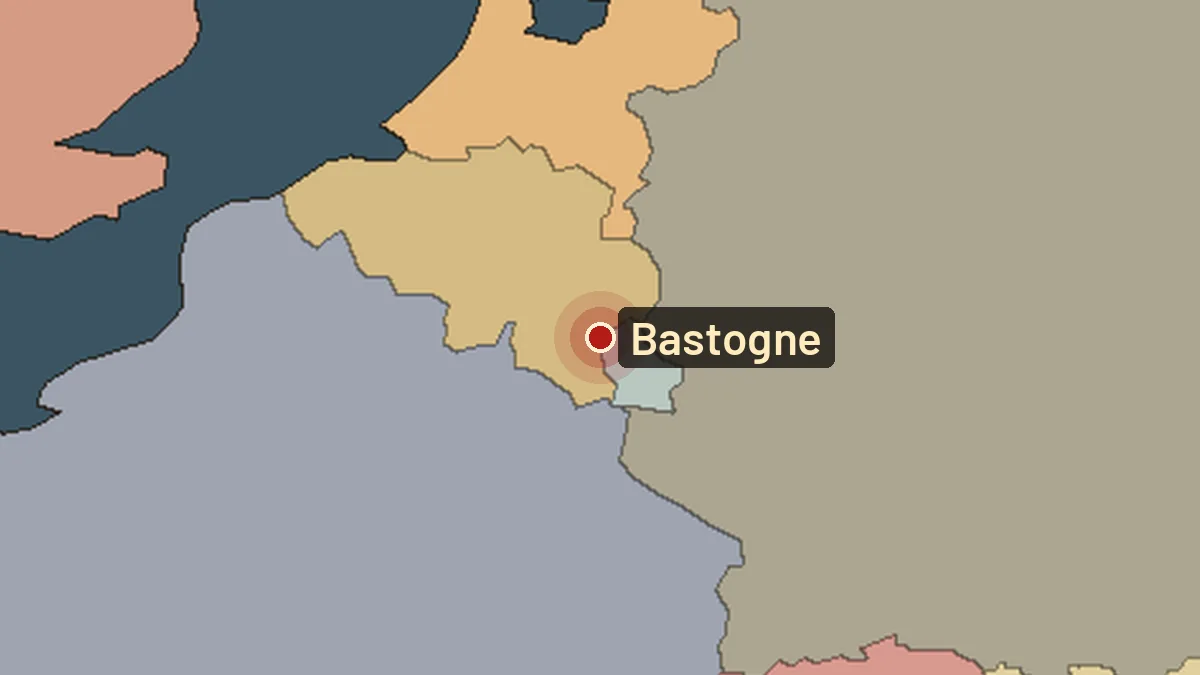
At dawn on 16 December 1944, in fog and snow, German artillery opened fire along a quiet stretch of the American front in the forests of the Ardennes. Behind the barrage came three German armies. For a few days it seemed that Hitler's last gamble might succeed: American units were overrun, roads jammed with retreating vehicles, and a deep bulge appeared in the Allied line. But the attack never reached the river Meuse, let alone its goal of Antwerp. The Battle of the Bulge became the largest battle the US Army fought in the Second World War, and it cost Germany the reserves it would need to defend the Reich.
Hitler's gamble
By the autumn of 1944 Germany was losing on every front. The Allies had freed France and most of Belgium, the Red Army stood on the Vistula and in East Prussia, and Allied bombing was wrecking German industry. Hitler decided that only a bold blow in the west could change the situation. He planned to strike through the Ardennes, as German armies had done with such success in May 1940, cross the Meuse and capture Antwerp, the main Allied supply port. That would split the British and Canadian armies in the north from the Americans further south and, he hoped, force the Western Allies to negotiate.
His generals, including Field Marshal Gerd von Rundstedt and Field Marshal Walter Model, thought the plan far too ambitious for the forces available and proposed a smaller attack. Hitler refused. In great secrecy, using couriers rather than radio and moving units at night, Germany gathered well over 200,000 men and around 1,000 tanks and assault guns, under the cover name Wacht am Rhein, "Watch on the Rhine".
Surprise in the forest
The Ardennes front was thinly held by American divisions that were either new to combat or resting after heavy fighting. Allied intelligence had noticed signs of a build-up but did not believe Germany would attack there in winter. Low clouds kept Allied aircraft, normally overwhelming, on the ground.
In the north, the Sixth Panzer Army under Sepp Dietrich ran into stubborn resistance on the Elsenborn Ridge and made slow progress. Its spearhead, Kampfgruppe Peiper, pushed deeper, and on 17 December its men shot about 80 American prisoners near Malmedy, a massacre that hardened American resolve. In the centre, Hasso von Manteuffel's Fifth Panzer Army made the deepest gains. To spread confusion, small teams of English-speaking German soldiers in American uniforms, organised by Otto Skorzeny, went behind the lines, and rumours of them led to American checkpoints questioning even generals about baseball.
St. Vith and Bastogne
Two road junctions decided the battle. At St. Vith, the US 7th Armored Division and other units held out until 21 December, delaying the German timetable by several days. Further south, the town of Bastogne, where seven roads met, was reached by the US 101st Airborne Division and armoured units just before the Germans surrounded it on 20 December.
On 22 December the Germans sent a demand for surrender. The acting commander of the 101st, Brigadier General Anthony McAuliffe, replied with a single word: "Nuts!" On 23 December the sky cleared, Allied aircraft returned in force and supplies were dropped into the town. Meanwhile General George Patton had done what many thought impossible: he turned large parts of his Third Army ninety degrees to the north in a few days and drove towards Bastogne in winter weather. His 4th Armored Division broke through to the defenders on 26 December.
At the tip of the bulge, the German 2nd Panzer Division got to within a few kilometres of the Meuse near Dinant, out of fuel, before American and British armour destroyed it around Christmas. The offensive had failed.
Rolling back the bulge
To coordinate the defence, Eisenhower had put Field Marshal Bernard Montgomery in charge of the American armies on the northern side of the bulge, a decision that caused friction, and a press conference in which Montgomery seemed to claim much of the credit angered American commanders. Germany launched two more attacks, Operation Nordwind in Alsace on 31 December and a large air strike on Allied airfields on 1 January 1945, Operation Bodenplatte, which destroyed many Allied aircraft but cost the Luftwaffe pilots it could not replace.
In January American forces attacked from north and south and met at Houffalize on 16 January. By 25 January the line was back roughly where it had been. Fighting in deep snow and bitter cold took a heavy toll on both sides, and Belgian and Luxembourgish civilians also suffered, with thousands killed.
The battle delayed the Allied advance by several weeks, but Germany paid a far higher price. It lost men, tanks and aircraft it could not replace, and its last reserves were gone just as the Red Army launched its great January offensive from the Vistula. Within four months the war in Europe was over.
Did you know?
- The name "Bulge" came from the shape of the German salient on newspaper maps of the front.
- The Ardennes had seen fighting in the First World War too: in August 1914 French armies attacking through the forests ran into German forces in the Battle of the Ardennes, part of the Battle of the Frontiers, and suffered heavy losses.
The Battle of the Bulge in World Wars: 1914–20XX
World Wars: 1914–20XX currently covers the First World War; a 1939 scenario is planned, and the Battle of the Bulge is part of its event database. In that event Germany and the United States both suffer heavy manpower losses and Germany's last reserves are used up.
The same ground is part of the 1914 map, where Belgium and Luxembourg are playable states standing in the path of the German armies. In the Parallel Fronts scenario, armoured divisions can already push through the Ardennes in 1914. Can you hold the forest, or break through it? Start a campaign and find out.
▶ Play now Free in your browser, no download needed.
Further reading: Wikipedia (English)