World Wars: 1914–20XX
Second World War (1939–1945)
Yalta Conference (1945): Roosevelt, Churchill and Stalin plan the peace
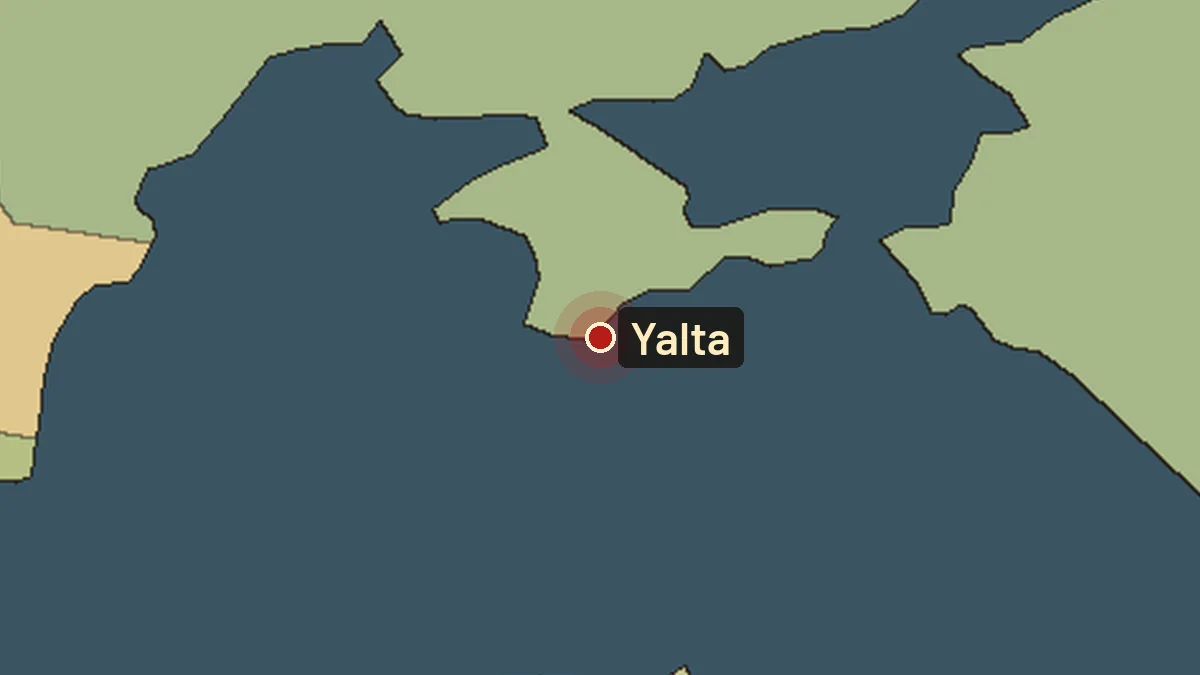
In early February 1945, as Soviet armies stood on the Oder less than 100 kilometres from Berlin and the Western Allies prepared to cross the Rhine, the leaders of the three great Allied powers met in a former imperial palace on the Black Sea coast of Crimea. For a week Franklin Roosevelt, Winston Churchill and Joseph Stalin discussed how to finish the war and organise the peace. The decisions taken at Yalta shaped the map of Europe and Asia for decades, and the conference became one of the most argued-over meetings of the twentieth century.
Why Yalta
The "Big Three" had met once before, at Tehran in late 1943. By early 1945 the end of the war in Europe was in sight, but many questions were open: what to do with Germany, who would govern liberated Poland, how the new world organisation the Allies had planned would work, and whether the Soviet Union would help defeat Japan, which the Americans expected to be long and bloody.
Stalin would not travel far from Soviet territory, so the conference was held at Yalta, recently freed from German occupation. The leaders and their delegations were housed in palaces once owned by the Russian aristocracy, and the main sessions took place at the Livadia Palace, built in 1911 as a summer residence for Tsar Nicholas II. Roosevelt, who had just been inaugurated for a fourth term, made the long journey by ship and plane although he was seriously ill; he died two months later.
Germany
The leaders confirmed that Germany would have to surrender unconditionally and would be occupied and disarmed. It would be divided into zones of occupation, and at Churchill's insistence France was given a zone, carved out of the British and American areas, and a place on the Allied Control Council that would govern Germany as a whole. Berlin, deep in the Soviet zone, would also be divided.
Reparations were discussed at length. The Soviet Union, which had suffered enormous destruction, demanded large payments, and the leaders accepted a total of 20 billion dollars, half of it for the USSR, as a basis for further negotiation, with Britain recording its reservations. War criminals were to be brought to justice.
Poland
Poland took up more time than any other issue. The war had begun with the invasion of Poland, and Britain had gone to war over it. Stalin insisted that the Soviet Union keep most of the eastern Polish territory it had annexed in 1939, roughly up to the Curzon Line, and that Poland be compensated with German land in the west, its exact extent to be settled later.
The government was even harder. The Western Allies recognised the Polish government-in-exile in London; the Soviets had installed a communist-led provisional government in Lublin, then Warsaw. The compromise was that the Lublin government would be reorganised "on a broader democratic basis" with democratic leaders from Poland and abroad, and that "free and unfettered elections" would be held as soon as possible. In practice, with the Red Army in control of the country, the communists dominated, and the elections held in 1947 were neither free nor fair.
The United Nations and Japan
The leaders agreed that a conference to found the United Nations would open in San Francisco on 25 April 1945, and settled a voting formula for the Security Council that gave the permanent members a veto. Stalin obtained additional seats for two Soviet republics, Ukraine and Belarus. It was also agreed that countries declaring war on Germany by 1 March 1945 would be invited to San Francisco, which led several neutral states, including Turkey, to declare war in February.
In a secret agreement, Stalin promised to enter the war against Japan within two or three months after Germany's surrender. In return the Soviet Union would receive southern Sakhalin and the Kuril Islands, and regain rights in Manchuria lost to Japan in 1905. The Soviet Union declared war on Japan on 8 August 1945, exactly three months after the German surrender.
The leaders also issued a Declaration on Liberated Europe promising that freed nations could choose their own governments through free elections. Less publicly, they agreed to return each other's citizens found in liberated areas, which led to the forced repatriation of many Soviet prisoners and refugees who did not want to go home.
A contested legacy
At first Yalta was greeted as a success. Within a few years, as communist governments took power across Eastern Europe, critics in the West called it a betrayal that had handed half of Europe to Stalin. Defenders reply that the Red Army already occupied those countries, that the Western leaders had little power to change that, and that Stalin broke the promises he made. In Poland and the Baltic states, "Yalta" became shorthand for the division of Europe into spheres of influence that lasted until 1989.
Did you know?
- At Yalta Stalin also raised the revision of the Montreux Convention on the Turkish Straits, and the leaders agreed that their foreign ministers would discuss it later; Soviet pressure on Turkey over the Straits followed after the war.
- Roosevelt, Churchill and Stalin met only twice as a trio, at Tehran and at Yalta. At the Potsdam Conference in July 1945, Roosevelt was dead and Churchill was replaced by Clement Attlee halfway through.
Yalta in World Wars: 1914–20XX
World Wars: 1914–20XX currently covers the First World War; a 1939 scenario is planned, and the Yalta Conference is part of its event database. In that event Germany is divided into occupation zones for the United States, Britain, France and the Soviet Union, and the Soviet Union commits to declaring war on Japan within about three months.
In the 1914 game the great question is the peace after the First World War, the settlement of Versailles that set the stage for 1939. You can lead Russia, Britain or Germany in 1914 and decide whether your war ends at a conference table or on the battlefield. Take command and shape your own peace.
▶ Play now Free in your browser, no download needed.
Further reading: Wikipedia (English)