World Wars: 1914–20XX
First World War (1914–1918)
Battle of Verdun (1916): ten months of attrition on the Meuse
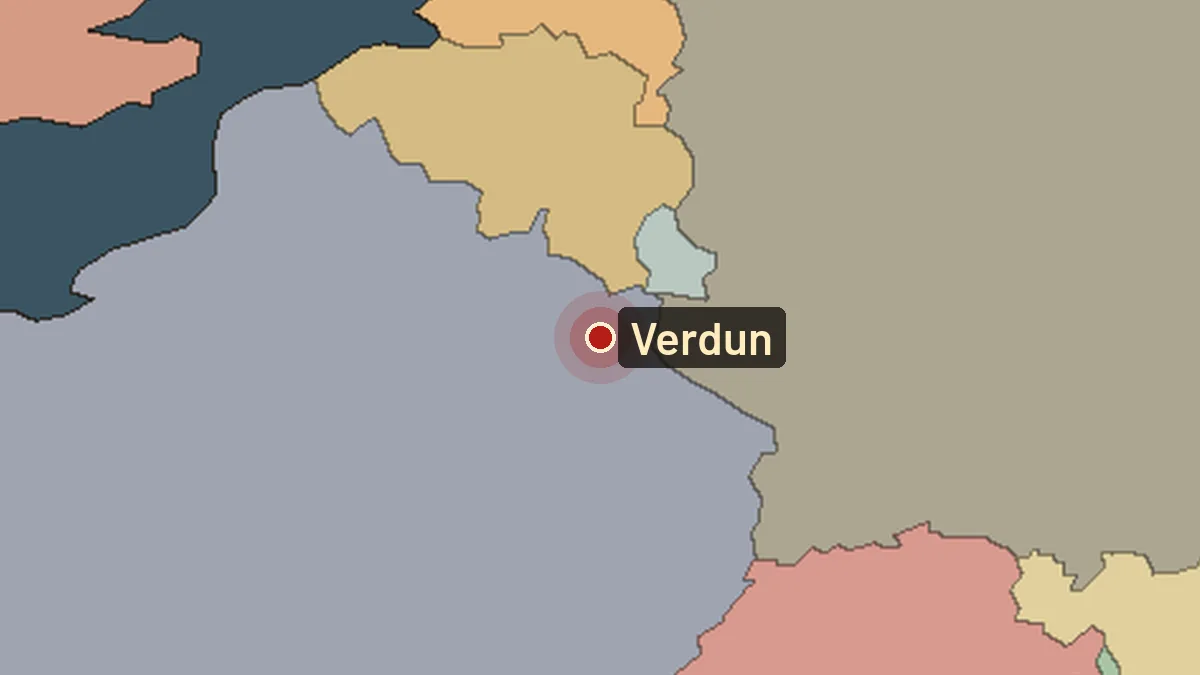
For ten months in 1916, a small area of hills, woods and forts around the French city of Verdun absorbed more shells than almost any battlefield in history. The German army attacked in February hoping to break France's will to fight; by December the French had recovered most of what they had lost, and both armies had suffered hundreds of thousands of casualties. No battle is more deeply rooted in French memory. For France, Verdun became the symbol of endurance; for the world, an image of industrial war at its most destructive.
Falkenhayn's idea
By the end of 1915 the Western Front had been deadlocked for more than a year. Erich von Falkenhayn, chief of the German General Staff since the Marne, believed that Britain was Germany's main enemy, but that it could be defeated only by knocking its strongest continental ally out of the war. According to his post-war memoirs, he proposed to attack a point the French would defend at any cost, so that the French army would be "bled white" by German artillery. Historians debate whether this was his real plan in 1916 or a later justification for a battle that went wrong; the German commanders on the spot certainly hoped to capture Verdun itself.
Verdun was a good choice for an attack. It lay in a salient that bulged into the German lines, supplied by only one narrow-gauge railway and one road, while the Germans had good rail links behind their front. The city had been a fortress for centuries and was ringed by modern forts, but in 1915 the French had stripped many of them of their guns for use elsewhere, believing that the Belgian forts' fate in 1914 had proven forts obsolete.
The German attack
The offensive, delayed for more than a week by snow and rain, began on 21 February 1916 with a bombardment by more than a thousand guns. The German Fifth Army, nominally commanded by Crown Prince Wilhelm, attacked on the east bank of the Meuse. In the Bois des Caures, two battalions of French light infantry under Lieutenant Colonel Émile Driant held out for almost two days before being overwhelmed; Driant was killed.
On 25 February a small German party walked into Fort Douaumont, the largest fort of the ring, almost unopposed: it was held by only a handful of French gunners. The loss caused shock in France. The same day General Philippe Pétain was given command of the defence. He reorganised the artillery, insisted on holding every position and, above all, solved the supply problem. The road from Bar-le-Duc to Verdun, soon known as the Voie Sacrée (Sacred Way), was kept open day and night for a constant stream of lorries carrying men, shells and food, with territorial troops shovelling gravel onto it to keep it usable.
Pétain also introduced a system of rotation, the noria, in which divisions were relieved before they were completely destroyed. As a result, a large part of the French army, by many accounts around three quarters of its divisions, served at Verdun at some point, which is why the battle touched almost every French family.
Months of attrition
When the attack on the east bank stalled, the Germans extended it to the west bank in March, fighting for months for the ridge called Le Mort Homme (Dead Man's Hill) and for Hill 304. On the east bank, Fort Vaux fell on 7 June after its garrison under Major Sylvain Raynal had fought for days in the tunnels, finally surrendering for lack of water. In late June, using a new phosgene gas shell, the Germans took the village of Fleury and approached Fort Souville, the last major fort before the city. An attack in mid-July reached its slopes, but went no further. It was the high-water mark of the German offensive.
By then Germany had to face crises elsewhere. Russia's Brusilov offensive struck Austria-Hungary in June, and on 1 July the British and French opened the Battle of the Somme. Falkenhayn halted major attacks at Verdun and was replaced at the end of August by Paul von Hindenburg, with Erich Ludendorff as his chief partner.
The French counter-attacks
Pétain had been promoted, and the defence passed to General Robert Nivelle, with the aggressive General Charles Mangin leading the attacks. Using a carefully planned creeping barrage, French troops recaptured Fort Douaumont on 24 October 1916, and Fort Vaux was abandoned by the Germans in early November. A final French offensive in mid-December pushed the line back close to where it had stood in February. The battle ended on 18 December.
Neither side achieved its aim. The French army had held, but at enormous cost, and the strain contributed to the mutinies of 1917. The German army had suffered almost as heavily. Nivelle's success at Verdun made him commander-in-chief, with disastrous results in the failed offensive of April 1917. Pétain, the "victor of Verdun", became a national hero; in 1940 that prestige would carry him to the head of the collaborationist Vichy regime.
Did you know?
- Nine French villages destroyed in the battle were never rebuilt. They are still officially listed as communes and are said to have "died for France"; each has a mayor appointed to keep its memory.
- The Douaumont Ossuary holds the bones of some 130,000 unidentified French and German soldiers gathered from the battlefield, and much of the ground is still a forest of shell craters.
Verdun in World Wars: 1914–20XX
In the Historical (1914) scenario the Battle of Verdun begins on 21 February 1916. France and Germany both suffer very heavy manpower losses, and for about 300 days attrition is heavier in Lorraine, making the region a grinding battlefield. French war support rises a little while German war support falls. The Battle of Verdun entry unlocks in the in-game encyclopedia.
Playing France, you must decide how much to pour into the defence of the Meuse; playing Germany, whether Verdun is worth the price at all. In the Parallel Fronts scenario bombers and armoured divisions mean a salient like Verdun can be cut off rather than slowly bled. Will you hold, or find a better way to break the deadlock?
▶ Play now Free in your browser, no download needed.
Further reading: Wikipedia (English)