World Wars: 1914–20XX
Second World War (1939–1945)
German occupation of Czechoslovakia (15 March 1939): the end of appeasement
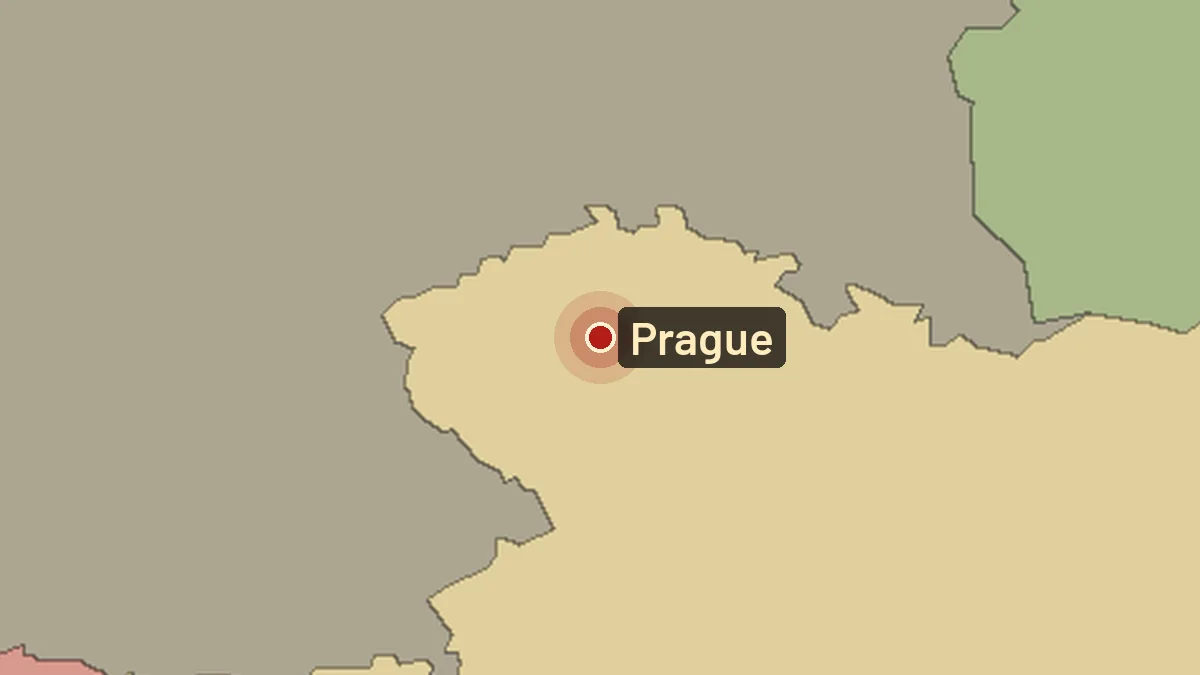
On the morning of 15 March 1939, in falling snow, German troops drove into Prague. Silent crowds lined the streets; some people wept, some shook their fists. That evening Hitler slept in Prague Castle, the ancient seat of Bohemian kings. Unlike the Rhineland, Austria or the Sudetenland, this was a country with no German majority, and its occupation could not be explained as the righting of a wrong from 1919. Six months after Munich, appeasement was dead.
After Munich
The Munich Agreement of September 1938 had left a weakened, smaller state without its border fortifications. It was renamed Czecho-Slovakia, with a hyphen, to show the wide autonomy now given to Slovakia and to Carpathian Ruthenia in the far east. President Edvard Beneš went into exile, and the new president, Emil Hácha, was an elderly lawyer and judge with no political ambitions. In November 1938 the First Vienna Award, decided by Germany and Italy, also gave Hungary a broad strip of southern Slovakia and Ruthenia.
Hitler was not satisfied. Already in October 1938 he ordered the army to prepare to "liquidate the rest of Czechoslovakia". He saw it as a hostile base in the middle of his future sphere and coveted its weapons, factories, gold and skilled workers.
Engineering a crisis
The opportunity came from Slovakia. Slovak nationalists around the priest-politician Jozef Tiso, the head of the autonomous Slovak government, were in contact with Berlin. On 9–10 March 1939 the Prague government, fearing secession, dismissed Tiso and sent troops into Slovakia. Hitler summoned Tiso to Berlin on 13 March and told him that Slovakia must declare independence at once or be left to Hungary. On 14 March the Slovak parliament proclaimed an independent Slovak state, which immediately asked for German protection.
That evening President Hácha travelled to Berlin by train, hoping to save what he could. He was kept waiting until after midnight. In the early hours of 15 March, Hitler, Göring and Ribbentrop told him that German troops would march regardless, and Göring threatened that Prague would be bombed if there was resistance. Hácha, in poor health, collapsed during the meeting and was revived by Hitler's doctor. Around four in the morning he signed a declaration placing "the fate of the Czech people" in the hands of the Führer, and telephoned Prague to order that the army should not resist.
Occupation
German troops crossed the border at dawn. In most places there was no fighting; at Místek, near Ostrava, a Czechoslovak company resisted briefly before obeying orders to stop. On 16 March Hitler proclaimed the Protectorate of Bohemia and Moravia. In name it kept a Czech government with Hácha as president, but real power lay with the Reich Protector, the former foreign minister Konstantin von Neurath, and later with harsher successors such as Reinhard Heydrich.
At the same time Hungary, with German approval, occupied Carpathian Ruthenia, crushing a short-lived independent Carpatho-Ukraine. A week later Germany also forced Lithuania to hand over the port of Memel (Klaipėda).
What Germany gained
The prize was enormous. Germany took over the gold reserves of the Czechoslovak national bank and the equipment of a modern army: by German figures, hundreds of tanks, more than a thousand aircraft, around a million rifles, tens of thousands of machine guns and thousands of artillery pieces. The Škoda works in Plzeň and other Czech factories went on to produce weapons for the German war effort. Czech-built tanks, known in German service as the Panzer 35(t) and 38(t), equipped several German tank divisions in the invasions of Poland and France.
For the Czech people, the occupation meant six years of repression. Universities were closed after student protests in November 1939, and resistance was punished with mass executions, especially after the assassination of Heydrich in 1942. The Jews of Bohemia and Moravia were deported, most of them via the Theresienstadt ghetto, and the great majority were murdered.
The turn in British and French policy
Chamberlain's first reaction was cautious, but anger in Parliament and in the press was overwhelming. In a speech in Birmingham on 17 March he asked whether this was a step towards an attempt to dominate the world by force. On 31 March 1939 Britain, with France, gave a guarantee to Poland, the most likely next target: if Poland's independence was threatened and Poland resisted, they would come to its aid. Britain also introduced peacetime conscription for the first time in its history in the spring of 1939. When Germany invaded Poland on 1 September, the guarantee brought Britain and France into the war.
Did you know?
- In Germany the Czech lands were called the "Protectorate", a word borrowed from the language of colonial rule, as in the French protectorates of Tunisia and Morocco.
- Emil Hácha remained nominal president of the Protectorate throughout the war. He was arrested in 1945 and died in prison before he could be tried.
The occupation of Czechoslovakia in World Wars: 1914–20XX
The game currently covers the First World War, and a 1939 scenario is planned. The German occupation of Czechoslovakia is part of the game's event database for that scenario: Germany annexes the Czech lands, a separate Slovak state is created, German production rises with the captured industry, and Britain and France give guarantees to Poland.
Its roots go back to the world you can play today. In 1914 Bohemia, Moravia and Slovakia were all part of Austria-Hungary, and Czech soldiers fought in Habsburg uniform on the Serbian, Russian and Italian fronts. Lead Austria-Hungary from 1914 and see whether your empire can hold its many peoples together.
▶ Play now Free in your browser, no download needed.
Further reading: Wikipedia (English)