World Wars: 1914–20XX
Second World War (1939–1945)
The Munich Agreement (September 1938): appeasement and the Sudetenland
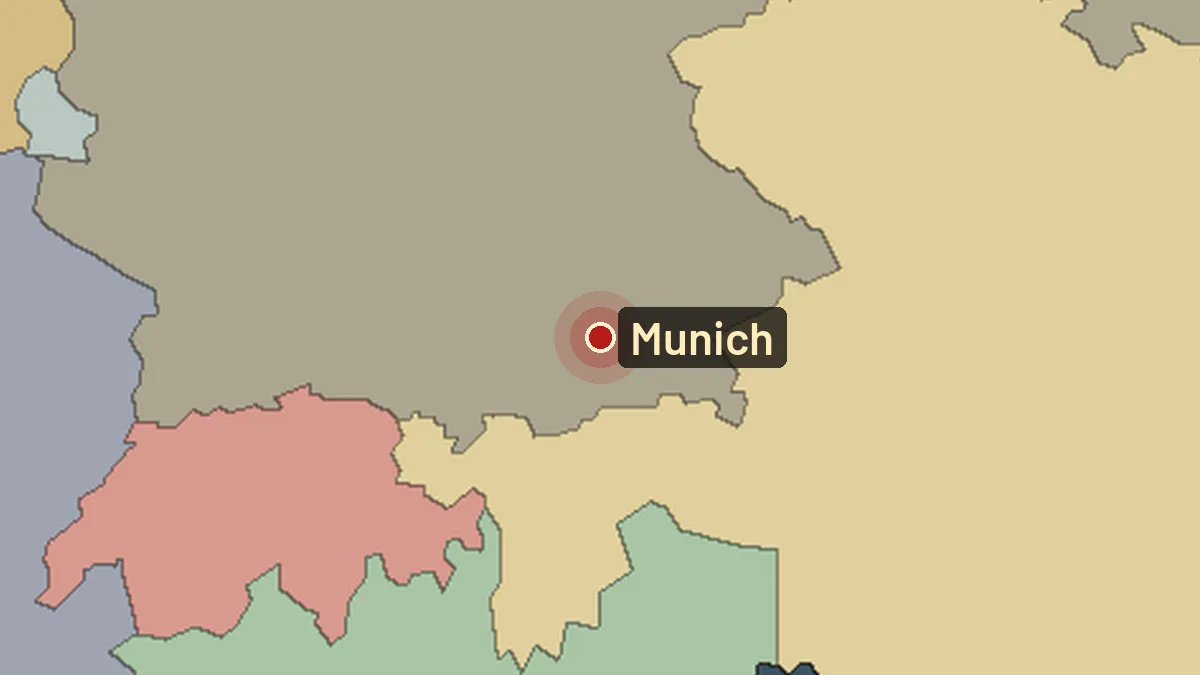
In the early hours of 30 September 1938, four leaders signed an agreement in Munich that decided the fate of a country whose representatives were waiting in a hotel nearby, not allowed into the room. Britain and France, Czechoslovakia's friends, had agreed with Hitler and Mussolini that the Czechoslovak border regions must go to Germany. Neville Chamberlain flew home and promised "peace for our time". Less than a year later Europe was at war. Munich has been a symbol ever since of the failure of appeasement.
A state built in 1918
Czechoslovakia was one of the new states born from the collapse of Austria-Hungary at the end of the First World War. Its leaders, Tomáš Masaryk and Edvard Beneš, built a parliamentary democracy, the only one in central Europe still standing by 1938, with a strong industry including the Škoda arms works.
The new state's borders followed the old frontiers of Bohemia and Moravia, which meant including around 3 million German speakers living mainly in the border regions, which came to be called the Sudetenland. Hit hard by the Great Depression and resentful of Czech rule, many Sudeten Germans turned to Konrad Henlein's Sudeten German Party, which by 1938 was taking orders from Berlin. Czechoslovakia had an alliance with France and a pact with the Soviet Union, and strong fortifications along its mountain border with Germany.
The crisis of 1938
After the annexation of Austria in March 1938, Czechoslovakia was surrounded on three sides. Hitler told Henlein to keep making demands that Prague could not accept, while the German army prepared plans for an attack. In May rumours of German troop movements led Czechoslovakia to mobilize partly, and Hitler, humiliated by talk that he had backed down, resolved to destroy the country.
In September, Hitler's speech at the Nuremberg rally and violence in the Sudetenland brought Europe close to war. The British Prime Minister, Neville Chamberlain, believed that the grievances of the Versailles settlement could be fixed by negotiation, and that Britain, with its rearmament incomplete, was not ready to fight. He flew to meet Hitler at Berchtesgaden on 15 September and accepted the principle that the Sudeten areas with German majorities should be transferred. Britain and France then pressed Czechoslovakia to agree.
When Chamberlain returned to Hitler at Bad Godesberg on 22–23 September, Hitler raised his demands: immediate occupation by German troops by 1 October. Chamberlain at first refused. Czechoslovakia mobilized, France called up reservists and the British fleet was readied. In a radio broadcast on 27 September Chamberlain spoke of the horror of going to war "because of a quarrel in a far-away country between people of whom we know nothing".
Munich
At the last moment, with Mussolini's help, Hitler agreed to a four-power conference in Munich on 29 September. Hitler, Chamberlain, the French Prime Minister Édouard Daladier and Mussolini met at the Führerbau, the Nazi party building. The Soviet Union was not invited, and the Czechoslovak delegates were only told the result. The agreement, signed shortly after midnight, gave Germany the Sudetenland in stages between 1 and 10 October, with an international commission to settle the details and vague promises to guarantee what was left of Czechoslovakia.
The next morning Chamberlain had Hitler sign a short Anglo-German declaration that the two peoples would never go to war again. Back in London, he waved it to the crowds and, from a window of 10 Downing Street, said he believed it was "peace for our time". Daladier, by contrast, was reportedly surprised by the cheering crowds that greeted him in Paris.
Consequences
Czechoslovakia lost its fortified border, millions of inhabitants and much of its industry, and what remained was left defenceless. President Beneš resigned and went into exile. Poland seized the Teschen area, and in November Hungary received a large strip of southern Slovakia. In March 1939 Germany occupied Prague and the rest of the Czech lands, proving that Hitler's aims went far beyond the Germans of the Sudetenland. Britain and France then gave guarantees to Poland, the step that led to war in September 1939.
Historians still debate Munich. Its critics argue that Britain and France threw away a well-armed ally and its fortifications, and that some German generals were preparing to move against Hitler if he started a war. Its defenders argue that Britain and France were not ready, that public opinion would not support war, and that the year gained allowed Britain to build fighters and radar. For the Soviet Union, being left out of Munich strengthened Stalin's distrust of the West.
Did you know?
- Chamberlain was 69 when he flew to Berchtesgaden, and it was his first flight on an aeroplane.
- In Czech the agreement is often called the "Munich betrayal", and "about us without us" became a common phrase for it.
Munich in World Wars: 1914–20XX
The game currently covers the First World War, and a 1939 scenario is planned. The Munich Agreement is part of the game's event database for that scenario. It is designed as a decision for Britain: follow appeasement and let the Sudetenland pass to Germany, or give Czechoslovakia a guarantee and raise the tension with Germany sharply. In the historical outcome the Sudetenland is transferred and Czechoslovakia's stability falls.
The roots of the crisis lie in the world you can play today: the Austria-Hungary that broke apart in 1918, the peace treaties of 1919, and Britain's memory of the losses of the Somme and Passchendaele. Start in 1914 and decide for yourself how the old empires should end.
▶ Play now Free in your browser, no download needed.
Further reading: Wikipedia (English)