World Wars: 1914–20XX
First World War (1914–1918)
The Ottoman Empire in World War I (1914–1918): fighting on six fronts
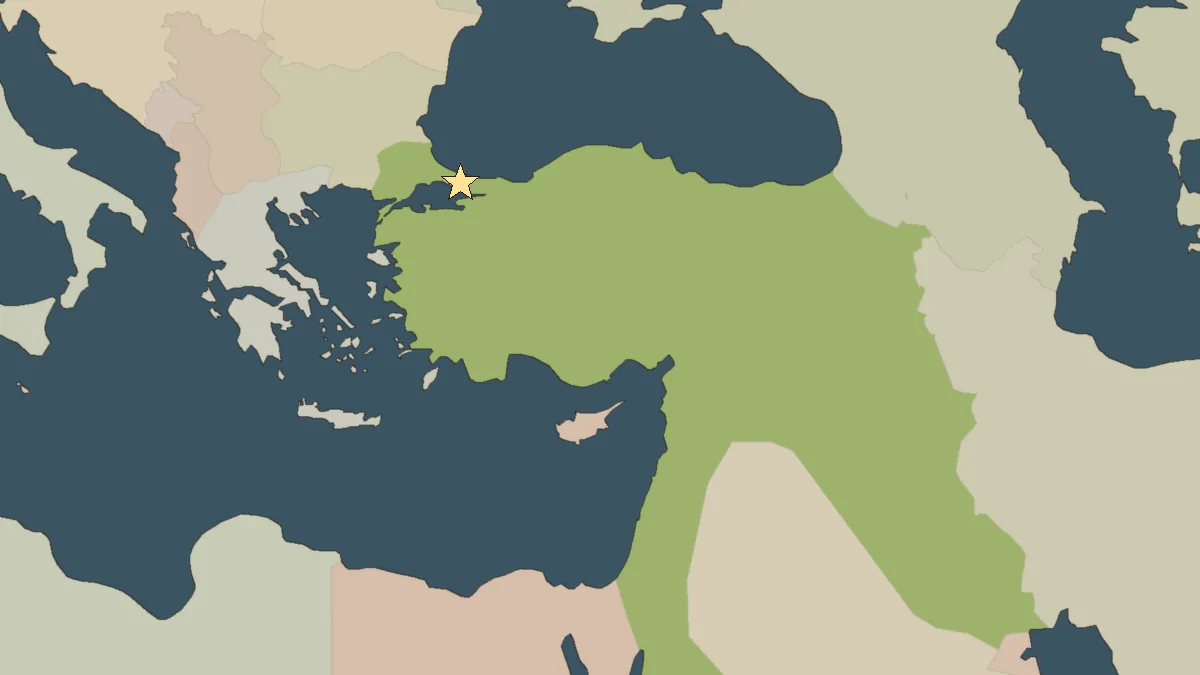
When the First World War began, the Ottoman Empire had just lost almost all its European provinces in the Balkan Wars. Many observers expected it to be a minor player. Instead it fought for four years on fronts stretching from the Caucasus mountains to the Suez Canal, the Dardanelles, the rivers of Iraq and the deserts of Arabia, won one of the war's most famous defensive victories at Gallipoli, and ended the war defeated and occupied. From its ruins came the modern Middle East and the Republic of Turkey.
Choosing a side
Since the coup of 1913 the empire had been run by the Committee of Union and Progress (CUP), dominated by three men: Enver Pasha, the war minister; Talat Pasha, the interior minister; and Cemal Pasha, the navy minister. Sultan Mehmed V reigned but held little power. The CUP leaders feared that the empire, isolated and weakened, would be carved up by the great powers, and above all they feared Russia, which wanted Istanbul and the straits.
On 2 August 1914 the grand vizier, Said Halim Pasha, with Enver's strong backing, signed a secret alliance with Germany. The same month Britain took over two battleships that the Ottomans had ordered and largely paid for in British yards, which caused anger in Istanbul. Two German warships, the battlecruiser Goeben and the light cruiser Breslau, escaped British pursuit in the Mediterranean and entered the Dardanelles; they were nominally transferred to the Ottoman navy as Yavuz Sultan Selim and Midilli, keeping their German crews. On 29 October 1914 they led an Ottoman squadron in raids on Russian Black Sea ports. Russia declared war in early November, followed by Britain and France, and in mid-November the sultan, as caliph, proclaimed a holy war against the Entente.
Many fronts at once
In the Caucasus, Enver himself led an ambitious winter offensive against the Russians at Sarıkamış in December 1914. Poorly supplied troops marched through deep snow and freezing mountains, and the Third Army was largely destroyed, more by cold and disease than by battle. In February 1915 Cemal Pasha led an attack across the Sinai on the Suez Canal, which was beaten back.
The empire's great success came at the Dardanelles. On 18 March 1915 the Allied fleet's attempt to force the straits failed with the loss of three battleships to mines, and the landings on the Gallipoli peninsula from 25 April became an eight-month stalemate. The Allies evacuated in January 1916. Lieutenant Colonel Mustafa Kemal emerged from the campaign as a national hero. A few months later, in April 1916, a British and Indian force besieged at Kut in Iraq surrendered to the Ottoman army.
The tide turns
From 1916 the pressure became too great. In the east, the Russians took Erzurum and Trabzon. In June 1916 Sharif Hussein of Mecca launched the Arab Revolt with British support, and the Hejaz railway became a target for raids. British forces took Baghdad in March 1917 and, after battles around Gaza, Jerusalem in December 1917. Ottoman troops also served in Europe, in Galicia, Romania and Macedonia, alongside their allies. Desertion grew, and famine struck parts of the empire, especially Lebanon and Syria.
The Russian Revolution brought a brief recovery in the east: under the Treaty of Brest-Litovsk in March 1918 the empire regained Kars, Ardahan and Batum, and Ottoman troops reached Baku in September 1918. But in the same month the British broke the Palestine front at Megiddo and advanced to Damascus and Aleppo, and Bulgaria's surrender cut the land link to Germany.
Civilian suffering
The war was also a catastrophe for the empire's civilians. Muslims, Christians and Jews alike died in great numbers from fighting, famine and epidemics, and millions of people were displaced as the front lines moved across eastern Anatolia, Mesopotamia, Syria and Palestine. The blockade of the coasts and the loss of farm labour to the army brought hunger even to cities far from the front.
Mudros and after
On 30 October 1918 the Ottoman delegation signed an armistice with Britain aboard HMS Agamemnon in the harbour of Mudros on Lemnos. The straits were opened, Allied fleets anchored off Istanbul, and the armistice allowed Allied occupation of strategic points. Enver, Talat and Cemal fled the country on a German ship in early November. The Treaty of Sèvres of 1920 would have reduced the empire to a rump state, but it was never put into effect: the national movement led by Mustafa Kemal fought the War of Independence, the sultanate was abolished in 1922, and the Republic of Turkey was proclaimed in 1923.
Did you know?
- The former Goeben, as Yavuz, stayed in Turkish service until 1950 and was only scrapped in the 1970s; few warships of her era served so long.
- The Ottoman government adopted the Gregorian day-and-month system in 1917, during the war, although years continued to be counted in the older Rumi calendar until 1926.
The Ottoman Empire in World Wars: 1914–20XX
The Ottoman Empire is one of the 26 states on the 1914 map, so you can lead it, and its entry is in the in-game encyclopedia from the start. In the Historical (1914) scenario the game pauses on 29 October 1914 and you decide whether to enter the war on the side of the Central Powers or keep armed neutrality, which strains relations with Germany. If you go to war, new fronts open, the straits close and the empire is at war with Russia, Britain and France; the Enver Pasha entry unlocks. Sarıkamış, Gallipoli (which makes Mustafa Kemal a national hero), Kut, the Arab Revolt, Baghdad, Jerusalem and Megiddo follow, and at Mudros you choose between signing the armistice and fighting on.
In the Parallel Fronts scenario the same six fronts are fought with armoured divisions, bomber wings and aircraft carriers. Can you hold the empire together where its leaders could not?
▶ Play now Free in your browser, no download needed.
Further reading: Wikipedia (English)