World Wars: 1914–20XX
First World War (1914–1918)
German Invasion of Belgium (1914): Liège, a scrap of paper and Britain
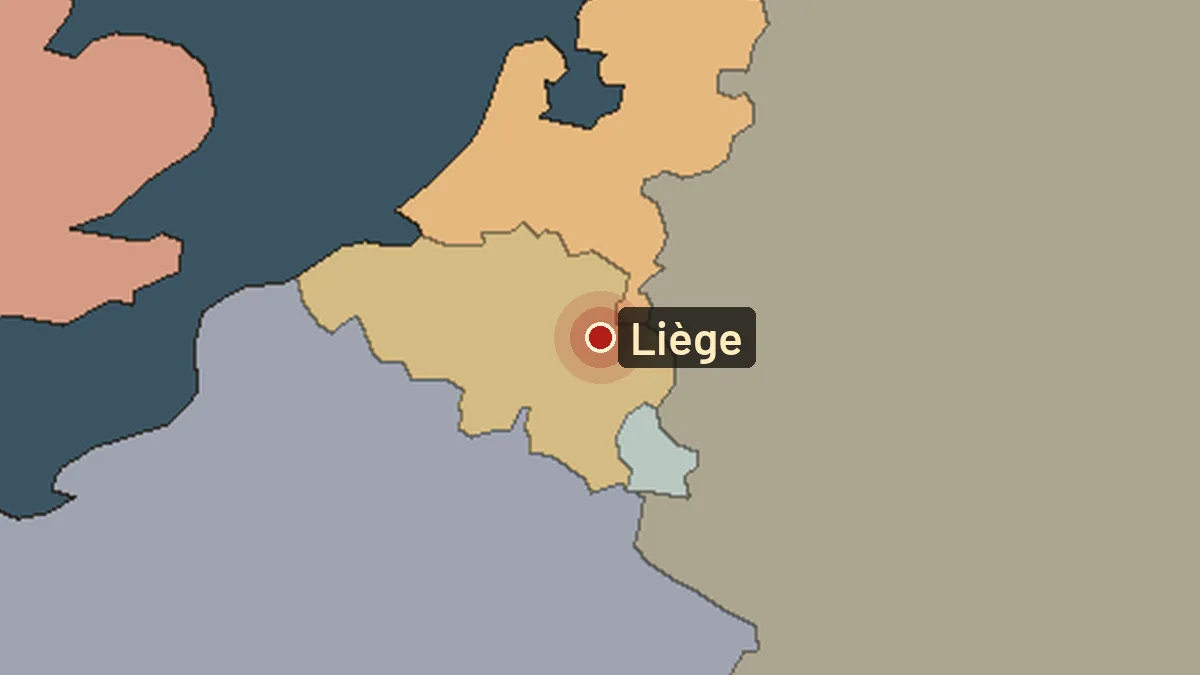
Belgium had done nothing to provoke a war in 1914. Its neutrality was guaranteed by the great powers, Germany included. But it lay on the shortest road from Germany into northern France, and the German war plan required that road. On 4 August 1914 German troops crossed the Belgian frontier. Belgium chose to fight rather than let them through, and the same day Britain declared war on Germany. The invasion turned a continental war into a world war and made "poor little Belgium" a symbol across the Allied world.
A guaranteed neutrality
Belgium became independent from the Netherlands in 1830. In the Treaty of London of 1839, Britain, France, Prussia, Austria and Russia recognised it as an independent and "perpetually neutral" state. For Britain the treaty had a strategic purpose: it kept the coast facing England, with the great port of Antwerp, out of the hands of any major power.
For the German General Staff, Belgian neutrality was an obstacle. The French frontier with Germany was short and heavily fortified, so the plan developed by Alfred von Schlieffen and adapted by Helmuth von Moltke sent the strong right wing of the German army through Belgium in a wide sweep around the French fortresses. Moltke dropped Schlieffen's idea of crossing the Dutch province of Limburg as well, which meant that the whole right wing had to pass through a narrow corridor near Liège. The Belgian forts there had to be taken in the first days of the war.
The ultimatum
On the evening of 2 August, the German minister in Brussels delivered a note claiming that France intended to advance through Belgium and demanding free passage for German troops. Belgium was given 12 hours to answer. If it agreed, it would be compensated; if it resisted, it would be treated as an enemy. King Albert I and his government met through the night and refused unanimously the next morning. Albert, who was also commander-in-chief, appealed to the guarantor powers for help.
In London, the foreign secretary, Sir Edward Grey, told the House of Commons on 3 August that Britain could not stand by if Belgian neutrality was violated. On 4 August Britain demanded that Germany withdraw from Belgium by 11 p.m. London time. In Berlin, Chancellor Theobald von Bethmann Hollweg told the British ambassador that Britain was going to war over a "scrap of paper", a phrase that soon appeared on British recruiting posters. No answer came, and at 11 p.m. on 4 August Britain and its empire were at war with Germany.
Liège and the advance
German troops entered Belgium on the morning of 4 August near Gemmenich. Liège was protected by a ring of twelve forts built in the 1880s by the engineer Henri Alexis Brialmont and defended by General Gérard Leman. The first German assaults on the night of 5 to 6 August were thrown back with heavy losses. When one brigade's commander was killed, Major General Erich Ludendorff, a staff officer, took command and on 7 August marched into the city and took the citadel. The forts, however, still blocked the roads and railways.
Germany then brought up its heaviest siege artillery, including the 42 cm Krupp howitzers nicknamed "Big Bertha" and Austro-Hungarian 30.5 cm Škoda mortars. Their shells smashed the concrete of the old forts. Fort Loncin was destroyed by an explosion in its magazine on 15 August, and Leman was found unconscious in the ruins. The last forts surrendered on 16 August. Liège had delayed the German timetable by a few days, though historians disagree on how much that mattered.
The German armies then poured through Belgium. Brussels was occupied on 20 August and the fortress of Namur fell days later. The Belgian field army withdrew to the fortified port of Antwerp, from where it attacked the flank of the German advance. Antwerp fell on 10 October after another heavy bombardment, but the army escaped west to the river Yser. There, at the end of October, the Belgians opened the sluices at Nieuwpoort and flooded the low ground, halting the German advance. A small corner of Belgium behind the Yser stayed free for the rest of the war.
Occupation and atrocities
The German troops, convinced that Belgian civilians were waging a guerrilla war (as French irregulars had done in 1870), reacted to real and imagined shots with mass executions and the burning of towns. In August 1914 several hundred civilians were killed in Dinant alone, and in Leuven (Louvain) much of the old town and the university library, with its hundreds of thousands of books and medieval manuscripts, were burned. Historians estimate that about 6,500 civilians were killed in Belgium and northern France in 1914. Allied propaganda exaggerated some of these events into stories of the "Rape of Belgium", and some of those inventions were later exposed, which for a time led many to doubt that the real killings had happened at all. Research has since confirmed them.
For four years Belgium lived under a harsh occupation, with requisitions, forced labour and food shortages, eased by an international relief effort organised by the American Herbert Hoover.
Did you know?
- King Albert I commanded his army in person throughout the war from the small strip of unoccupied land behind the Yser and became known as the "Soldier King".
- The library of Leuven was rebuilt after the war with American donations, only to be burned again during the German invasion of 1940.
Belgium in World Wars: 1914–20XX
In the Historical (1914) scenario this event arrives on 4 August 1914. Germany declares war on Belgium, Britain declares war on Germany, and both Britain and Belgium join the Entente. The Western Front opens, and British war support rises. The Belgium entry unlocks in the in-game encyclopedia.
Belgium is one of the 26 playable states on the 1914 map, so you can take King Albert's place and decide how long Liège and Antwerp can hold. In the Parallel Fronts scenario the German right wing rolls in with armoured divisions and bombers, and Belgium's forts face a far more modern enemy. Can a small neutral country make the giant pay for every kilometre?
▶ Play now Free in your browser, no download needed.
Further reading: Wikipedia (English)
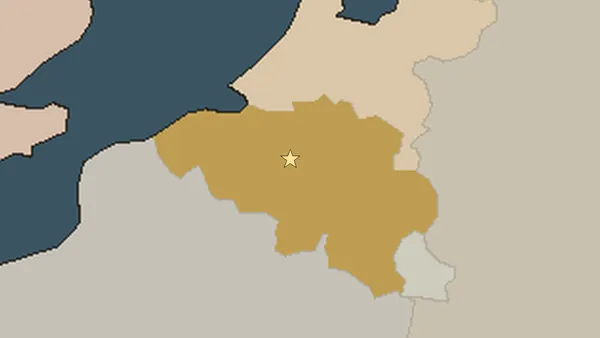 Belgium in WWI