World Wars: 1914–20XX
First World War (1914–1918)
Second Battle of Ypres (1915): the first great poison gas attack
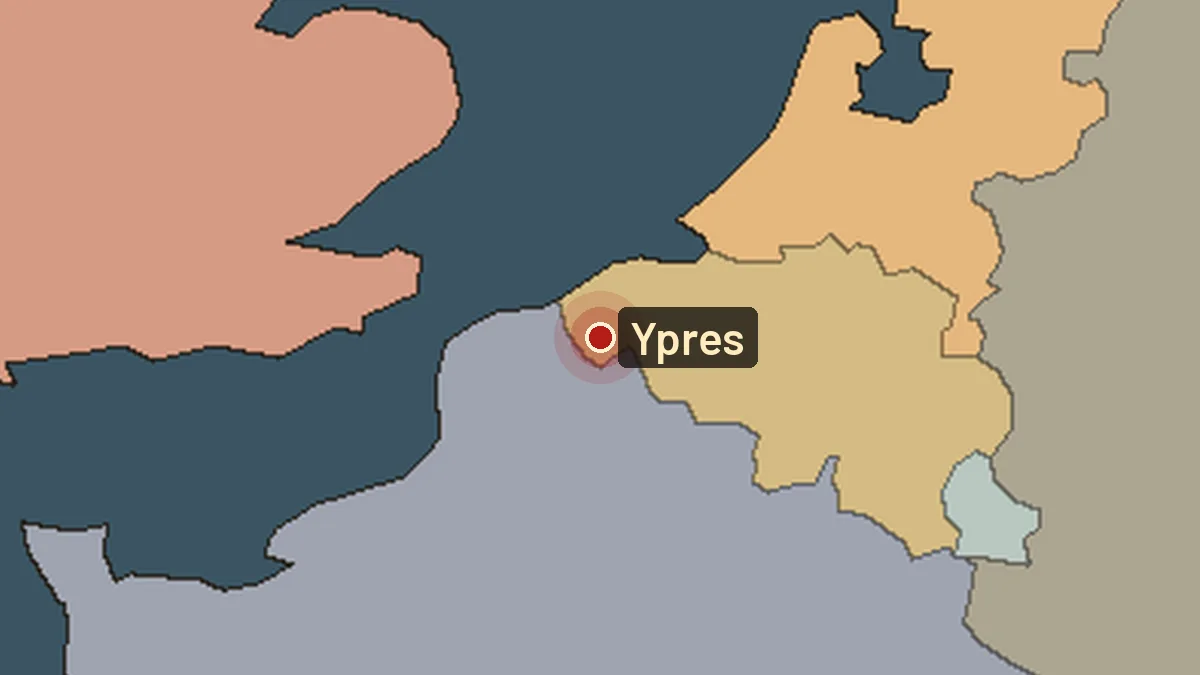
Late in the afternoon of 22 April 1915, French soldiers north of the Belgian town of Ypres saw a strange yellow-green cloud rising from the German trenches and drifting towards them on the breeze. Within minutes men were choking, coughing and collapsing. Those who could ran. A gap several kilometres wide opened in the Allied line. The Second Battle of Ypres was the first time poison gas was used on a large scale in war, and it changed the nature of the fighting on the Western Front for the rest of the war.
The salient
Ypres, an old cloth-trading town in Flanders, was the last important piece of Belgium still in Allied hands. In the autumn of 1914 the British, French and Belgians had held it in the bloody First Battle of Ypres, and the front had settled into a bulge, or salient, pushing into the German lines east of the town. Salients were dangerous to hold, because the enemy could fire into them from three sides.
By early 1915 the German chief of staff, Erich von Falkenhayn, was preparing his main effort against Russia in the east. In the west he wanted only limited attacks, and he agreed to test a new weapon at Ypres.
Germany's new weapon
German chemists, led by Fritz Haber of the Kaiser Wilhelm Institute in Berlin, proposed releasing chlorine, a heavy gas produced in quantity by Germany's chemical industry, from pressurised cylinders dug into the front line. When the wind blew towards the enemy, the gas would roll across no man's land and sink into the trenches. Germany had already fired shells filled with an irritant gas against the Russians at Bolimów in January 1915, but in the freezing cold it had little effect.
The 1899 Hague Declaration banned projectiles meant to spread asphyxiating gases. German officials argued that gas released from cylinders was not a projectile. Thousands of cylinders were installed opposite Ypres, but for weeks the wind was wrong.
22 April and the Canadian stand
At about five in the evening on 22 April the wind finally turned. Around 150 tonnes of chlorine were released along about 6 kilometres of front near Langemarck, against two French divisions, one of them made up of colonial troops from Algeria and the other of older Territorial soldiers. Chlorine attacks the lungs and eyes; men drowned in the fluid it caused. The French line broke. Many men died, although estimates of the number vary widely.
The Germans advanced several kilometres, but cautiously. Their infantry had no proper protection against their own gas, the attack had been planned as a limited test, and there were no large reserves ready to exploit the breach. On the edge of the gap stood the 1st Canadian Division, in its first major battle. The Canadians and British troops rushed up from reserve threw themselves into the breach in a series of desperate counter-attacks. On 24 April the Germans released gas again, this time directly at the Canadians near St Julien. Without masks, soldiers held wet cloths, sometimes soaked in urine, over their faces. Their line was pushed back but not broken.
A month of fighting
The battle continued into May with renewed German attacks, more gas and heavy shelling. The British commander, General Horace Smith-Dorrien, recommended withdrawing to a shorter line; he was removed from command, and his successor, General Herbert Plumer, carried out much the same withdrawal soon afterwards. When the fighting ended on 25 May the salient was much smaller, and the Germans held ridges from which they could shell Ypres. The town itself, including its great medieval Cloth Hall, was gradually reduced to ruins.
What it changed
Militarily, the result was limited. The Allies kept Ypres, and the Germans had given away the secret of a powerful weapon for a small gain. But the moral line had been crossed. Within months both sides were using gas. The British released their own chlorine at Loos in September 1915, and over the next three years armies turned to deadlier agents such as phosgene and mustard gas. Gas masks became part of every soldier's equipment, and the image of men in masks became one of the symbols of the war.
Did you know?
- The Canadian doctor John McCrae wrote the poem "In Flanders Fields" during the Second Battle of Ypres in May 1915, after the death of a friend. It made the red poppy the symbol of remembrance for the war dead.
- Ypres gave its name to the deadliest gas of the war: the Germans first used mustard gas near the town in July 1917, and the French called it "yperite".
Ypres and gas in World Wars: 1914–20XX
The Second Battle of Ypres has its own entry in the in-game encyclopedia, which unlocks on 22 April 1915, the day of the first great gas attack. The Poison gas entry unlocks on the same day, telling how chlorine, phosgene and mustard gas were used and how gas masks reduced their effect. In the Historical (1914) scenario the Western Front is by then locked in trench warfare, and the question is whether any new weapon can break the deadlock.
In the Parallel Fronts scenario, where engines, radio and flight matured decades early, the war in Flanders is fought with armoured divisions and air wings, but the trenches and the salient remain. Can you hold Ypres, or break the line where 1915's generals could not?
▶ Play now Free in your browser, no download needed.
Further reading: Wikipedia (English)