World Wars: 1914–20XX
Second World War (1939–1945)
The Soviet Invasion of Poland (1939) and the partition that followed
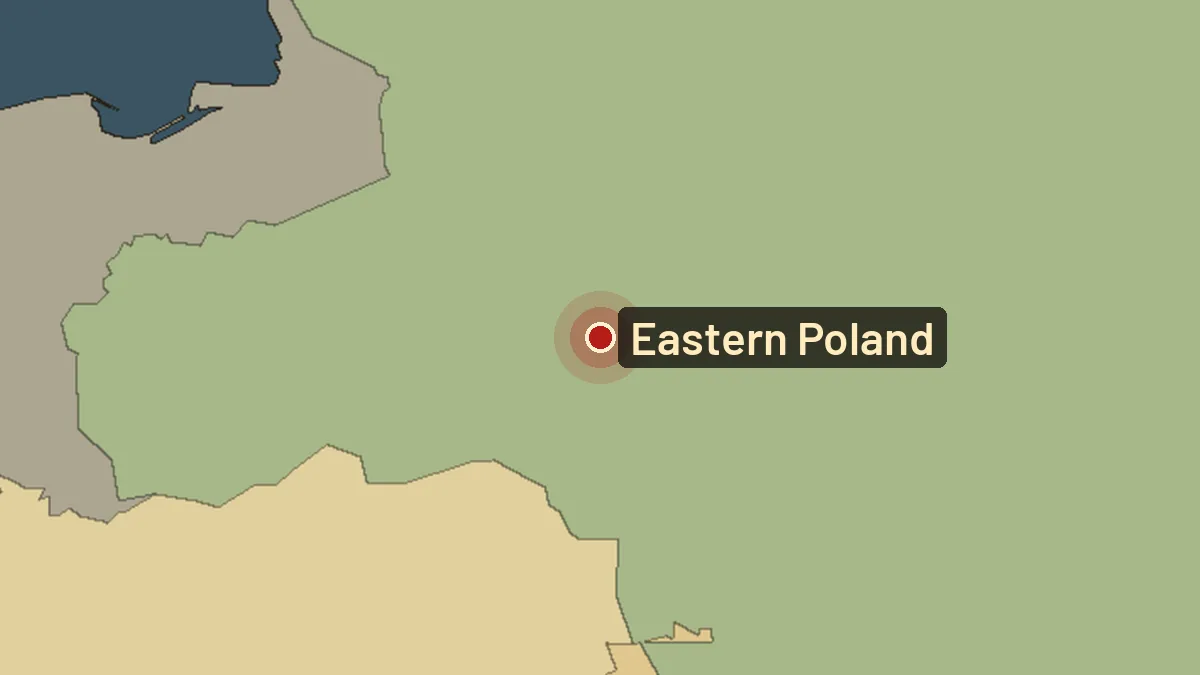
Early on 17 September 1939, while the Polish army was still fighting the Germans around Warsaw and on the Bzura, the Soviet Red Army crossed Poland's eastern border along its whole length. Moscow claimed that the Polish state had ceased to exist and that it was protecting the Ukrainians and Belarusians of the region. In reality it was carrying out the secret protocol it had signed with Nazi Germany less than a month earlier. Within three weeks Poland had been divided between its two neighbours, and some 13 million of its citizens were under Soviet rule.
A secret line through Poland
On 23 August 1939 the foreign ministers Vyacheslav Molotov and Joachim von Ribbentrop signed a German-Soviet non-aggression pact in Moscow. Its public text promised neutrality. Its secret additional protocol, whose existence the Soviet Union denied for fifty years, divided Eastern Europe into spheres of interest. In Poland the line followed the rivers Narew, Vistula and San, giving the Soviets roughly the eastern half of the country.
These eastern borderlands had a long and contested history. Russia had ruled them before 1914. After the First World War and the Polish-Soviet War of 1919–1921, the Treaty of Riga left them to Poland. Their population was mixed: Poles, Ukrainians, Belarusians, Jews and Lithuanians, with Poles dominant in the towns and among landowners. Soviet propaganda played on these divisions.
Germany had pressed Moscow to enter the war from the first days of September. Stalin waited until the Polish army was clearly beaten and until a ceasefire with Japan, after the battles at Khalkhin Gol in Mongolia, had been agreed on 15 September.
The Red Army moves in
The Soviets attacked with two fronts, the Belorussian under Mikhail Kovalyov and the Ukrainian under Semyon Timoshenko, together several hundred thousand men with large numbers of tanks. Facing them were thin border troops and units that had retreated from the west. Marshal Rydz-Śmigły, the Polish commander-in-chief, ordered his forces not to fight the Soviets except in self-defence or when attacked, hoping to save what remained of the army for a last stand near Romania.
In many places resistance was therefore limited, and some local Ukrainian and Jewish communities welcomed the Red Army. Elsewhere there was hard fighting. The city of Grodno was defended for several days by soldiers, police, scouts and civilians, some of them using petrol bombs against Soviet tanks. The Border Protection Corps fought a significant action at Szack at the end of September. Lwów (today Lviv) was surrounded by both German and Soviet troops and surrendered to the Soviets on 22 September.
The same day German and Soviet troops held a joint parade at Brest-Litovsk as the town was handed over to the Red Army, a striking image of the new partnership. Polish prisoners, including many officers, were taken east in large numbers, and in some places captured soldiers, policemen and officials were shot.
The fourth partition
On 28 September Germany and the Soviet Union signed a Boundary and Friendship Treaty. It moved the line east to the river Bug, giving Germany more of central Poland around Lublin and Warsaw, while Lithuania passed into the Soviet sphere. Poles call this the fourth partition of their country, after the three of the eighteenth century.
The Soviets then held staged elections to "people's assemblies", which asked to join the Soviet Union. In November 1939 the territories were annexed to the Ukrainian and Belorussian Soviet republics. Wilno (Vilnius) had already been handed to Lithuania in October, shortly before Lithuania itself was absorbed by the Soviet Union in 1940.
Soviet rule was harsh. Property was nationalised, Polish institutions closed, and in 1940 and 1941 hundreds of thousands of people, many of them families of officers, officials, settlers and so-called class enemies, were deported to Kazakhstan, Siberia and the Soviet north. In the spring of 1940 the NKVD secret police shot about 22,000 Polish officers, policemen and members of the elite in the Katyn forest and other sites. The Soviet Union blamed Germany for the Katyn massacre and admitted its responsibility only in 1990.
The border drawn in 1939 broadly followed the Curzon Line proposed by the Allies in 1919–1920. After 1945 it became, with small changes, the eastern border of post-war Poland, and the country was shifted westwards onto former German land.
Did you know?
- When Germany invaded the Soviet Union in 1941, Stalin released many Polish prisoners and deportees to form an army under General Władysław Anders. It left the Soviet Union through Iran and later fought in Italy, most famously at Monte Cassino in 1944.
- Britain's guarantee to Poland covered only aggression by Germany, so Britain and France did not declare war on the Soviet Union after 17 September.
The Soviet invasion of Poland in World Wars: 1914–20XX
World Wars: 1914–20XX currently covers the First World War; a 1939 scenario is planned, and the Soviet invasion of Poland is already part of the game's event database for it. There the event is designed to follow the secret protocol: the Soviet Union declares war on Poland, eastern Poland passes to the Soviets, western Poland to Germany, and the Polish state is partitioned.
In the 1914 map you can play today, these same borderlands are part of the Russian Empire, facing Germany and Austria-Hungary across the front lines of the Eastern Front. Lead Russia in 1914, or try the Parallel Fronts scenario where tanks and aircraft roll across those plains decades early, and see who ends up holding them.
▶ Play now Free in your browser, no download needed.
Further reading: Wikipedia (English)