World Wars: 1914–20XX
Second World War (1939–1945)
The Winter War (1939–40): how Finland held off the Soviet Union
On 30 November 1939 Soviet bombers struck Helsinki and the Red Army crossed the Finnish border along its whole length, from the Gulf of Finland to the Arctic Ocean. Moscow expected the campaign to last a couple of weeks. Instead, a country of fewer than four million people held off the world's largest army through the coldest winter in decades. Finland lost territory in the peace of March 1940, but it kept its independence, and the Red Army's clumsy performance was noticed in Berlin and around the world.
A border too close to Leningrad
Finland had been an autonomous grand duchy of the Russian Empire for more than a century. It declared independence in December 1917, after the Bolshevik revolution, and survived a short, bitter civil war in 1918 in which the Whites, led by the former Russian imperial officer Carl Gustaf Emil Mannerheim, defeated the Reds. The border then ran only about 30 kilometres from Petrograd, later Leningrad, the Soviet Union's second city.
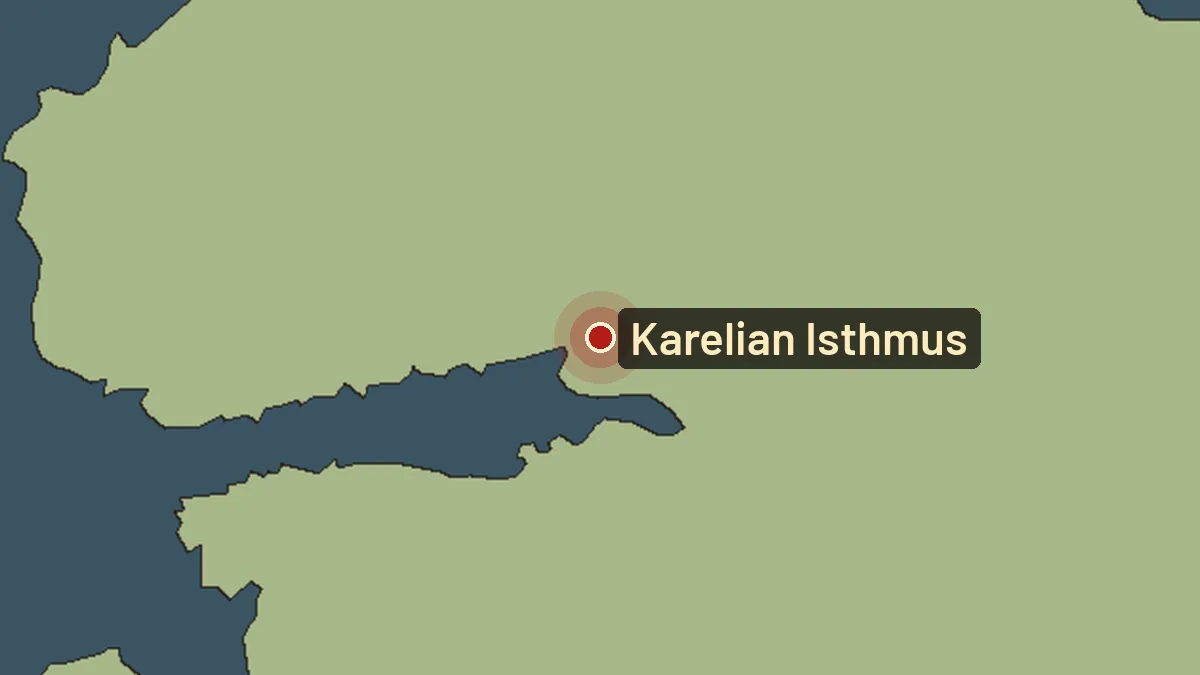
The Nazi-Soviet pact of August 1939 placed Finland in the Soviet sphere. In October Stalin invited a Finnish delegation to Moscow and demanded that the border on the Karelian Isthmus be moved back, that several islands in the Gulf of Finland be handed over and that the Hanko peninsula be leased as a naval base. In exchange he offered a larger but empty stretch of forest in eastern Karelia. The Finns were willing to give some ground but not Hanko or their main defensive line, and talks broke down in November.
On 26 November the Soviets claimed that Finnish artillery had shelled the village of Mainila on their side of the border. Historians widely agree that the shots were fired by Soviet forces themselves. Four days later the invasion began, and the Soviets set up a puppet "Finnish Democratic Republic" under the exiled communist Otto Kuusinen in the border town of Terijoki.
Snow, forests and the Mannerheim Line
The Red Army attacked with roughly half a million men in the first phase, with thousands of tanks and aircraft. The Finns could field about 300,000 soldiers, very few tanks, little artillery ammunition and an air force of a little over a hundred planes. Mannerheim, now 72, became commander-in-chief.
On the Karelian Isthmus the Soviets ran into the Mannerheim Line, a chain of trenches, bunkers, obstacles and a few concrete strongpoints between the Gulf of Finland and Lake Ladoga. It was far weaker than later propaganda suggested, but Soviet attacks in December were poorly coordinated and failed with heavy losses.
Further north, where roads were few and the forest endless, Soviet divisions advanced in long columns tied to the roads. Finnish ski troops, dressed in white and moving silently through the woods, cut the columns into isolated pockets, which the Finns called motti, after the word for a stacked cubic measure of firewood. At Suomussalmi and on the Raate road in December and early January, two Soviet divisions were destroyed in temperatures that fell below minus 40 degrees. Finnish soldiers used bottles of petrol against tanks and named them "Molotov cocktails", a joke at the expense of the Soviet foreign minister, who had claimed that Soviet planes were dropping food, not bombs.
The February offensive and a hard peace
The Soviet Union was expelled from the League of Nations on 14 December, and volunteers and supplies arrived from Sweden and elsewhere. Britain and France discussed sending an expeditionary force, partly as a pretext to seize the Swedish iron ore fields on the way, but nothing arrived in time.
Stalin reorganised. Semyon Timoshenko took command on the Isthmus, the Kuusinen government was quietly dropped, and fresh troops, guns and tanks were massed. A huge offensive began on 1 February 1940 with days of artillery fire, and on 11 February the line broke near Summa. The exhausted Finns fell back towards Viipuri (Vyborg). With no reserves left and no real help in sight, the government sought terms.
The Treaty of Moscow was signed on 12 March and the fighting stopped at noon the next day. Finland ceded about 11 per cent of its territory, including the Karelian Isthmus, Viipuri, its second city, and the shores of Lake Ladoga, and leased Hanko to the Soviets. More than 400,000 Karelians, about an eighth of the population, chose to leave their homes rather than live under Soviet rule.
The Soviet Union had won, but the cost was staggering, and the image of an incompetent Red Army encouraged Hitler to believe it could be beaten quickly. The Soviets drew lessons and began reforms. Finland, seeking to recover its lost lands, joined the German attack on the Soviet Union in June 1941, beginning what Finns call the Continuation War.
Did you know?
- The Finnish sniper Simo Häyhä is credited with several hundred kills during the war, more than any other sniper in history, though the exact figure is debated.
- In Finland the national unity of 1939–40, uniting former Whites and Reds only twenty years after their civil war, is remembered as the "spirit of the Winter War".
The Winter War in World Wars: 1914–20XX
World Wars: 1914–20XX currently covers the First World War; a 1939 scenario is planned, and the Winter War is already part of the game's event database for it. There it is designed as a long, costly war: the Soviet Union attacks Finland, both sides suffer heavy manpower losses, the world's view of the Red Army's quality drops, and after about 104 days a peace hands Karelia to the Soviets.
In the 1914 map Finland does not yet exist as a state: it is part of the Russian Empire, and it was the collapse of that empire in 1917 that made it independent. Play Russia in the Historical (1914) scenario and see whether you can hold your empire together, or try Parallel Fronts, where engines and aircraft change war in the northern forests a generation early.
▶ Play now Free in your browser, no download needed.
Further reading: Wikipedia (English)