World Wars: 1914–20XX
First World War (1914–1918)
Sultan Mehmed V Reşad (1844–1918): the Ottoman sultan of the First World War
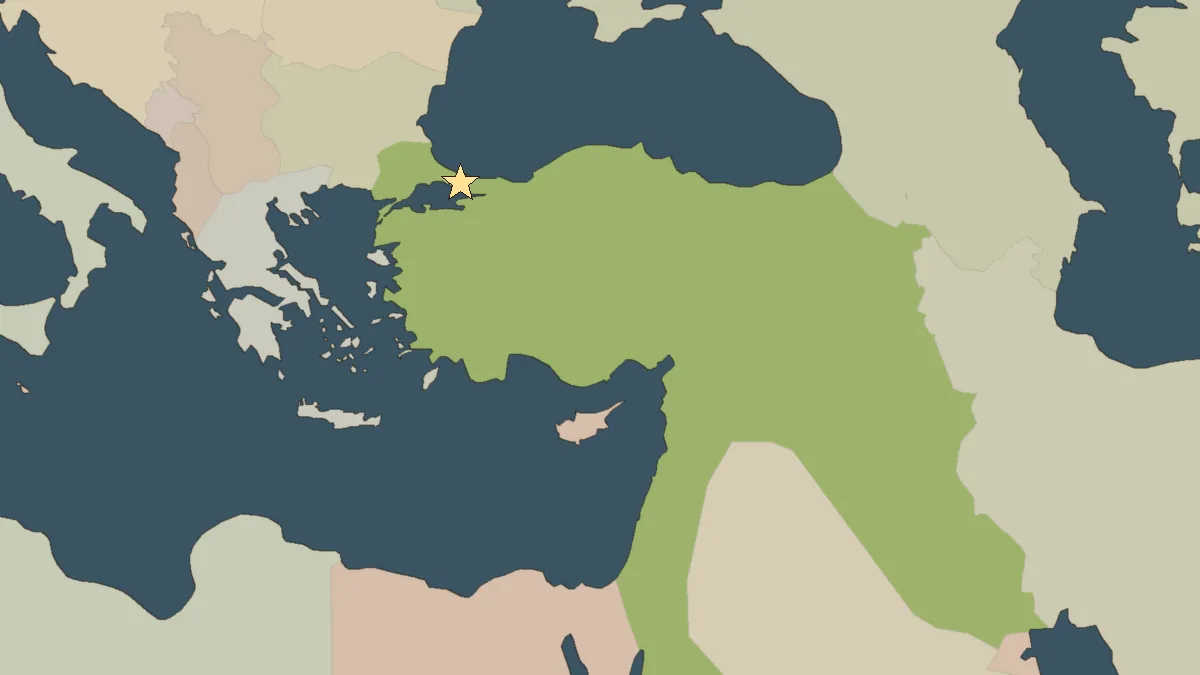
Mehmed V Reşad came to the throne at 64, after more than three decades of living quietly in the shadow of his brother Abdülhamid II. He was the first Ottoman sultan to begin his reign as a constitutional monarch, and he reigned rather than ruled: real power lay with the Committee of Union and Progress (CUP) and, from 1913, with the leaders Talat, Enver and Cemal. Yet it was in his name that the empire entered the First World War, and in his name, as caliph, that a holy war was proclaimed in November 1914.
A long wait
Mehmed Reşad was born in Istanbul in 1844, a son of Sultan Abdülmecid I. Two of his brothers, Murad V and Abdülhamid II, would reign before him. When Abdülhamid II took the throne in 1876, Reşad, as the next in line, became a figure to be watched. For some thirty years he lived largely confined to his residence, closely observed by the sultan's informers, cut off from political life. He passed the time with reading, music and religion; he was known for his attachment to the Mevlevi Sufi order.
Sultan of the constitution
The Young Turk Revolution of 1908 forced Abdülhamid to restore the constitution of 1876 and reopen parliament. In April 1909 a counter-revolt in Istanbul, known in Turkey as the 31 March Incident, was crushed by the "Action Army" marching from Salonica, and Abdülhamid was deposed. On 27 April 1909 Reşad was proclaimed sultan as Mehmed V. Amendments to the constitution that year cut the sultan's powers, and Mehmed V accepted the role of a constitutional monarch who signed what his governments put before him.
He was a gentle, pious and well-liked figure, but his reign was one of almost unbroken disaster for the empire. In 1911 he made a journey through the Balkan provinces, visiting Salonica, Skopje and the plain of Kosovo, a rare show of the sultan among his subjects meant to calm revolts in Albania. The same year Italy invaded Ottoman Libya, and by the peace of 1912 the empire had lost it. Then came the Balkan Wars of 1912–1913, in which Bulgaria, Serbia, Greece and Montenegro took almost all of the empire's remaining lands in Europe, including Salonica. Only Edirne was recovered in 1913.
In January 1913 Enver and his comrades stormed the Sublime Porte, the seat of government, and forced the grand vizier to resign. After the assassination of Grand Vizier Mahmud Şevket Pasha in June, the CUP took full control. From then on the sultan's approval was largely a formality.
Into the world war
The empire's leaders signed a secret alliance with Germany on 2 August 1914. Mehmed V is generally described as having had little enthusiasm for war, and part of the cabinet opposed it, but the decision lay with the CUP leadership, above all Enver Pasha. After the Ottoman fleet, led by the former German warships Yavuz and Midilli, bombarded Russian Black Sea ports at the end of October, Russia, Britain and France declared war in early November.
Because the Ottoman sultan was also caliph, the spiritual leader claimed by Sunni Muslims, his government and its German ally hoped to turn the war into a religious struggle. On 14 November 1914 a call to jihad was proclaimed in Istanbul in his name, urging Muslims in the British, French and Russian empires to rise. In practice the call had little effect: most Muslim soldiers in Allied armies continued to serve, and in 1916 the Sharif of Mecca led an Arab revolt against the Ottomans.
The war years brought both victory and catastrophe. Ottoman troops defeated the Allied landings at Gallipoli in 1915 and forced a British and Indian army to surrender at Kut in 1916, but suffered disaster in the Caucasus and steady losses in Mesopotamia and Palestine. Shortages, epidemics and inflation struck the whole population.
The last months
Mehmed V lived long enough to see Baghdad and Jerusalem lost to the British, but not the end of the empire. He died at Yıldız Palace on 3 July 1918, aged 73, and was buried in his tomb at Eyüp in Istanbul. His brother Mehmed VI Vahdeddin succeeded him and, four months later, faced the Armistice of Mudros on 30 October 1918. The sultanate itself was abolished in 1922, four years after Mehmed V's death.
Did you know?
- One of the two dreadnoughts ordered from Britain before the war, Reşadiye, was named after him. Britain seized it in August 1914 before it could be delivered.
- The gold coin known in Turkey as the "Reşat altını" was first minted in his reign, and it is still a familiar gift at weddings today.
Mehmed V in World Wars: 1914–20XX
Mehmed V Reşad has his own entry in the in-game encyclopedia, available from the start, and the Ottoman Empire is one of the states you can lead from 28 June 1914. In the Historical (1914) scenario, the Ottoman entry into the war on 29 October 1914 pauses the game and lets you decide: join the Central Powers, as Enver did, or keep the empire in armed neutrality, which strengthens stability at home but angers Germany.
Join the war and the Caucasus and Mesopotamian fronts open while the straits close. Ahead lie Gallipoli, Kut and the long defence of Palestine. Can you give the old sultan the victory his reign never had?
▶ Play now Free in your browser, no download needed.
Further reading: Wikipedia (English)