World Wars: 1914–20XX
First World War (1914–1918)
Joseph Joffre (1852–1931): "Papa Joffre", the French victor of the Marne
In the summer of 1914, the man responsible for France's survival was a heavy, white-moustached general of 62 who rarely raised his voice and never missed a meal. Joseph Joffre had planned an offensive that failed disastrously in the first weeks of the war. Yet when the German armies were closing on Paris, he kept his nerve, turned his retreating armies around and won the Battle of the Marne. For two years he was the most powerful man in France; then the slaughter of Verdun and the Somme cost him his command.
From the Pyrenees to the colonies
Joffre was born in 1852 in Rivesaltes, a small town near Perpignan in the far south of France, the son of a cooper. A gifted mathematician, he entered the elite École Polytechnique and served as a young officer during the siege of Paris in the Franco-Prussian War of 1870–71. He became a military engineer, and most of his career was spent building fortifications and railways rather than leading troops in battle.
Much of that work was done in the French colonial empire: in Taiwan and Indochina in the 1880s, in West Africa, where in 1894 he led a column to Timbuktu, and in Madagascar, where he fortified the naval base of Diego Suarez. Back in France he rose steadily. In 1911 he was appointed chief of the General Staff, with command of the army in wartime. He was chosen partly because he was considered loyal to the Republic and free of political or religious controversy.
Plan XVII and the disasters of August
Before 1914 the French army was dominated by the doctrine of the offensive: the belief that spirit and attack would overcome firepower. Joffre's war plan, Plan XVII, foresaw French offensives into Lorraine and the Ardennes. He underestimated the size of the German force that would come through Belgium, partly because he did not expect the Germans to use reserve corps in the front line.
In the Battle of the Frontiers in August 1914 the French attacks were shattered by German machine guns and artillery. France lost hundreds of thousands of men in a few weeks. Joffre reacted ruthlessly: he dismissed dozens of generals he considered incompetent, sending many to Limoges, far from the front, which gave the French language the verb limoger, "to sack".
The Marne
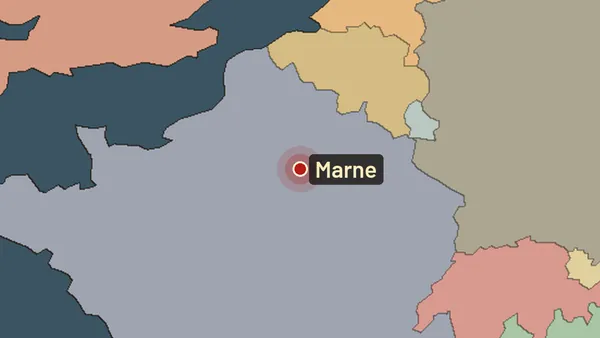
What made Joffre's reputation was what he did next. Instead of panicking, he organised an orderly retreat, used the railways to move troops from his right wing to his left, and created a new Sixth Army near Paris. When air and cavalry reconnaissance showed that General von Kluck's German First Army had turned east of Paris, exposing its flank, and General Gallieni in Paris urged an attack, Joffre ordered a general counter-offensive.
On 6 September 1914 his order of the day told the troops that the moment had come to stop looking back: units that could no longer advance must hold their ground at any cost rather than retreat. For six days the French and British fought along a front of over 200 kilometres, and the Germans fell back to the Aisne. Paris was saved, and with it France's chance to continue the war. Asked later who had won the Marne, Joffre is said to have replied that he did not know who had won it, but he knew who would have been blamed if it had been lost.
The years of attrition
After the Marne the front froze into trenches, and Joffre's strategy became one of continuous pressure. In 1915 he launched costly offensives in Artois and Champagne that gained little ground. Within the Allied coalition he pushed for coordinated attacks, and at Chantilly in December 1915 the Allies agreed to strike together in 1916.
Germany struck first. When the Germans attacked Verdun in February 1916, Joffre was criticised because the forts there had been stripped of many guns and the defences neglected. The battle was eventually held under Philippe Pétain and Robert Nivelle, but Joffre's reputation suffered. The Anglo-French offensive on the Somme from July 1916 brought enormous losses for limited gains. By the end of 1916 politicians had lost confidence in him. In December he was removed from active command, made Marshal of France, and replaced by Nivelle.
Later life
Joffre remained a respected figure. In 1917 he travelled to the United States with a French mission to welcome America into the war, and he was elected to the Académie française in 1918. He died in Paris in January 1931 and was buried at Louveciennes, near the capital. Historians still debate his record: the commander whose prewar plans and attacks cost so many lives was also the one whose calm judgement at the Marne helped prevent a quick German victory.
Did you know?
- Joffre's calm was legendary. Even during the Great Retreat he insisted on his regular meals and a full night's sleep, and his soldiers called him "Papa Joffre".
- The Avenue Joffre in Shanghai's former French Concession, today's Huaihai Road, was named after him.
Joffre in World Wars: 1914–20XX
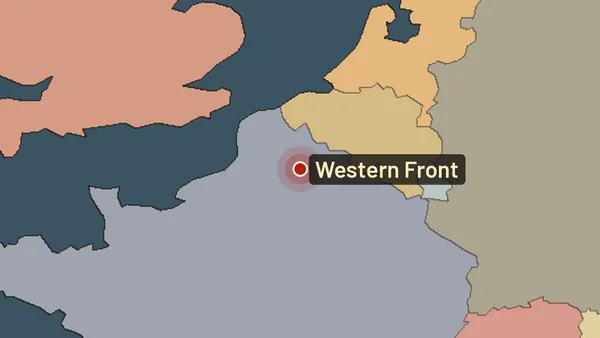
In the Historical (1914) scenario the Joffre entry unlocks in the in-game encyclopedia when the First Battle of the Marne arrives on 5 September 1914. The battle raises French morale and lowers German morale, costs both sides heavy manpower, and turns the Western Front into trench warfare, which also unlocks the Trench entry. France is one of the 26 states on the 1914 map, so you can take Joffre's place and lead its armies yourself.
In the Parallel Fronts scenario the Marne is no longer a fixed point: armoured divisions can reach Paris in days, and holding the line will take more than calm nerves. Will you be the general who saves Paris?
▶ Play now Free in your browser, no download needed.
Further reading: Wikipedia (English)
 Trench warfare