 World Wars: 1914–20XX
First World War (1914–1918)
First Battle of Ypres (1914): the end of the war of movement
In this article
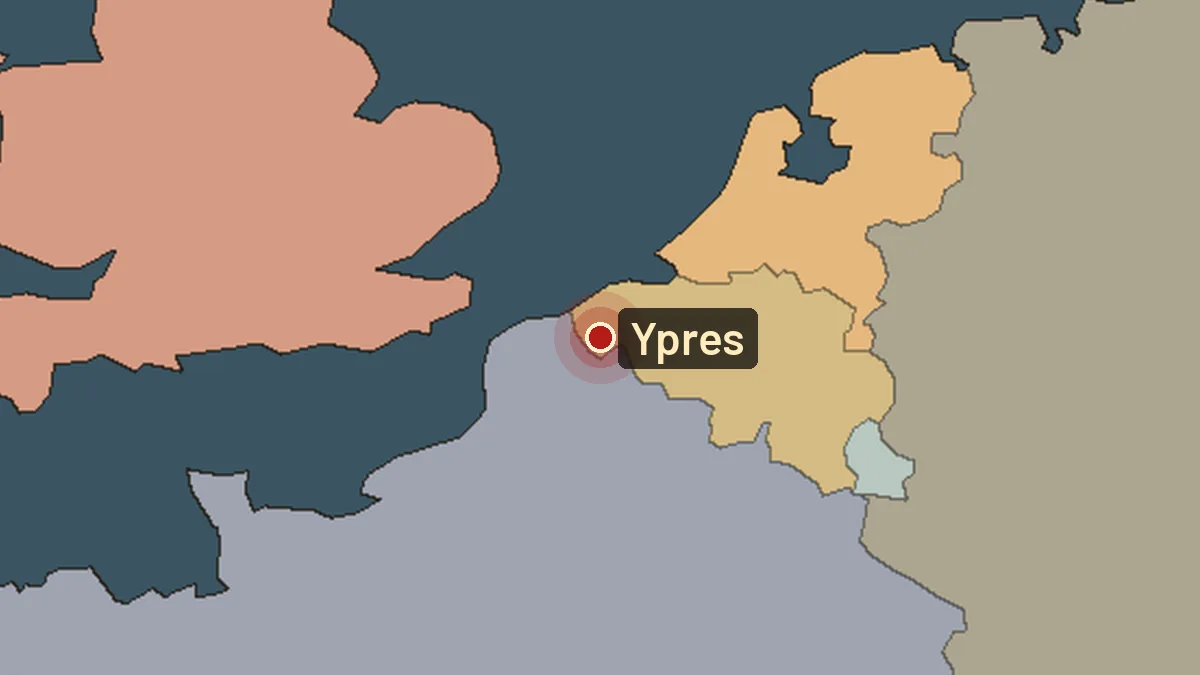
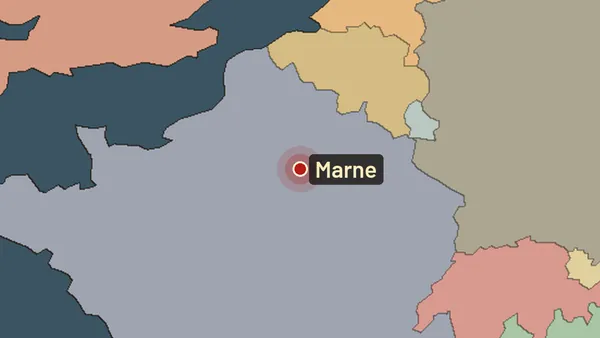
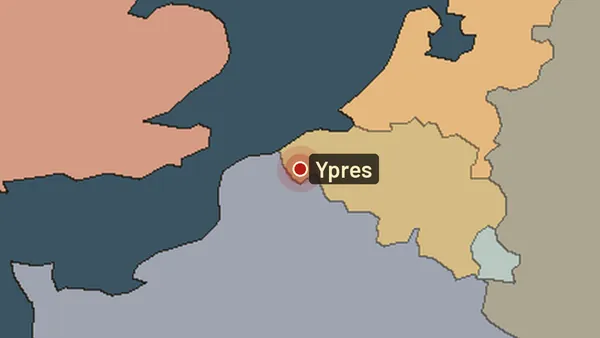
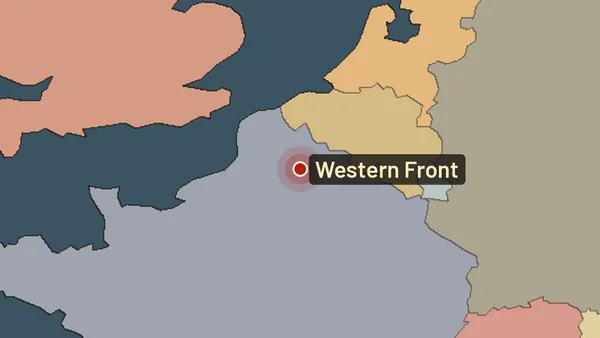
The First Battle of Ypres was the last great battle of movement on the Western Front in 1914. After the Marne, both sides tried to outflank each other to the north in the "race to the sea". In Flanders their armies met head-on. For more than a month German forces attacked around the town of Ypres, and British, French and Belgian troops held a curved line in front of it. When the fighting died down in November, a continuous line of trenches ran from the North Sea to Switzerland.
The race to the sea
After the German retreat from the Marne in September 1914, each side tried to turn the other's open northern flank. The front extended northwards through Picardy and Artois. The Belgian army, which had withdrawn from Antwerp before the city fell on 10 October, took position on the Yser river near the coast. The British Expeditionary Force was moved from the Aisne to Flanders, closer to its supply ports on the Channel.
The Yser and Ypres
In the second half of October the German army, reinforced by new reserve corps, attacked along the whole front from the coast to the south of Ypres. On the Yser the Belgian army, with French support, stopped the advance after the sluices at Nieuwpoort were opened at the end of October to flood the low-lying land between the armies. Around Ypres the British, with French troops under the overall coordination of Ferdinand Foch, faced repeated attacks.
Gheluvelt and Nonne Bosschen
The most dangerous day for the defenders was 31 October, when German troops broke into the village of Gheluvelt on the Menin Road east of Ypres. A counter-attack by a battalion of the Worcestershire Regiment helped to restore the line. On 11 November German troops, including units of the Prussian Guard, attacked again along the Menin Road and broke into the woods at Nonne Bosschen before being pushed back. After that the attacks diminished, and winter weather ended the battle.
Langemarck and the young volunteers
Several of the new German reserve corps included many young volunteers with little training. Their attacks near Langemarck, north of Ypres, in late October and on 10 November suffered heavy losses. A German army communiqué described regiments of young men advancing while singing "Deutschland, Deutschland über alles", and the event was later remembered in Germany as the "Kindermord bei Ypern", the massacre of the innocents at Ypres. Historians have shown that the reality was different from the legend; many of the soldiers were not students, and the story was used for political purposes in the following decades.
Why it mattered
The battle ended the war of movement in the west. The British pre-war regular army suffered such losses that Britain from then on relied on the Territorial Force, the Indian Army and new volunteer armies. Ypres remained in Allied hands for the rest of the war, at the centre of a salient that would see major battles in 1915, 1917 and 1918.
Did you know?
- Khudadad Khan, a machine-gunner of the 129th Duke of Connaught's Own Baluchis, became the first soldier of the Indian Army to receive the Victoria Cross, for his actions on 31 October 1914 near Hollebeke.
- The Menin Gate memorial in Ypres records the names of more than 54,000 soldiers of the British Empire who died in the salient and have no known grave. The Last Post is sounded there every evening.
- Adolf Hitler, then a volunteer in a Bavarian reserve regiment, first saw combat near Ypres in October 1914.
Ypres in World Wars: 1914–20XX
In the game's Historical (1914) scenario Flanders is where the open northern flank of the Western Front closes. If you lead Germany, you can try to reach the Channel ports before the line hardens; if you lead Britain, France or Belgium, you must hold the gap with the forces you have. In the Parallel Fronts scenario, motorised troops and aircraft make the race to the sea much faster.
▶ Play now Free in your browser, no download needed.
Sources and further reading
Figures and dates in this article follow these works; where historians disagree, the range of estimates is given.
- Ian F. W. Beckett, Ypres: The First Battle, 1914 (2004)
- Gary Sheffield, The Chief: Douglas Haig and the British Army (2011)
- Hew Strachan, The First World War (2003)
- Wikipedia (English)
 Trench warfare