World Wars: 1914–20XX
First World War (1914–1918)
The Meuse-Argonne Offensive (1918): the largest American battle of the First World War
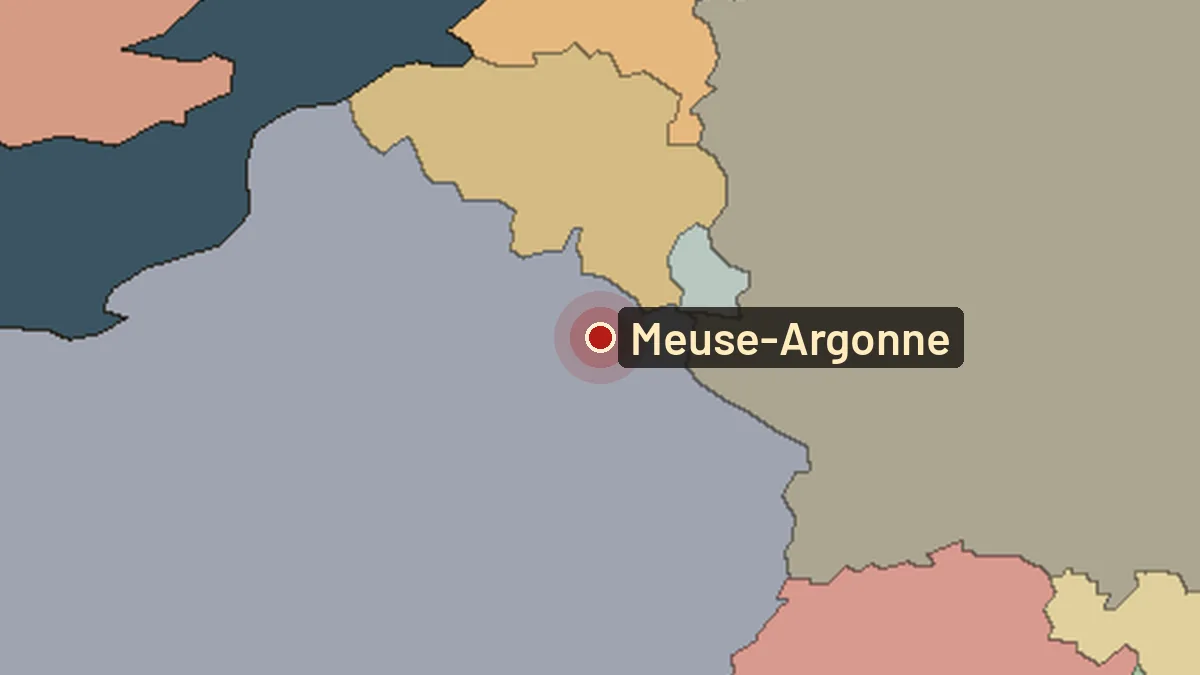
The Meuse-Argonne offensive was the largest battle the United States fought in the First World War and one of the largest in its history. More than one million American soldiers took part over 47 days. Attacking north from near Verdun through hilly, wooded country, the American First Army advanced slowly at first and at great cost, then broke through in November. It was part of the series of Allied attacks that ended the war on 11 November 1918.
The plan
In late September 1918 Marshal Ferdinand Foch launched attacks along much of the Western Front. The American sector lay between the Meuse river and the Argonne forest, with the French Fourth Army under Henri Gouraud attacking on its left. The aim was to advance towards Sedan and cut the railway line that supplied much of the German army in France. John Pershing, commander of the American Expeditionary Forces, had only two weeks to move his army there after the battle of Saint-Mihiel, and many of his divisions had little experience.
The first weeks
The attack began on 26 September after a heavy bombardment. The German defences were organised in depth, using hills, woods and villages. The heights of Montfaucon were taken on 27 September, a day later than planned, and then the advance slowed. Roads were jammed, supplies ran short, and German reserves arrived. In the Argonne forest the "Lost Battalion" of the 77th Division was cut off for several days in early October before being relieved. American and French troops fought for weeks against the German positions known as the Kriemhild line, part of the Hindenburg Line system.
The breakthrough
In mid-October Pershing handed command of the First Army to Hunter Liggett and formed a Second Army. The heights of Romagne and Cunel were taken, and the army was reorganised and resupplied. On 1 November a new, carefully prepared attack broke through the German positions. American troops advanced rapidly and by 7 November had reached the heights above the Meuse opposite Sedan. Fighting continued until the armistice came into effect at 11 a.m. on 11 November.
Why it mattered
The offensive tied down a large part of the German army at a time when the British, French and Belgian armies were also attacking further north. Historians such as Edward Lengel describe how an inexperienced American army learned under fire, at a high cost in lives, and how its supply and command problems eased in the later weeks. With the other Allied attacks of the autumn, it left the German army unable to stop the Allied advance.
Did you know?
- The Meuse-Argonne American Cemetery at Romagne-sous-Montfaucon, with more than 14,000 graves, is the largest American military cemetery in Europe.
- On 8 October Corporal Alvin York, a soldier from Tennessee, and a small group of men captured 132 German soldiers; he became one of the best-known American soldiers of the war.
- The offensive was also fought during the influenza pandemic of 1918, which put many soldiers on both sides in hospital.
Meuse-Argonne in World Wars: 1914–20XX
In the game's Historical (1914) scenario the United States can enter the war, and its fresh armies can change the balance in the west. If you lead the United States, you decide how quickly to bring your forces to the front; if you lead Germany, you must hold a long line with tired troops. In the Parallel Fronts scenario, motor transport and aircraft make it easier to supply a large army in difficult country.
▶ Play now Free in your browser, no download needed.
Sources and further reading
Figures and dates in this article follow these works; where historians disagree, the range of estimates is given.
- Edward G. Lengel, To Conquer Hell: The Meuse-Argonne, 1918 (2008)
- David Stevenson, 1914–1918: The History of the First World War (2004)
- Wikipedia (English)