 World Wars: 1914–20XX
First World War (1914–1918)
The Nivelle Offensive (1917): the Chemin des Dames and the French mutinies
In this article
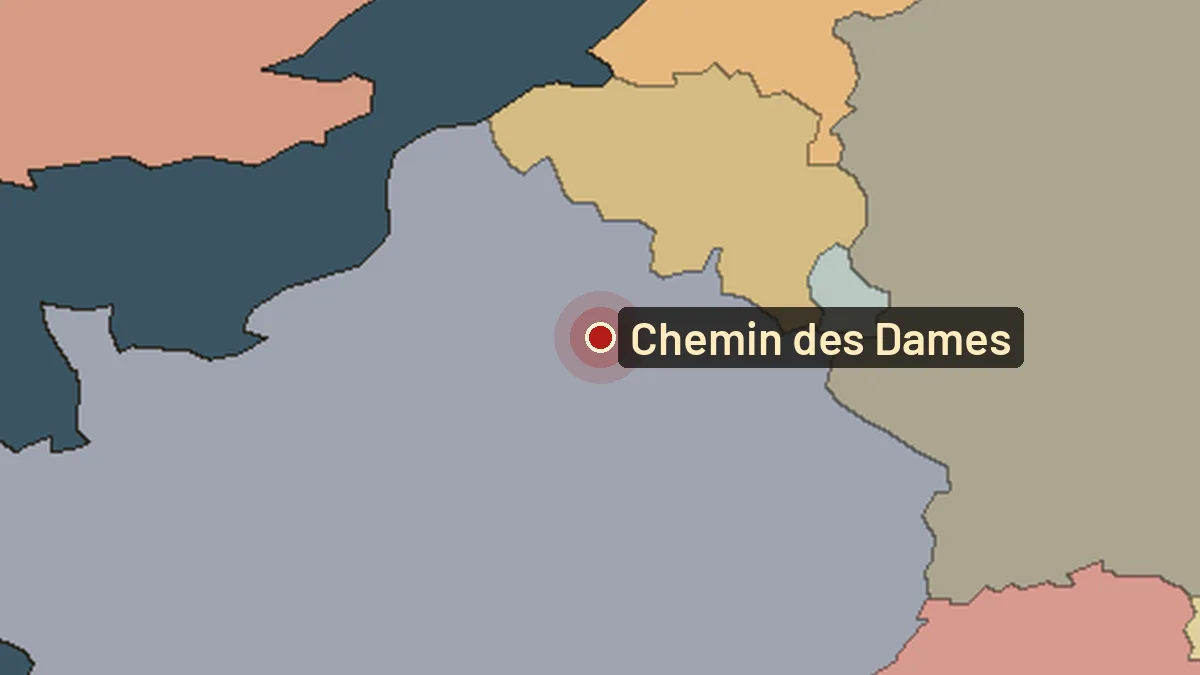
The Nivelle offensive was the main French offensive of 1917. Its commander, General Robert Nivelle, promised a breakthrough of the German front within two days. The attack on the Chemin des Dames ridge, which began on 16 April 1917, took some ground but fell far short of that promise. In the weeks that followed, units in a large part of the French army refused to take part in further attacks.
Nivelle's plan
Robert Nivelle had become known for successful counter-attacks at Verdun in late 1916, using carefully timed artillery barrages. In December 1916 he replaced Joseph Joffre as commander-in-chief. He was convinced that the same methods on a larger scale could break the German front in a single blow, and he persuaded the French and British governments to support his plan. The British would attack first near Arras, from 9 April, to draw in German reserves.
The German withdrawal
In February and March 1917 the German army withdrew from a large salient between Arras and Soissons to a new, shorter and strongly fortified position, the Siegfriedstellung, known to the Allies as the Hindenburg Line. The withdrawal disrupted part of the Allied plan. The Germans had also learned much of the French intentions, and they strengthened the defences on the Chemin des Dames, a long ridge north of the Aisne with steep slopes, quarries and caves.
The attack
The French attacked on 16 April in cold, wet weather. Some first positions were taken, but the creeping barrage moved ahead of the infantry, and German machine guns in protected positions on the ridge and on its reverse slopes stopped the advance. At Berry-au-Bac, French tanks went into action for the first time; many were destroyed by artillery. Fighting continued into May, and the French took part of the ridge, but there was no breakthrough. On 15 May Nivelle was replaced by Philippe Pétain.
The mutinies
From late April and above all in May and June 1917, soldiers in many French divisions refused to go into attacks or protested against their conditions. Most continued to hold the line but would not take part in new offensives. Pétain responded with improved leave, food and rest, a promise to avoid costly attacks, and courts-martial. The historian Guy Pedroncini counted 554 death sentences, of which 49 were carried out. The German army learned little of the extent of the crisis at the time.
Why it mattered
The failure of the offensive ended the hope of a quick decision in the west in 1917. Under Pétain the French army concentrated on limited attacks with heavy artillery support while waiting for American troops and more tanks. A larger share of the offensive effort on the Western Front in the second half of 1917 fell to the British army, at Passchendaele and Cambrai.
Did you know?
- The Chemin des Dames, "the Ladies' Way", takes its name from the daughters of King Louis XV, for whom the road along the ridge was improved in the 18th century.
- The anonymous "Chanson de Craonne", sung by French soldiers after the offensive, became a well-known song of protest against the war.
- The Caverne du Dragon, an old quarry under the ridge used by both armies during the war, is today a museum.
The Chemin des Dames in World Wars: 1914–20XX
In the game's Historical (1914) scenario the Western Front in 1917 offers the same choices the generals faced: attack for a breakthrough or wait for new weapons and allies. If you lead France, you decide when and where to commit your reserves; if you lead Germany, you can shorten your line as the Germans did in 1917. In the Parallel Fronts scenario, tanks and aircraft are already mature, which changes what an offensive can achieve.
▶ Play now Free in your browser, no download needed.
Sources and further reading
Figures and dates in this article follow these works; where historians disagree, the range of estimates is given.
- Robert A. Doughty, Pyrrhic Victory: French Strategy and Operations in the Great War (2005)
- David Stevenson, 1914–1918: The History of the First World War (2004)
- Wikipedia (English)
 The first tanks (Flers–Courcelette)