 World Wars: 1914–20XX
First World War (1914–1918)
The Battle of Passchendaele (1917): the Third Battle of Ypres
In this article
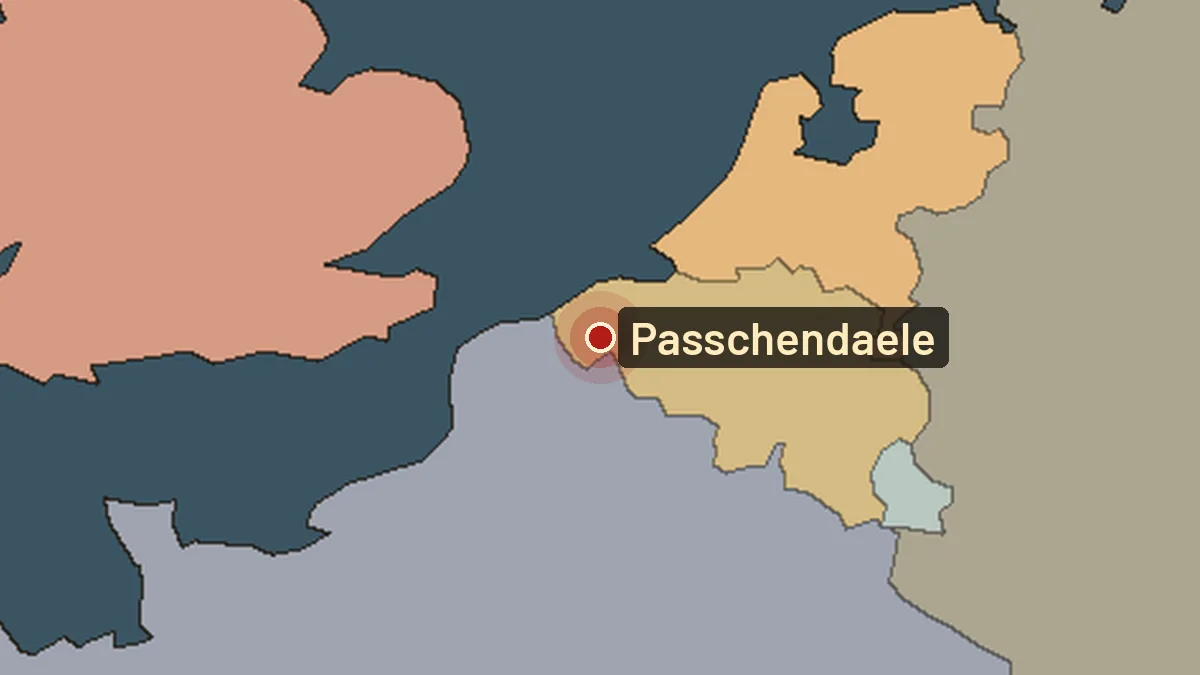
The Third Battle of Ypres, usually called Passchendaele after the village on the ridge that was its final objective, was the main British offensive of 1917. For more than three months British, Dominion and French troops attacked from the salient around Ypres. Heavy rain turned the shell-torn ground into deep mud. The offensive gained a few kilometres and the Passchendaele ridge at great cost, and it remains one of the most debated battles of the war.
Aims and Messines
Douglas Haig, the British commander-in-chief, had long wanted an offensive in Flanders. He hoped to break out of the Ypres salient, reach the Belgian coast and the bases used by German submarines, and keep pressure on the German army while the French army recovered from the crisis that followed the Nivelle offensive. As a first step, on 7 June 1917 the British Second Army under Herbert Plumer attacked the Messines ridge south of Ypres. Nineteen large mines, dug under the German positions over many months, were exploded at dawn, and the ridge was taken within hours.
July and August: rain and mud
The main offensive, under Hubert Gough's Fifth Army, began on 31 July after a long bombardment. The first day gained ground in the north, but on the higher ground near the Menin Road the German defences held. That evening it began to rain, and August was unusually wet. In the low, clay-rich land, where the artillery had destroyed the drainage, the battlefield became a landscape of water-filled shell holes. The German army defended with a system of concrete pillboxes, flexible lines and counter-attack divisions.
Plumer's "bite and hold"
In late August Haig gave the main role to Plumer. In dry weather in September and early October, Plumer's attacks at the Menin Road (20 September), Polygon Wood (26 September) and Broodseinde (4 October) advanced a short distance each time behind massive artillery support and held their gains against counter-attacks. Then the rain returned. Attacks at Poelcappelle and the First Battle of Passchendaele in October failed in the mud. Canadian troops under Arthur Currie finally took the village of Passchendaele on 6 November, and the offensive ended on 10 November.
The debate
Historians have long argued about the battle. Critics, among them Robin Prior and Trevor Wilson, argue that the offensive was continued long after its aims had become unreachable and that the conditions made success impossible. Others point out that it inflicted heavy losses on the German army at a time when the French army could not attack, and that Plumer's methods showed how the British army was learning. The numbers of dead and wounded on both sides are still disputed.
Did you know?
- Tyne Cot Cemetery near Passchendaele, with nearly 12,000 graves, is the largest Commonwealth war cemetery in the world.
- Two of the Messines mines did not explode in 1917. One went off during a thunderstorm in 1955; the other is still underground.
- Mustard gas was first used by the German army near Ypres in July 1917, which is why it is called "Yperite" in French.
Passchendaele in World Wars: 1914–20XX
In the game's Historical (1914) scenario Flanders stays one of the most important sectors of the Western Front, close to the Channel ports. If you lead Britain, you decide whether to attack there and when to stop; if you lead Germany, you choose how to defend a salient that the enemy wants to break out of. In the Parallel Fronts scenario, armour and air power change the value of holding a low ridge in the mud.
▶ Play now Free in your browser, no download needed.
Sources and further reading
Figures and dates in this article follow these works; where historians disagree, the range of estimates is given.
- Robin Prior, Trevor Wilson, Passchendaele: The Untold Story (1996)
- Gary Sheffield, The Chief: Douglas Haig and the British Army (2011)
- Wikipedia (English)
 Douglas Haig