World Wars: 1914–20XX
First World War (1914–1918)
The Battles of the Isonzo (1915–1917): eleven offensives on the Soča
In this article
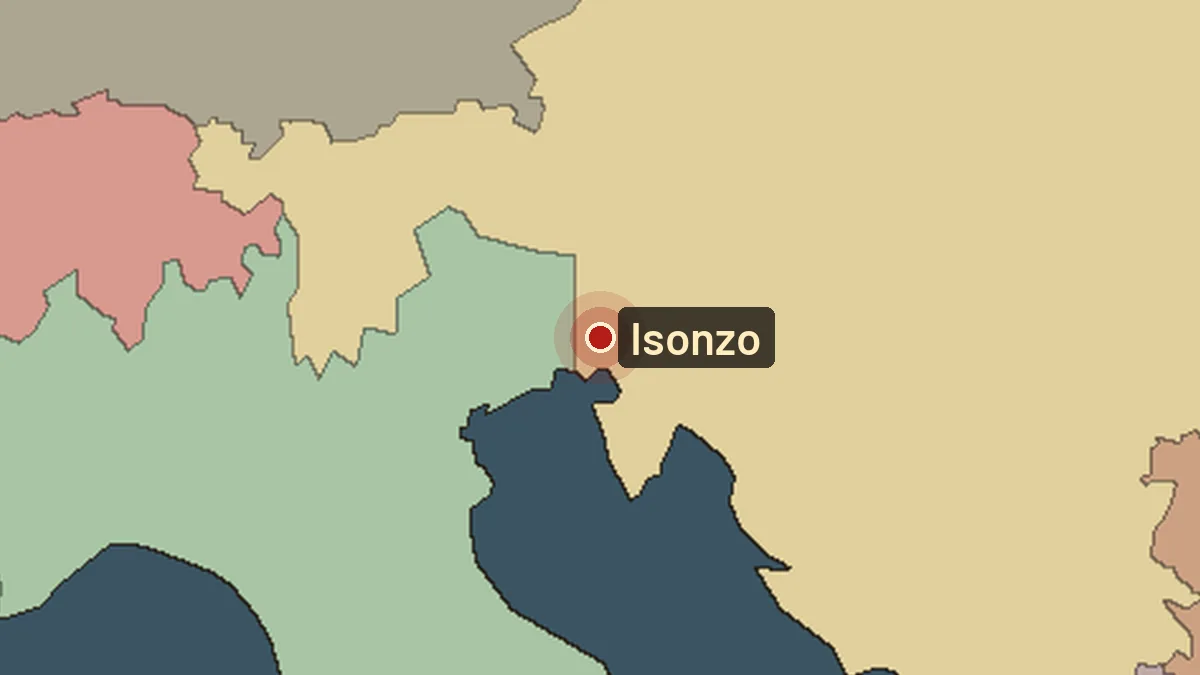
After Italy entered the war on the side of the Allies in May 1915, its main front against Austria-Hungary ran along the Isonzo river, known in Slovene as the Soča. Over the next two and a half years the Italian army under Luigi Cadorna launched eleven offensives there. They gained some ground, including the town of Gorizia, but never broke through to Trieste or Ljubljana. The fighting on the Isonzo was among the costliest of the war for both sides.
A front in the mountains
Italy declared war on Austria-Hungary on 23 May 1915, after signing the Treaty of London with Britain, France and Russia, which promised it territory from Austria-Hungary. The new front stretched for about 600 kilometres along the Alps, but the most practical route for an Italian offensive lay in the east, along the Isonzo, towards Trieste and the Habsburg heartland. There, Austro-Hungarian troops under Svetozar Boroević held the heights above the river and the stony Carso plateau. The attackers had to climb towards fortified positions, often under fire from higher ground.
1915: the first four battles
The first four battles of the Isonzo, between June and December 1915, brought small gains at a high cost. The Italian army entered the war short of heavy artillery and machine guns, and it was learning, like the other armies before it, how to attack prepared defences. On the Carso, shells shattered the limestone into splinters, which added to the number of wounded.
1916: Gorizia
In May 1916 Austria-Hungary attacked from the Trentino in the "punitive expedition" on the Asiago plateau, which the Italians stopped in June. Cadorna then moved forces back to the Isonzo, and in the Sixth Battle, in August 1916, Italian troops took Monte Sabotino and the town of Gorizia on 9 August. It was the largest Italian success on the Isonzo. Three more battles in the autumn of 1916 gained little.
1917: Bainsizza and exhaustion
The Tenth Battle in May and June 1917 and the Eleventh Battle in August and September brought the Italians onto the Bainsizza plateau north of Gorizia. The Austro-Hungarian army held, but its commanders judged that it might not survive another such battle. Austria-Hungary asked Germany for help, and the joint offensive that followed in October 1917, the Twelfth Battle of the Isonzo, became known as the Battle of Caporetto.
Why it mattered
The Isonzo front tied down a large part of the Austro-Hungarian army that might otherwise have fought against Russia, Serbia or Romania. For Italy, the cost in lives was very heavy, and the repeated offensives with limited results weakened the army before Caporetto. The battles also left a deep mark on the memory of the region, today divided between Italy and Slovenia, where many cemeteries and museums mark the old front line.
Did you know?
- The Isonzo front was the setting for much of Ernest Hemingway's novel A Farewell to Arms. Hemingway himself served as an ambulance volunteer on the Piave in 1918.
- Mountain warfare on this front led both sides to build roads, cable cars and tunnels high in the Julian Alps; remains of them can still be visited.
- Svetozar Boroević was one of the few Austro-Hungarian commanders of South Slav origin to reach the rank of field marshal.
The Isonzo in World Wars: 1914–20XX
In the game's Historical (1914) scenario Italy is neutral at the start and may join the war later, as it did in May 1915. If you lead Italy, you face the same choice as Cadorna: where to attack in the mountains and how much to commit. If you lead Austria-Hungary, you must hold a new front while fighting Russia and Serbia. In the Parallel Fronts scenario, aircraft and modern artillery change the way mountain positions can be attacked and defended.
▶ Play now Free in your browser, no download needed.
Sources and further reading
Figures and dates in this article follow these works; where historians disagree, the range of estimates is given.
- Mark Thompson, The White War: Life and Death on the Italian Front 1915–1919 (2008)
- David Stevenson, 1914–1918: The History of the First World War (2004)
- Wikipedia (English)