 World Wars: 1914–20XX
Second World War (1939–1945)
The Pacific and Asia (1937–1945): Japan's war from China to Midway and Okinawa
In this article
The war in Asia began before the war in Europe and ended after it. For China it lasted eight years, from 1937 to 1945. In the Pacific, it became a war decided largely by aircraft carriers, submarines and the capacity to supply forces across thousands of kilometres of ocean.
China, 1937–1941
Full-scale war between Japan and China began in July 1937. Japanese forces took Shanghai and Nanjing and much of eastern China, but China continued to resist from the interior under Chiang Kai-shek, while Communist forces fought in the north. The war in China tied down a large part of the Japanese army throughout the conflict.
1941–1942: Japan's advance
To secure oil and other resources after an American embargo, Japan decided to strike the United States, Britain and the Netherlands. On 7 December 1941 its carrier aircraft attacked the US fleet at Pearl Harbor, and at the same time Japanese forces attacked Malaya, the Philippines and Hong Kong. Within five months Japan took Malaya and Singapore, which surrendered on 15 February 1942, the Dutch East Indies, the Philippines and Burma.
1942–1944: the turn
The Battle of the Coral Sea in May 1942 checked a Japanese move towards Australia. At Midway in June 1942 the US Navy sank four Japanese aircraft carriers. From August 1942 to February 1943 American forces fought for Guadalcanal. The Allies then advanced across the Pacific in two lines, taking key islands and bypassing others, while American submarines destroyed much of Japan's merchant fleet. The battles of the Philippine Sea in June 1944 and Leyte Gulf in October 1944 broke the Japanese navy as a fighting force.
1945: the end
The battles of Iwo Jima and Okinawa in 1945 were among the costliest of the Pacific war. American bombers attacked Japanese cities from bases in the Marianas. On 6 August 1945 an atomic bomb destroyed Hiroshima; on 8 August the Soviet Union declared war on Japan and invaded Manchuria; on 9 August a second atomic bomb destroyed Nagasaki. Emperor Hirohito announced Japan's surrender on 15 August, and it was signed in Tokyo Bay on 2 September 1945.
Did you know?
- Three of the four Japanese aircraft carriers sunk at Midway were hit by American dive bombers within about six minutes.
- Estimates of Chinese deaths in the war of 1937–1945, military and civilian, run from about 15 million to over 20 million.
Key events on this front
- Attack on Pearl HarborOn 7 December 1941 Japanese carrier aircraft struck the US Pacific Fleet at Pearl Harbor, Hawaii. Why Japan attacked, what was hit and missed, and how it changed the war.
- Battle of MidwayIn June 1942 US codebreakers and carrier aircraft ambushed the Japanese fleet near Midway and sank four carriers. How the trap was set and why the battle turned the Pacific War.
- Hiroshima and NagasakiOn 6 and 9 August 1945 the United States dropped atomic bombs on Hiroshima and Nagasaki. How the bombs were built, what they did to both cities, and the debate since.
- Soviet invasion of ManchuriaOn 8 August 1945 the Soviet Union declared war on Japan and overran Manchuria within days. Why Stalin entered the Pacific War and what it left behind.
- Surrender of JapanOn 15 August 1945 Emperor Hirohito told his people Japan would surrender, and on 2 September the act was signed aboard USS Missouri. How the war finally ended.
Play this moment
Free in your browser, no download needed.
Sources and further reading
Figures and dates in this article follow these works; where historians disagree, the range of estimates is given.
- Ronald H. Spector, Eagle Against the Sun: The American War with Japan (1985)
- Jonathan Parshall, Anthony Tully, Shattered Sword: The Untold Story of the Battle of Midway (2005)
- Richard B. Frank, Downfall: The End of the Imperial Japanese Empire (1999)
- Wikipedia (English)
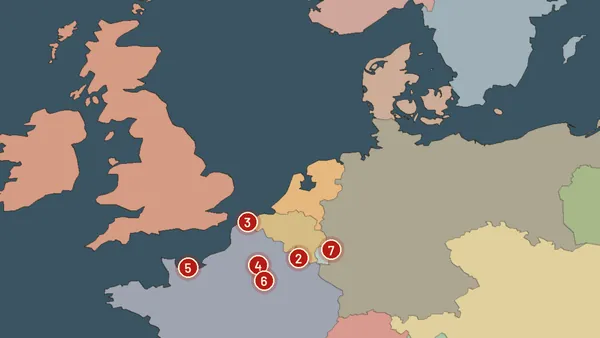 Western Europe, 1939–1945
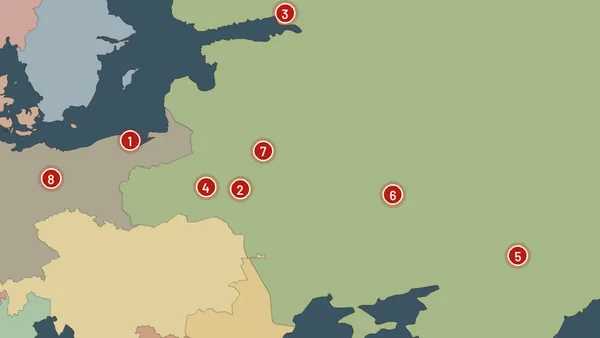 Eastern Front, 1939–1945
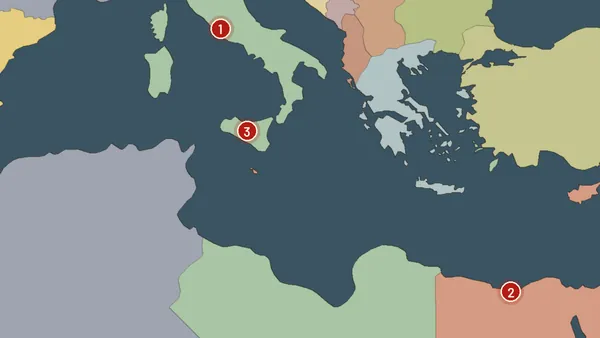 Mediterranean and North Africa
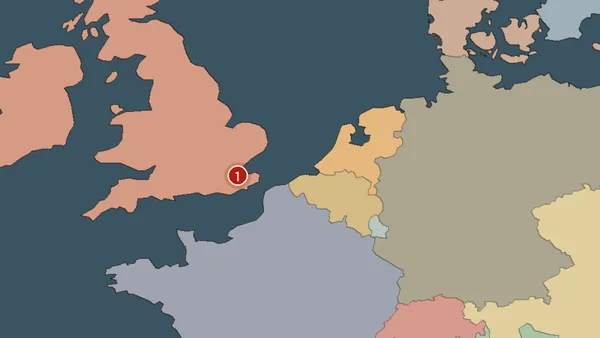 Air war, 1939–1945