 World Wars: 1914–20XX
Second World War (1939–1945)
Western Europe (1939–1945): from the fall of France to D-Day and the Rhine
In this article
In the west the Second World War began very differently from the first. Instead of four years of trench war, France was defeated in six weeks in 1940. Four years later the Allies returned in the largest amphibious operation in history, and eleven months after that Germany surrendered.
1939–1940: from the "Phoney War" to the fall of France
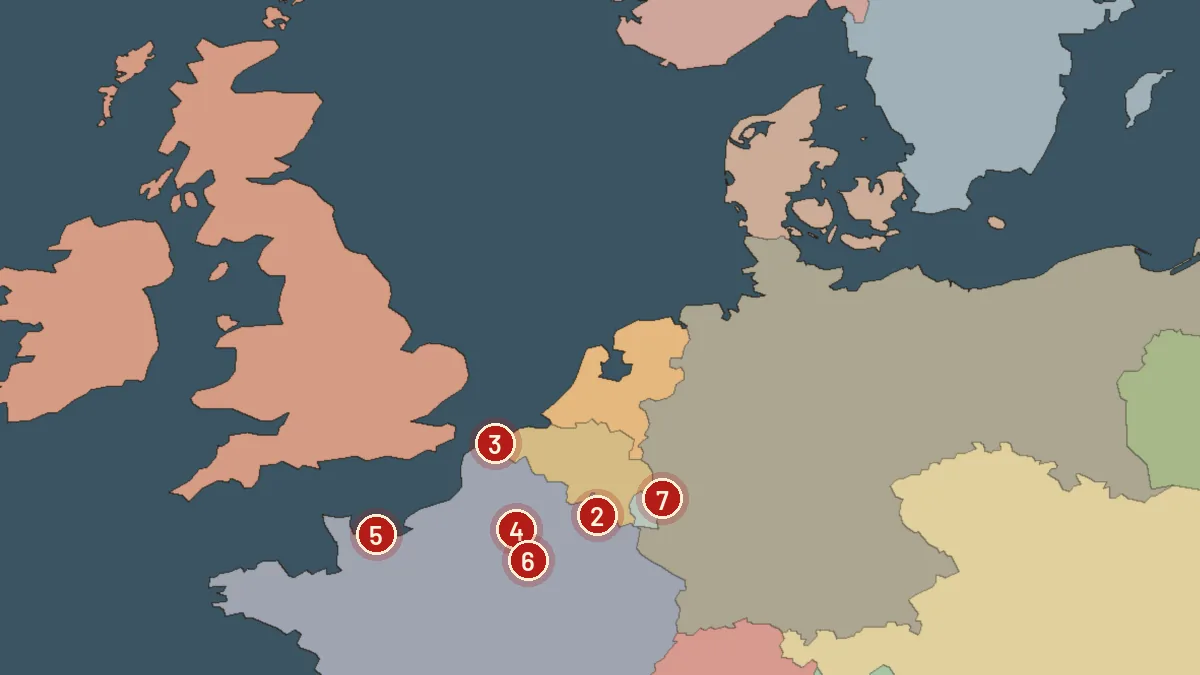
Britain and France declared war on Germany on 3 September 1939, after the invasion of Poland, but there was little fighting in the west for months, a period known as the "Phoney War". In April 1940 Germany occupied Denmark and attacked Norway. On 10 May 1940 it invaded the Netherlands, Belgium and Luxembourg. The main German armoured force advanced through the Ardennes, crossed the Meuse at Sedan and reached the Channel coast, cutting off the Allied armies in Belgium. More than 330,000 British and French soldiers were evacuated from Dunkirk. Paris was occupied on 14 June, and France signed an armistice on 22 June 1940.
1940–1944: occupation
For four years Germany occupied most of Western Europe. Britain, after the Battle of Britain, continued the war from across the Channel. The Allies landed in North Africa and Italy first, while preparing the invasion of France. In August 1942 a largely Canadian raid on Dieppe failed with heavy losses, showing how difficult a landing on a defended coast would be.
1944–1945: liberation
On 6 June 1944 American, British, Canadian and other Allied troops landed in Normandy. After almost two months of hard fighting they broke out at the end of July, and a second landing in southern France followed in August. Paris was liberated on 25 August. An attempt to cross the Rhine at Arnhem in September failed, and in December Germany launched a surprise offensive in the Ardennes, the Battle of the Bulge, which was stopped by January 1945. The Allies crossed the Rhine in March 1945 and advanced into Germany, meeting Soviet troops on the Elbe on 25 April. Germany surrendered unconditionally on 7 and 8 May 1945.
Why the campaigns ended as they did
The German victory of 1940 is usually explained by a bold plan, concentrated armour and air power, and Allied mistakes in command and deployment, rather than by German superiority in numbers or equipment. The Allied victory of 1944–1945 rested on control of the air and sea, enormous industrial production, and the fact that most of the German army was fighting on the Eastern Front.
Did you know?
- Germany actually had fewer tanks than France and Britain combined in May 1940; the difference lay in how they were used.
- The Normandy landings were preceded by an elaborate deception, Operation Fortitude, that convinced German commanders the main landing would come at Calais.
Key events on this front
- Operation WeserübungOn 9 April 1940 Germany invaded Denmark and Norway. The sinking of the Blücher, the King's escape, Narvik, and how the campaign made Churchill prime minister.
- Battle of FranceIn May 1940 German tanks crossed the Ardennes, broke through at Sedan and reached the Channel in ten days. How France, unbeaten in 1914–18, fell in six weeks.
- Dunkirk evacuationBetween 26 May and 4 June 1940 some 338,000 Allied soldiers were rescued from Dunkirk. The halt order, the East Mole, the little ships and why it mattered.
- Armistice of 22 June 1940On 22 June 1940 France signed an armistice at Compiègne, in the railway carriage of 1918. Its terms, the two zones, Vichy and de Gaulle's Free France, explained.
- D-Day (Normandy landings)On 6 June 1944 Allied armies landed on five Normandy beaches in the largest seaborne invasion in history. How Overlord was planned, what happened on D-Day and how Normandy was won.
- Liberation of ParisIn August 1944 the Paris Resistance rose against the German garrison and French and American troops entered the city. How Paris was freed after four years, and why it was spared.
- Battle of the BulgeIn December 1944 Germany launched a surprise offensive through the snowy Ardennes towards Antwerp. How it broke through, why Bastogne held, and how it spent the last reserves.
Play this moment
Free in your browser, no download needed.
Sources and further reading
Figures and dates in this article follow these works; where historians disagree, the range of estimates is given.
- Gerhard L. Weinberg, A World at Arms: A Global History of World War II (1994)
- Karl-Heinz Frieser, The Blitzkrieg Legend: The 1940 Campaign in the West (2005)
- Antony Beevor, D-Day: The Battle for Normandy (2009)
- Rick Atkinson, The Guns at Last Light: The War in Western Europe, 1944–1945 (2013)
- Wikipedia (English)
 Eastern Front, 1939–1945
 Mediterranean and North Africa
 Air war, 1939–1945