 World Wars: 1914–20XX
Second World War (1939–1945)
Why did Germany invade the Soviet Union in 1941?
Short answer
Germany invaded the Soviet Union on 22 June 1941 because Hitler's long-held aim was to conquer territory in the east, destroy the Soviet state and take its resources, especially grain and oil. He also hoped that a quick victory would leave Britain without a potential ally and allow Germany to face Britain and the United States from a position of strength.
In this article
Ideology and aims
Hitler had written in the 1920s that Germany should gain "living space" in eastern Europe. The Nazi leadership saw the war against the Soviet Union as a war of conquest and annihilation against communism and against peoples it considered inferior. Plans drawn up before the invasion foresaw the deaths of millions of Soviet civilians through starvation in order to feed Germany. The Nazi-Soviet Pact of 1939 had only postponed this conflict.
Strategic calculations
After the fall of France in 1940, Britain refused to make peace, and the Battle of Britain showed that Germany could not easily invade it. Hitler argued that Britain was holding out in the hope of Soviet and American help, and that defeating the Soviet Union would remove that hope. German leaders expected a campaign of a few months, underestimating the Red Army after its poor performance in the Winter War against Finland. In December 1940 Hitler ordered the preparation of Operation Barbarossa.
Why it failed
The invasion, with about three million German and allied soldiers, won huge early victories and captured millions of Soviet soldiers. But the Soviet Union mobilised new armies, moved factories to the east and fought on. Supply problems, the autumn mud and the winter slowed the Germans, and in December 1941 a Soviet counter-offensive pushed them back from Moscow. Historians such as David Glantz and Jonathan House show how the Red Army learned and recovered, and the war in the east became the largest and deadliest land war in history.
Read more
 The Molotov–Ribbentrop PactOn 23 August 1939 Germany and the Soviet Union signed a non-aggression pact whose secret protocol divided Eastern Europe. Why the enemies made a deal, and what followed.
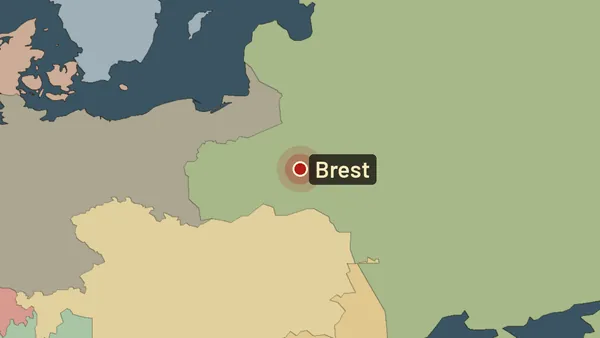 Operation BarbarossaOn 22 June 1941 Germany invaded the Soviet Union in the largest land offensive in history. The great encirclements, Leningrad, Kiev and the stall before Moscow.
 Battle of StalingradFrom August 1942 to February 1943 German and Soviet armies fought for Stalingrad on the Volga. How the city battle began and how the Red Army trapped the German 6th Army.
More questions
- Why did the Second World War start?
- When did the Second World War start and end?
- How many people died in the Second World War?
- Which countries were the Allies and the Axis in the Second World War?
- Why did Japan attack Pearl Harbor?
- Why was Stalingrad a turning point in the Second World War?
- What was D-Day?
- Did Turkey fight in the Second World War?
- Which countries were neutral in the Second World War?
- Why were atomic bombs dropped on Japan?
- How did the Second World War end?
Play this moment
Free in your browser, no download needed.
Sources and further reading
Figures and dates in this article follow these works; where historians disagree, the range of estimates is given.
- David M. Glantz, Jonathan M. House, When Titans Clashed: How the Red Army Stopped Hitler (1995)
- Ian Kershaw, Fateful Choices: Ten Decisions That Changed the World, 1940–1941 (2007)