 World Wars: 1914–20XX
First World War (1914–1918)
Why did the Western Front become a stalemate?
Short answer
In late 1914 neither side could outflank the other, so both dug trenches from the North Sea to Switzerland. Defenders with machine guns, artillery and barbed wire could stop most attacks, and they could bring up reserves by rail faster than attackers could advance on foot across shell-torn ground. Breakthroughs only became possible in 1918.
From movement to trenches
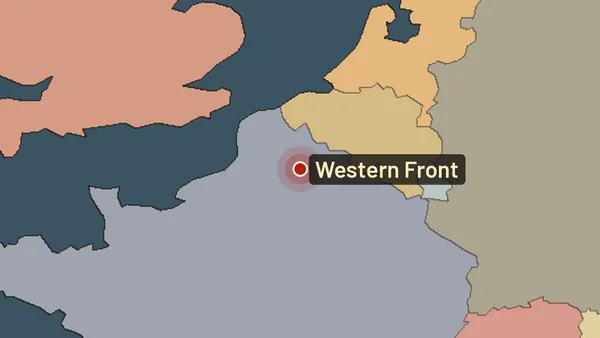
After the Battle of the Marne in September 1914 the German army withdrew to the Aisne and dug in. Both sides then tried to get around each other's northern flank in the so-called "race to the sea", which ended in the fighting at Ypres in October and November. By the end of 1914 a continuous line of trenches ran for about 700 kilometres, and there were no open flanks left to attack.
Why attacks failed
An attacking army first had to cross no man's land under fire, then get through barbed wire and capture trenches defended by machine guns and supported by artillery. Even when the first line fell, defenders held further lines behind it. Railways allowed the defender to rush reserves to a threatened sector, while the attacker's troops, guns and supplies had to move forward across ground destroyed by shelling. Radio was still primitive, so commanders often lost contact with their troops once an attack began.
How the deadlock was broken
Armies spent years learning how to attack. The solutions combined many elements: more accurate artillery fire without warning, creeping barrages, small infantry units with light machine guns and grenades, tanks, aircraft and better supply systems. In 1918 both the German spring offensives and the Allied counter-offensives finally broke through, and the war of movement returned. Historians such as Tony Ashworth have also shown how soldiers in quiet sectors adapted to life in the trenches between the great battles.
Read more
 Trench warfareFrom 1914 to 1918 millions of soldiers lived and fought in trenches. Why the front dug in, how a trench system worked, life in the line and how the deadlock broke.Machine gun in WWIHow Hiram Maxim's invention dominated the battlefields of 1914–1918, why a few machine guns could stop a battalion, and how armies learned to live and fight with them.Heavy artillery in WWIFrom the "Big Bertha" howitzers that smashed the Belgian forts in 1914 to the creeping barrages of 1918: how artillery became the deadliest weapon of the First World War.
More questions
- Why did the First World War start?
- When did the First World War start and end?
- How many people died in the First World War?
- Who won the First World War?
- Which countries fought in the First World War?
- Why did the Ottoman Empire enter the First World War?
- What was the Schlieffen Plan?
- Why did the United States enter the First World War?
- What new weapons were used in the First World War?
- How did the First World War end?
- How did the First World War lead to the Second?
Play this moment
Free in your browser, no download needed.
Sources and further reading
Figures and dates in this article follow these works; where historians disagree, the range of estimates is given.
- Tony Ashworth, Trench Warfare 1914–1918: The Live and Let Live System (1980)
- John Ellis, The Social History of the Machine Gun (1975)