 World Wars: 1914–20XX
First World War (1914–1918)
How many people died in the First World War?
Short answer
About 8.5 to 10 million soldiers, sailors and airmen died in the First World War, and around 20 million were wounded. Civilian deaths from military action, hunger and disease are harder to count; estimates are usually around 6 to 7 million. The influenza pandemic of 1918–1919 is normally counted separately.
In this article
Military deaths
The commonly used figures, such as those of the Encyclopædia Britannica, put total military deaths at about 8.5 million, and other estimates reach 10 million. Germany and Russia each lost roughly 1.7 to 2 million soldiers, France about 1.4 million, Austria-Hungary about 1.2 million and the British Empire about 900,000. In proportion to its population, Serbia suffered some of the heaviest losses of any country. Most soldiers were killed by artillery fire, and many more died of wounds and disease.
Civilian deaths
Civilians died in invasions and occupation, at sea, in air raids, and above all from hunger and disease. The Allied naval blockade caused severe food shortages in Germany and Austria-Hungary, and epidemics spread in Serbia, the Ottoman Empire and eastern Europe. Because records were incomplete or lost, historians give ranges rather than exact numbers.
Why the numbers differ
Different sources count different things: some include deaths from disease or prisoners who died in captivity, others do not, and borders changed after the war. Many records were destroyed, especially in Russia and the Ottoman Empire. The influenza pandemic, which killed tens of millions worldwide in 1918 and 1919, spread partly through troop movements but is usually treated as a separate catastrophe. Our statistics page gives the military figures country by country.
Read more
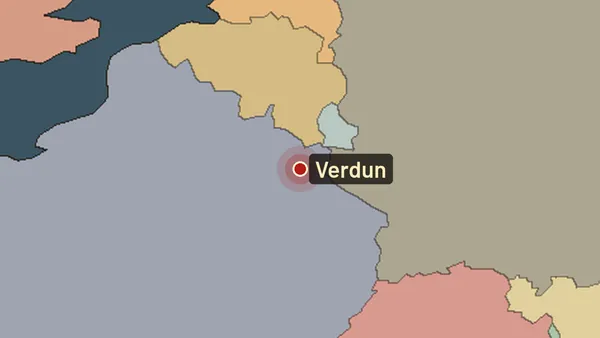 Battle of VerdunFrom February to December 1916 the German and French armies fought for the fortress city of Verdun. Falkenhayn's plan, Fort Douaumont, Pétain, the Sacred Way and why Verdun became a symbol.
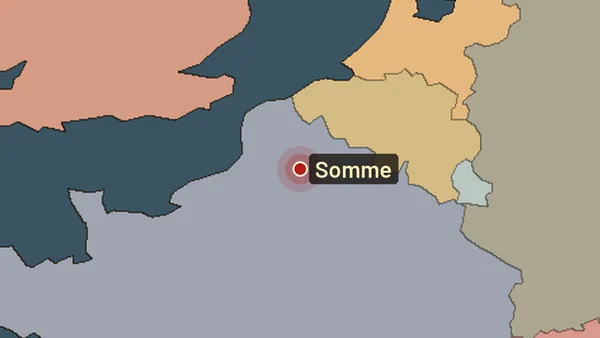 Battle of the SommeOn 1 July 1916 British and French armies attacked on the Somme. Why the bombardment failed, what happened on the first day, and how it cost over a million casualties.
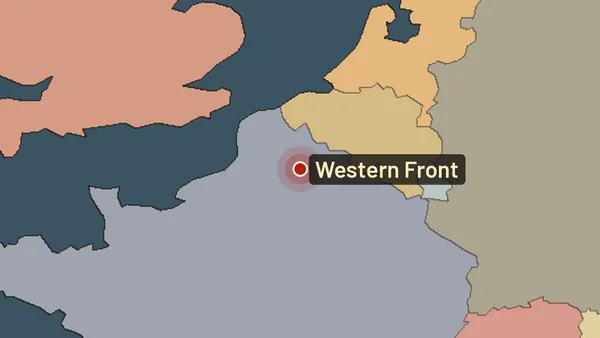 Trench warfareFrom 1914 to 1918 millions of soldiers lived and fought in trenches. Why the front dug in, how a trench system worked, life in the line and how the deadlock broke.
More questions
- Why did the First World War start?
- When did the First World War start and end?
- Who won the First World War?
- Which countries fought in the First World War?
- Why did the Ottoman Empire enter the First World War?
- What was the Schlieffen Plan?
- Why did the United States enter the First World War?
- What new weapons were used in the First World War?
- Why did the Western Front become a stalemate?
- How did the First World War end?
- How did the First World War lead to the Second?
Play this moment
Free in your browser, no download needed.
Sources and further reading
Figures and dates in this article follow these works; where historians disagree, the range of estimates is given.
- David Stevenson, 1914–1918: The History of the First World War (2004)
- Hew Strachan, The First World War (2003)